


If you were forwarded this newsletter, join 6,205 weekly readers—some of the smartest GTM founders and operators—by subscribing here:
Thanks to the companies that made the AI x GTM Summit possible! (+stats/notable attendees)
Is AI copy good or bad? The reality is not so binary. It’s more nuanced. But that’s a horrible “hook” on LinkedIn or X, so you don’t see those posts going viral.
One camp says AI copy is garbage. “Soulless slop that’s destroying cold outbound.”
The other camp says AI copy is the future. “Personalization at scale, finally.”
For this session at the AI x GTM Summit, Eric Linssen (my Chief Vibes Officer of the event) did a live teardown (with the audience) of four cold emails. What worked, what didn’t, and what this tells us about the state of AI copy in 2026.
Here’s what we covered:
The game: AI or Human? (4 email teardowns)
What makes AI copy good (when it works)
The AI “tells” everyone notices now
Timing matters 10x more than copy
Stop asking, start giving (proactive value)
Human in the loop for the final mile (for now)
Subject lines, deliverability, and other details that matter
Follow Eric on LinkedIn (and apply to join Demand Collective if you’re a DG practitioner—or send to a DG friend or colleague)!
[Suggested Spotify playlist while reading this series]
IYMI:
Session #1 → Sorting the World into your CRM (GTM gold is stuck in your top seller’s brain: How to extract + operationalize it) || YouTube video of Matthew and Andreas’ full session (22 mins)
Session #2 → Infrastructure for agentic GTM: data stack, orchestration, and activation || YouTube video of Nico’s full session (23 mins)
Session #3 → Getting agents deployed into your GTM systems: pitfalls, opportunities, and best practices || YouTube video of Joe’s full session (19 mins)
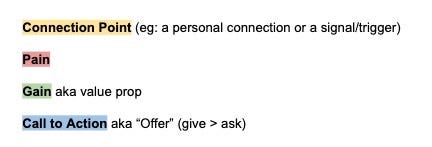
Before getting into the examples, I wanted to share a basic cold email framework I’ve been using for over a decade. I was taught this framework in my first job as an SDR, and it still works great as a prompt/example when scaling experiments with AI. Here’s the framework:
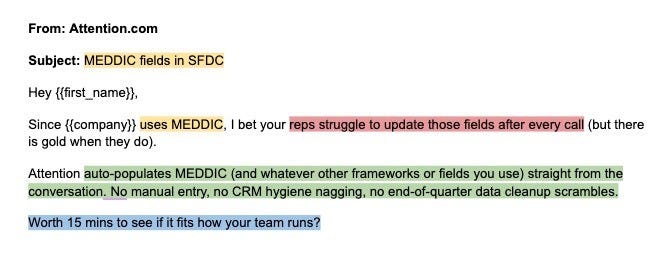
And here’s the framework applied to an example:
AIDA is another framework that works well.
Alright, let’s get into the other examples and reactions/lessons from them.
The game: AI or Human? (4 email teardowns)
We showed four cold emails to the audience.
Email #1: Cursor
Subject: Saw your AI tooling req
Hey {{first_name}},
Noticed {{company}} is hiring devs with AI coding tool experience. Sounds like you’re serious about building this into how the team works, not just letting people experiment.
That’s the hard part. Most eng orgs I talk to are stuck between “everyone uses whatever” and “we should probably have a strategy here.”
Happy to share what’s working for teams making that shift if useful.
Audience rated it around 7/10.
You can pull keywords like this from tools like Sumble.
Eric’s take: “Two things make this good. One, the specificity—AI tooling req, hiring devs with AI coding experience. That’s two very specific signals. You couldn’t send this to just anyone. Two, the tone. It says ‘devs’ not ‘developers.’ It says ‘rec’ not ‘requisition.’ It feels human.”
The audience was split on whether it was written by human or AI. Most guessed AI (correctly), but a few said human. That’s a good sign. It means the copy passed the “turing test” for some people.
Email #2: Lovable
Subject: React + Supabase + Tailwind
Hey {{first_name}},
Was reading {{company}}’s job post mentioning React, Supabase, and Tailwind. That’s exactly the stack Lovable outputs out of the box.
Curious if your team’s explored using AI to scaffold new features or spin up internal tools faster. A few companies with similar stacks have cut their prototyping time from weeks to hours.
Worth a quick chat to see if it fits your workflow?
Audience called this one “slop.”
Eric: “The AI breath is strong on this one.”
The problems: “Was reading” feels robotic. “That’s exactly” is a tell. “Curious if your team’s explored” is the kind of phrasing no human actually uses. The whole thing reads like it was assembled from parts, not written.
Email #3: Attention
Subject: Saw you run MEDDIC
Hey {{first_name}},
Since {{company}} uses MEDDIC, I bet your reps struggle to update those fields after every call (but there’s gold when they do).
Attention auto-populates MEDDIC (and whatever other frameworks or fields you use) straight from the conversation. No manual entry, no CRM hygiene nagging, no end-of-quarter data cleanup scrambles.
Worth 15 mins to see if it fits how your team runs?
This one was written by AI (Claude). The audience thought it was pretty good.
This one worked better because the signal is clear (MEDDIC usage). The pain is relatable (reps not updating fields). The value prop is specific (auto-populates from conversation). Again, tools like Attention (previous calls), Rox, and Sumble give you data that you can get creative with to build unique signals for your market.
My critique: I don’t love “Worth 15 mins?” as a CTA. Asking for time in a cold email is a big ask. More on that below.
Email #4: Stripe
Subject: Saw your post on cross-border payments
Hey {{first_name}},
Just read your LinkedIn post about the headaches of paying international contractors, so I figured this might be timely.
Stripe just rolled out Stablecoin Financial Accounts that lets you hold, receive, and send stablecoins in 101 countries. Settlements are near-instant, and transaction costs are about half what you’re paying on traditional cross-border rails.
If international payments are a growing line item, might be worth a look.
Happy to walk through how it works if useful.
AI also wrote this one. The audience had mixed reactions. Some liked it, some didn’t.
The signal here is solid (LinkedIn post about cross-border payments). The timing is good. But the copy feels a bit dense, and “might be worth a look” is soft.
What makes AI copy good (when it works)
Across all four examples, a pattern emerged.
The good ones had:
Specific signals. Not generic firmographics. Real signals that show you did research.
Human tone. “Devs” not “developers.” Short sentences. Contractions.
Clear pain → value. I have this problem, you solve it, here’s how. Again, think about this framework: Connection Point, Pain, Gain, CTA.
The bad ones had:
Robotic phrasing (“AI breath”). “Was reading,” “Curious if your team’s explored,” “That’s exactly”.
Generic structure. Could be sent to anyone with minor tweaks.
No real insight. Just restating what you found, not adding perspective or tying it to your company’s value prop.
The AI “tells” everyone notices now
Eric pointed out something important: the bar is rising every few months.
A year ago, “noticed” was fine. Now it’s a tell. Same with m-dashes (—). Same with “exactly.” Same with overly structured sentences.
The audience is getting smarter. People assume every cold email is AI until proven otherwise. One person in the chat said: “By default I assume every outreach email is AI from now on.”
That’s the new baseline. Your AI copy has to be good enough to pass that filter.
Timing matters 10x more than copy
I strongly believe that email copy (human-written or AI-written) matters far less than reaching out to a company at the right time.
If I’m actively looking for a CRM and some CRM vendor sends me a mediocre cold email, I’ll probably respond. I’m in market. The timing is right. The copy can be average.
The inverse is also true. If I’m not looking for a CRM and someone sends me a perfectly crafted, beautifully personalized email with common connections and rich context... I’m still not responding. I’m not in market.
Timing is 10x more important than copy. Maybe 100x!
The implication (if true) means that you should spend more energy on signal detection (finding accounts that are in-market right now) than on copy optimization. Though the copy does matter. The signal is the unlock.
Stop asking, start giving (proactive value)
Another theme that kept coming up was that the best cold emails give something, not ask for something.
“Worth 15 minutes?” is an ask. You’re asking for their time.
You should try to proactively give them something instead (even a unique insight). Ideally, it’s something so valuable they’d be willing to pay money for it. But, you’re giving it to them for free.
Examples from the session:
CRM audit for Attention: Instead of asking for 15 minutes, run an automated audit of their open opportunities. Show them: “You have 842 open opps. 72% have MEDDIC fields filled out accurately. Here’s your 28% gap.” That’s useful. That’s value.
Candidates for Bravado: Bravado has a database of sales candidates. When a VP of Sales opens a job req for Enterprise AEs, they don’t just pitch the database. They query it, find 2-3 candidates that match the job req, and send those profiles in the email. “Hey, you should chat with Sarah, Mary, and John. Here are their profiles. Want to see more like them?”
The VP of Sales gets actual candidates in their inbox. Their immediate question (”Are the candidates any good?”) is answered before they even have to ask. That email only works if you send it now. Wait six weeks and they’ve already hired those AEs. The window closes.
That’s what “proactive value” looks like. Not a generic lead magnet. Something specific to their situation that answers their next question.
Timing + proactive value + specificity = response.
Human in the loop for the final mile (for now)
One thing I feel strongly about: fully automated outbound isn’t there yet.
AI is very good at research. It can pull signals, enrich accounts, draft personalized emails. In most cases, the final mile—the moment before you hit send—should still be a human. Especially in the enterprise.
Why? Because there’s always context that the AI doesn’t have. Maybe you met this person at a conference last year. Maybe their company just had layoffs, and the tone needs to shift. Maybe the AI pulled a signal that’s technically accurate but feels off when you read it.
A human catches that. An agent doesn’t.
My recommendation: AI does 90% of the work (research, drafting, prioritization). Human does the last 10% (review, tweak, send).
The exception: inbound and quasi-marketing use cases (like if someone downloads a whitepaper, emailing attendees before or after an event, etc). These are lower-stakes, higher-volume, more templated. The cost of a miss is low.
For true cold outbound to accounts you really care about (like a top 500 target/named account)? Human-in-the-loop is the way. At least for now. For your Tier 3 accounts (lower ACV deals), go ahead and automate away!
Subject lines, deliverability, and other details that matter
A few other things came up in this session.
Subject lines:
Keep them short (three words or less is ideal).
Make them conversational, not “markety”.
“Saw your AI tooling req” works. “Cursor + {{company}}: AI Coding Strategy” doesn’t.
Deliverability:
If your emails don’t land in the inbox, nothing else matters.
Use tools like Instantly for warming and rotation.
If you’re sending from lookalike domains (not your primary), keep signatures text-only—no images, no links. And sadly, I would recommend you fully disable Open and Clicks because they both hurt deliverability.
Signature blocks:
Text only if you’re sending from secondary domains.
If you’re sending from your primary domain and you have high transactional email volume (like Ramp or Zoom), you have more flexibility.
The Bottom Line
AI email copy is neither good nor bad. It depends on the context whether you should use it or not. But, the foundational models are getting incredibly good at cold email when you give it the right context (and examples). I wouldn’t have said that at the beginning of 2025.
The formula that’s working:
Signal first. Find accounts that are in-market right now. This matters more than copy.
Specificity. Use real signals in your emails. Not generic firmographics.
Human tone. Read it out loud. Does it sound like a person wrote it?
Give, don’t ask. Proactive value beats “Worth 15 minutes?”
Human-in-the-loop. AI does the research and drafting. Human does the last-mile review before send.
The bar is rising. Your AI copy needs to be better than it was six months ago just to stay even. But if you nail the timing and add real value, cold email (with the help of AI) can absolutely work.
Timing is the unlock. Copy is the execution.
Watch the full session on YouTube (22 minutes):
Thanks again to Eric for co-hosting this one with me.
The “AI or Human?” live teardown format was fun. Might have to run it back sometime.
Follow Eric on LinkedIn (and if you spend $100K+/mo on ads, apply to join Demand Collective—Eric’s community)!
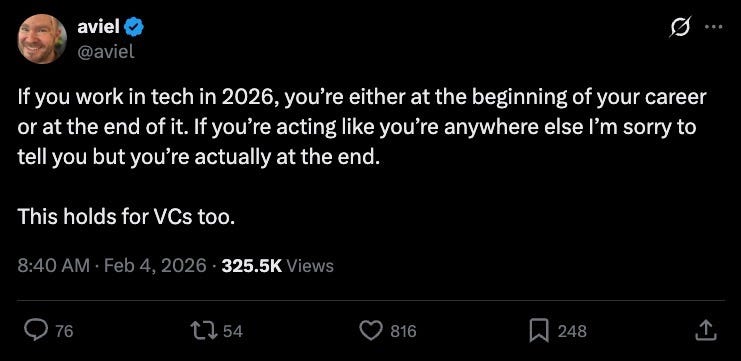
I can’t stop thinking about this tweet (yes, it’s about AI)
Session #5 summary coming next: Automating signals that work in your specific market.
Thank you for your attention and trust,
Brendan 🫡
PS: Check out the sponsors that made this event possible: Rox, Attention, Clarify, Sumble, Instantly.