


If you were forwarded this newsletter, join 6,910 weekly readers—some of the smartest GTM founders and operators—by subscribing here:
Thanks for reading this hand-rolled, 100% organic, farm-to-table (human-written) newsletter.

Presented by Clay.

Bring AI agents, enrichment, and intent data together and turn insights into relevant, timely action. Start building for free.
& Supported by:

Attention → AI Agents for RevOps
Clarify → The Autonomous CRM
Nooks → Agent Workspace for Intelligent Outbound
Sumble → Buying signals from tech stacks, people data, & active projects
11x.ai → Accelerate growth with a digital GTM workforce

Happy April Fool’s Day (aka: Who has the most creative marketing team Day)!
One quick thing before we jump into today’s Research Report (which took over 30 hours of research), register for our webinar/hackathon on April 14th: How GTM Teams are using MCPs and Claude/Claude Code.
(We’re capping it at 300, and we already have 184 registered—just announced today).
The GTM Tech Stacks of the Fastest-Growing Private B2B Companies
65% of the fastest-growing private B2B companies use Clay. Zero use an off-the-shelf AI SDR.
We analyzed the GTM tech stacks of 62 of the fastest-growing private B2B companies to find out what the best companies actually use. The results challenge a lot of conventional wisdom about what a modern GTM stack looks like.
We pulled technographic data from Sumble, enriched with Clay, and used Claude to cross-reference customer logo walls, case studies, review sites, and vendor websites across dozens of GTM tools.
The result:

(Side note: this is the kind of research that would have taken weeks to do manually. Having access to tools like Sumble, Clay, and Claude made it possible to build and verify this entire dataset in a fraction of the time.)
The best way to view the full interactive dataset (searchable, sortable by valuation, headcount, sales team size, and number of tools) is to visit: ProspectingStack.com/top-tech-stacks.
This post covers the highlights and takeaways:
The companies in this dataset
Three companies’ GTM stacks worth studying
Top categories:
CRM
Sales Engagement
Data Enrichment
Intent & Signals
Data Orchestration
Dialers
AI SDRs
Data Infrastructure
The default stack
What this data tells us
The full dataset
Alright, let’s get into it.
The companies in this dataset
We built the list of fast-growing (private) B2B companies by looking at a combination of revenue growth and headcount growth. And used several sources, including lists like the Forbes AI 50, Forbes Cloud 100, CNBC Disruptor 50, and Enterprise Tech 30. The companies had to be doing at least $10M ARR and not public.
We plan to update this list over time.
Three stacks worth studying
Before we get to the category-level analysis, here are three stacks that stood out.
Rippling (31 tools, 4,947 employees, $13.5B valuation) has the largest GTM stack in the dataset. They run the full traditional stack (Salesforce, HubSpot, Gong, Outreach, Salesloft, ZoomInfo) alongside modern tools (Clay, Common Room, Amplemarket, Nooks). They also have deep data infrastructure (dbt, Snowflake, Fivetran, Airbyte, Census, Hightouch, Segment). This is what a mature, heavily-invested GTM org looks like.

Vercel (28 tools, 724 employees, $3.5B valuation) punches way above its weight. A 724-person company with 28 GTM tools and 4 data orchestration platforms (Zapier, Make, n8n, Tray.io, Workato). They’re running Clay, Sumble, Common Room, and Fireflies alongside the traditional stack. This is a company that’s automating its GTM motion aggressively. We wrote about the agents Vercel built in-house in our last post: 9 Lessons From 11 Growth-Stage Companies That Built GTM Agents In-House.
Drata (24 tools, 581 employees, $3.0B valuation) shows what a lean but sophisticated stack looks like. Every tool has a clear job: 6sense + Demandbase for intent, Clay + ZoomInfo + Apollo + Clearbit for data, Outreach for sequencing, Gong for conversational intelligence, and Clari for pipeline visibility.
Again, you can see the full GTM tech stack of any company in the dataset at ProspectingStack.com/top-tech-stacks.
CRM
Salesforce and HubSpot run everything
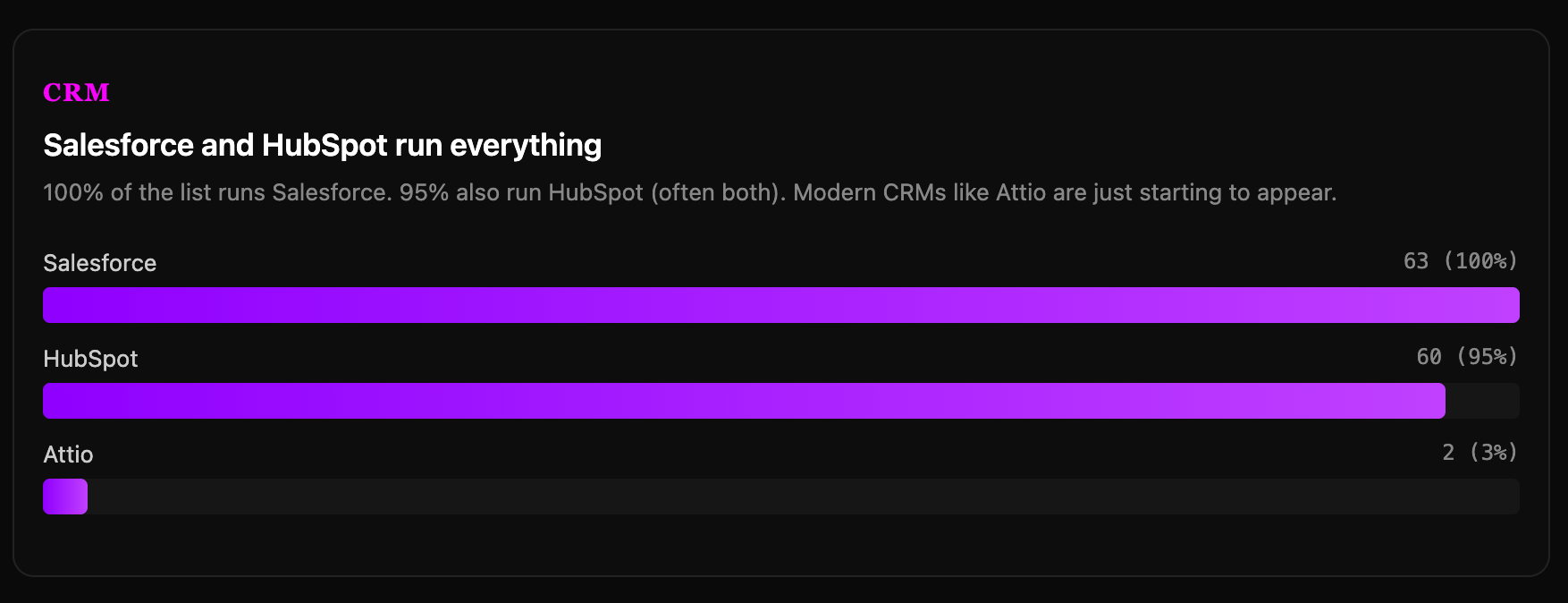
Every single company in this dataset runs Salesforce. 100%. HubSpot is right behind at 95%. Most run both (HubSpot for Marketing, in many cases).
Modern CRMs like Attio are starting to appear, but they’re still in single digits.
Uncle Benioff’s grip on the growth-stage and scale-stage B2B market is inescapable.
Sales Engagement
Gong is the most adopted GTM tool after CRM
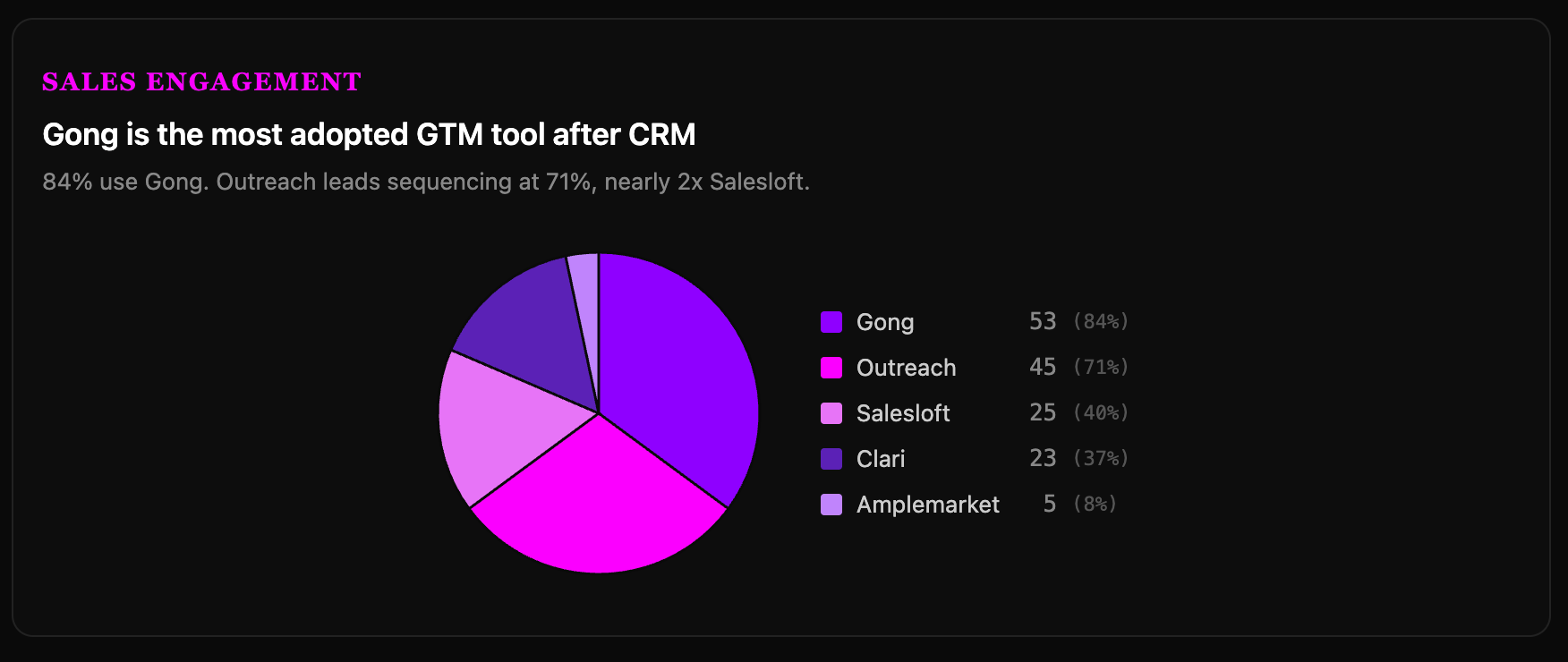
This one surprised me. Gong at 84% adoption is ahead of Outreach (71%) and well ahead of Salesloft (40%). Gong has become the default operating system for how these companies understand their customer conversations. Though more companies are starting to layer in Attention.com on top (or replacing Gong in some cases).
Outreach leads sequencing at nearly 2x Salesloft’s adoption rate. Clari shows up at 37%, which makes sense for companies at this stage that need forecasting rigor. Worth noting: Clari and Salesloft recently merged. Yet another consolidation move in a category that used to have clear lanes. That means a single entity now touches 77%+ of these stacks across both forecasting and sequencing.
Amplemarket is the newcomer at 8%, showing up at early-adopters like Rippling, Vanta, and Deel.
Data Enrichment
Clay is now the #2 data tool, ahead of Sales Navigator
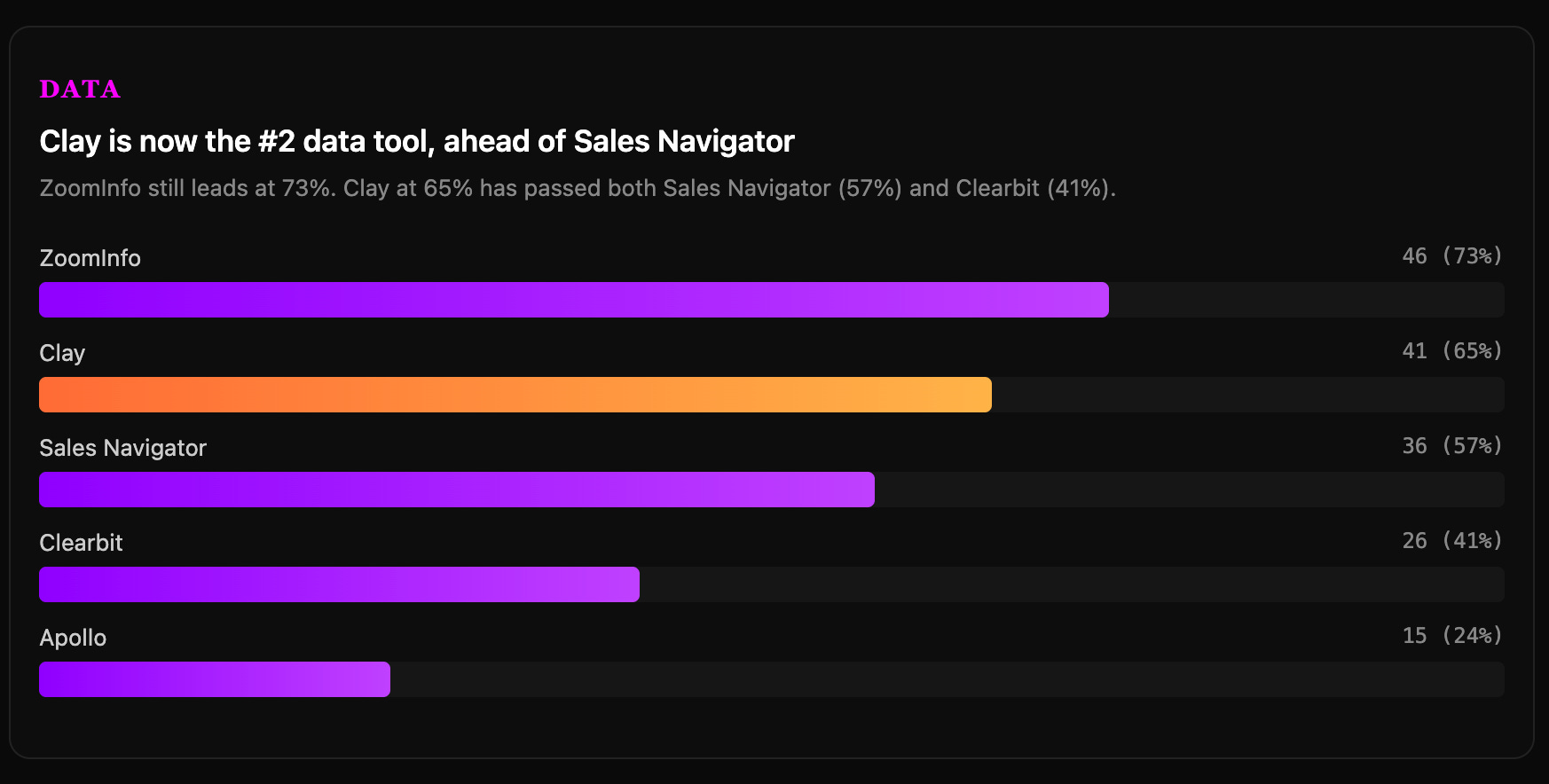
ZoomInfo still leads at 73%. But Clay is on their heels at 65%, ahead of Sales Navigator (57%), Clearbit (41%), and Apollo (24%).
Clay went from “that cool/weird Clay table thing” to a core infrastructure tool at nearly two-thirds of the fastest-growing private B2B companies. Companies like Ramp, Rippling, Grafana Labs, Drata, and Notion are running Clay alongside (or replacing parts of) the traditional enrichment stack.
Intent & Signals
6sense and Demandbase still dominate, but the category is fragmenting
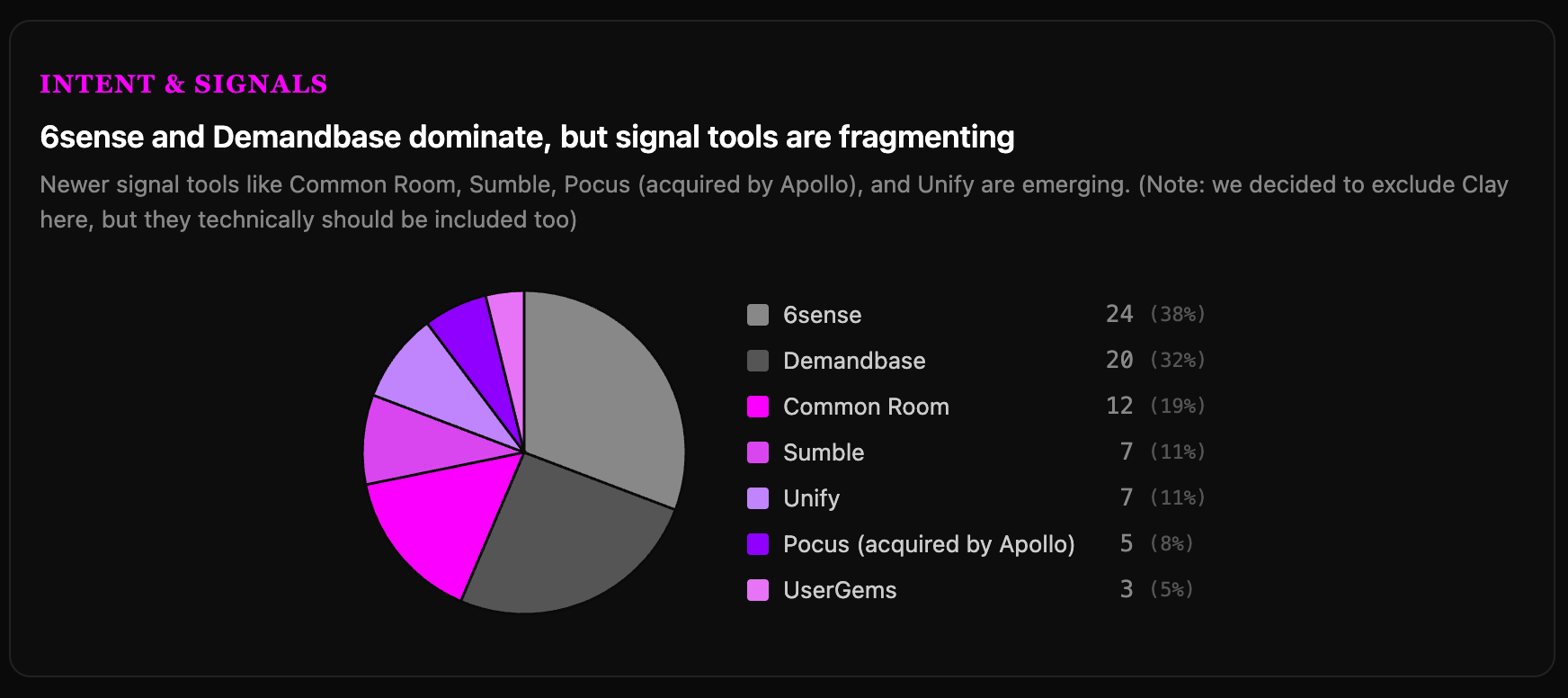
6sense (38%) and Demandbase (32%) still own the intent category. They’re the two that show up in nearly every mature stack.
But a new class of signal tools is gaining traction. Common Room (19%), Sumble (11%), and Unify (11%) are showing real adoption at these companies. They’re smaller, lighter, and more tightly integrated into sales workflows than the traditional ABM platforms.
You could argue Clay should also be included in this category, but we decided to exclude them, and focus this section on the purpose-built signal and intent tools: the legacy ABM platforms vs. the newer signal-native tools.
As I’ve watched this space evolve, it’s clear that (marketing) intent data is becoming less valuable for sellers, and are being replaced by more transparent (sales) signal providers.
Data Orchestration
This is where RevOps/GTM Engineers live
65% of these companies use Clay. And over half use Zapier (54%). Workato is at 41%. Make at 21%. n8n at 19%. Tray.io at 16%.
This is the connective tissue of the modern GTM stack. The way these companies wire together their enrichment, sequencing, CRM, and intent tools is where most of the operational value comes from. And it’s exactly the layer that a GTM Engineer owns. Without thoughtful architecting of data orchestration, automation/agentic workflows will break (eg: sending emails to customers that shouldn’t be receiving them, false internal alerts to reps, bad data in reporting, etc.).
The companies with the most tools in this dataset aren’t just buying more software. They’re building autonomous workflows, which are only possible because of the unsexy work of data orchestration.
Dialers
Most of these companies don’t cold call (yet)
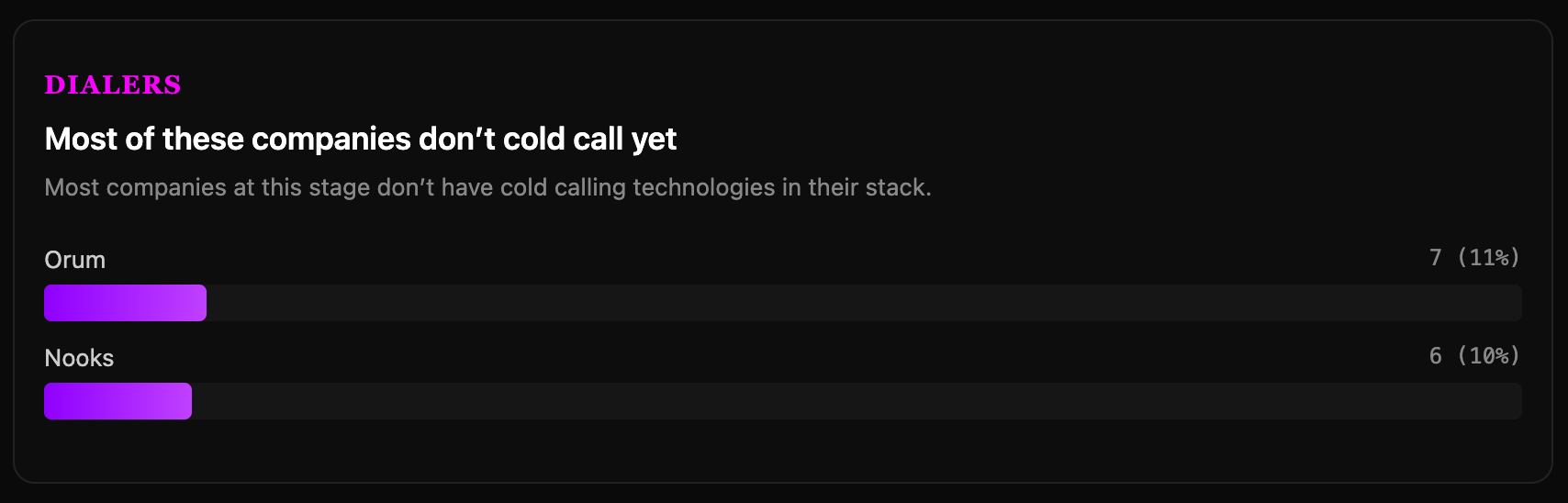
Orum shows up at 7 companies. Nooks at 6. The vast majority of these companies don’t have a dialer in their stack yet.
Which makes sense based on the profile of these companies. Many of them are product-led or inbound-heavy companies where cold calling isn’t a primary motion. But for the ones that do run outbound via cold calls, Orum and Nooks are the two names that keep coming up.
AI SDRs
Zero adoption (so far)
None of the companies use an off-the-shelf AI SDR.
These companies are building custom outbound workflows with Claude + Clay + Outreach/Salesloft (see: 11 Growth-Stage Companies That Built GTM Agents In-House), not buying autonomous agents.
That likely says more about the technical DNA of these companies (they have the engineering talent—including GTMEs—to build in-house) than it does about the AI SDR category, which is still early and finding its footing at different company profiles.
Data Infrastructure
The invisible foundation
One thing that jumped out: dbt and Snowflake are nearly as common as Gong. dbt shows up in 84% of these stacks. Snowflake at 79%. Fivetran at 48%. Segment at 43%.
These aren’t GTM tools in the traditional sense. But they’re the plumbing underneath the GTM stack. The companies that run the most sophisticated go-to-market motions are the same ones that invested early in data infrastructure. That correlation is worth paying attention to. This aligns with what Kyle Norton shared with us in our AI x GTM Summit, that Data foundations is Phase 1 in his AI Transformation Roadmap for Revenue Leaders.
What this data tells us
A few patterns jump out when you look at the full dataset:
The “core three” are non-negotiable. Salesforce, Gong and Snowflake/dbt appear in 80%+ of these stacks.
Clay is infrastructure now. At 65% adoption, Clay has crossed from “nice-to-have” into “default.” It’s the second-most adopted data tool behind only ZoomInfo, ahead of LinkedIn Sales Navigator. I suspect they’ll jump into the core stack (80%+) within the next year, if not sooner.
The intent category is splitting. Legacy ABM platforms (6sense, Demandbase) still have the largest footprint, but newer signal tools (Common Room, Unify, Sumble) are landing at the same companies. These aren’t replacements, but additions. The “System of Intelligence” may shape up to be a stack, not a single platform.
Off-the-shelf AI SDR adoption is zero at the top. The companies with the most technical talent and the most aggressive growth targets are not buying autonomous AI SDRs. They’re building their own workflows.
The full dataset
The complete interactive dataset is live at ProspectingStack.com/top-tech-stacks.
You can search by company, filter by category, sort by valuation, headcount, sales team size, or number of tools, and click into any company to see their full stack.

Data sourced from Sumble and Clay, plus Claude to pull customer logos from websites and review sites.
If you found this Research Report useful, share it with someone who geeks out on GTM tech stacks.
And if you think we’re missing a tool or a company, reply to this email or reach out to me, Brendan Short, on LinkedIn (the dataset is a living thing, and we’ll keep updating it).

As always, thank you for your attention and trust. I do not take it for granted.
See you next time,
Brendan 🫡