


If you were forwarded this newsletter, join 7,431 weekly readers—some of the smartest GTM founders and operators—by subscribing here:
Thanks for reading this hand-rolled, 100% organic, farm-to-table (human-written) newsletter.

Presented by Clay.

Bring AI agents, enrichment, and intent data together and turn insights into relevant, timely action. Start building for free.
& Supported by:

Attention → AI Agents for RevOps
Clarify → The Autonomous CRM
Nooks → Agent Workspace for Intelligent Outbound
Sumble → Buying signals from tech stacks, people data, & active projects
11x.ai → Accelerate growth with a digital GTM workforce

→ Join 700+ tomorrow for How GTM Teams are using MCPs and Claude/Claude Code.

I’ve written a lot about the GTM Engineer role over the past 18 months. When you should hire one, what they should work on, how most companies are using them wrong, and FAQs about the new role. And, more broadly, AI/innovation.
But I hadn’t seen a company treat these things the way Vanta does.
Vanta created a position called Founder in Residence, GTM Innovation. The person in it, Shashank Khanna, is part product manager, part engineering manager, part hands-on builder. He identifies areas of automation across Vanta’s entire go-to-market org, prototypes the initial solution himself, then hands it off to a team of GTM Engineers who report to him. The main goal is to “build AI-first workflows across sales, marketing, and customer success.”
Shashank’s background is what makes this unique role work. He has a CS degree from UCLA, engineering stints at Amazon and SoFi, and was a startup founder/CEO that went through YC. Tldr: he’s a unicorn hire. Someone who can talk to a VP of Sales about pipeline and then go build the system that fixes it.
In this post, we cover:
What is an “AI in Residence”?
What is a state machine?
V1: Three pillars (eliminate busy work, enable reps, scale best plays)
V2: The state machine approach and Vanta’s in-house AI SDR
How Vanta decides what to build next
Vanta’s first-party data advantage
The AI in Residence org chart
Takeaway
Alright, let’s get into it.
What is an “AI in Residence”?
I went back and found Christina’s (CEO of Vanta) original post (see below) about their search for an AI in Residence:
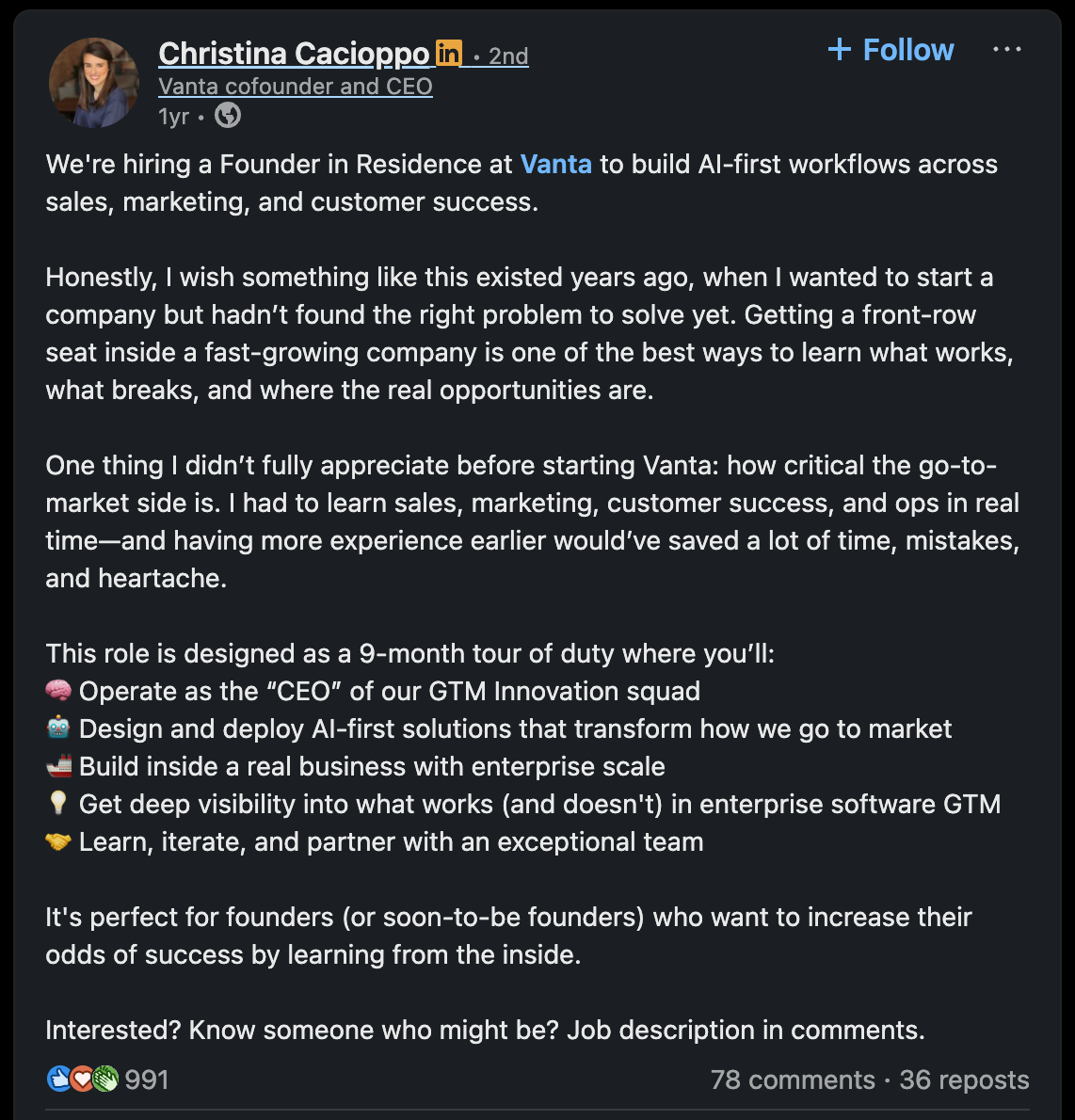
A few things stood out to me when reading this:
It’s a tops-down initiative (from the CEO directly). True, full-on AI transformation has to be done this way, in my experience.
This is new, weird, uncharted waters. An entrepreneurial-type person is required.
AI-first workflows across all GTM departments (sales, marketing, customer success), not just pipe gen.
Very cool jd. I hope—and expect—to see more like it. We’ll get more into the specifics of the role, and where it sits, towards the end of this post. But first, what is Vanta building with this role?
What is a state machine?
Last week, when I asked Shashank how Vanta thinks about applying AI across their go-to-market org, he told me the core framework is: treat your GTM motion like a state machine.
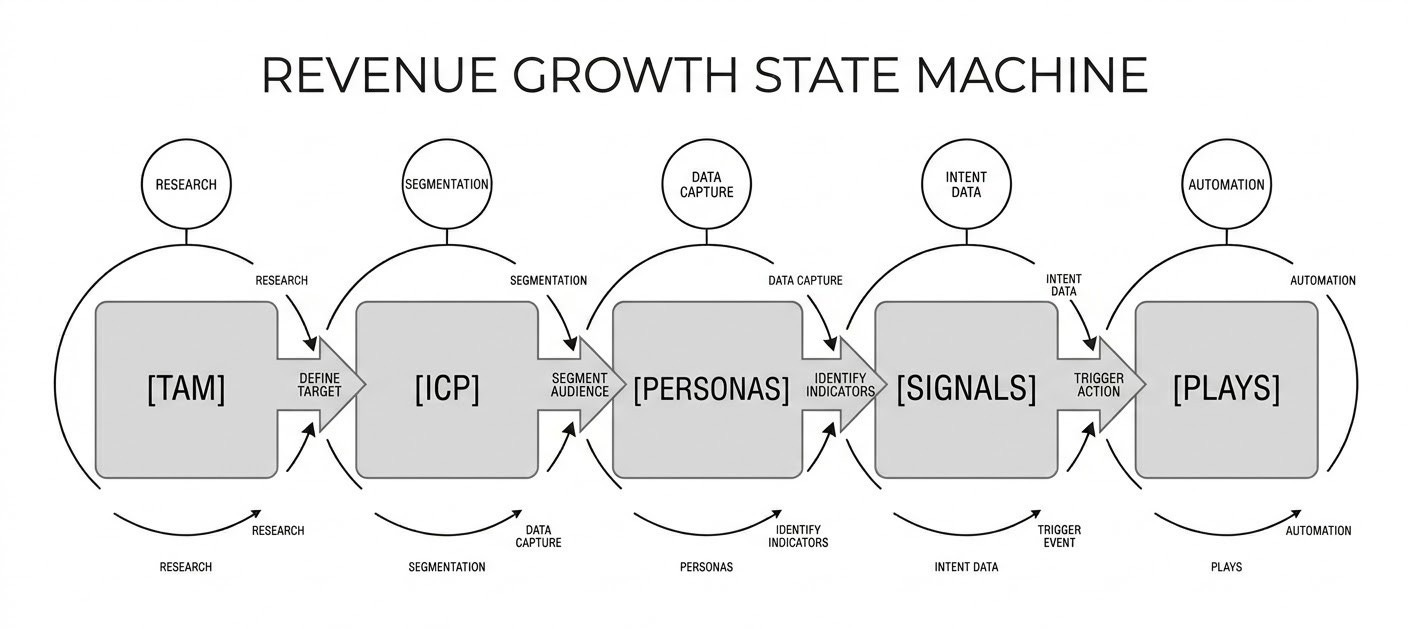
A state machine is an engineering concept. At any given point, a system is in one defined “state.” When certain inputs change, the system transitions to a new state. Think of a vending machine: it goes from “waiting for money” to “item selected” to “dispensing.” Each transition is triggered by a specific input.
Shashank’s argument is that most GTM workflows already behave like state machines. We just haven’t modeled them that way.
Take outbound. At any given point, there’s an optimal combination of ICP, persona, signal, and play. When a relevant event happens (a new competitor launches, a regulation changes, funding dries up), the optimal state shifts. Your ICP scoring should change. Your personas should change. Your messaging should change. Most teams adjust these manually, slowly, if at all.
Vanta is trying to model these systems programmatically so they can adjust automatically.
V1: Three pillars
When Shashank’s team started, they organized their work around three pillars:
Eliminate busy work → Take the repetitive, time-consuming tasks that reps do every week and automate them.
Scale best plays → Identify what’s working for individual reps and deploy it across the org.
Enable reps to build their own agents → Give reps access to tools so they can experiment on their own.
Each of these pillars produced real, live systems that are running today.
By the way, last month I wrote about 3 AI workflows Vanta shipped in a single day (during a Clay hackathon); you can find them here: 9 Lessons From 11 Growth-Stage Companies That Built GTM Agents In-House.
Eliminate busy work (example: the QBR workflow)
This is Vanta’s most popular automation. Before this existed, CSMs and AMs would spend 2-4 hours per week preparing for QBRs. They’d manually pull customer data, check product adoption, assess health metrics, look for upsell opportunities, and build a deck.
Now there’s a button in Salesforce that does all of it. One click. Magic.
When a rep clicks it, the system runs account research using Clay, Snowflake, and Workato as an ETL pipeline, with LLM calls (via Anthropic’s API) at each stage. It checks the customer’s progress within Vanta (how much of their SOC 2 is complete, risk indicators, health metrics), identifies upsell opportunities (did they raise funding recently?), and generates a formatted slide deck using Google Slides and Google Docs APIs.
The automation has been triggered over 1,500 times since launch. Vanta has since expanded the same pattern to pre-call decks, post-call decks, and value engineering workflows.
Enable reps (example: Dust.tt and bottoms-up agent building)
For the third pillar, Vanta chose a platform called Dust.tt and gave every rep access. No formal training program. No mandated use cases. Just: “here’s the tool, experiment, go build.” (Dust just published a case study about how Vanta uses them if anyone wants to learn more.)
The value of this approach is less about any individual agent a rep builds and more about the signal it generates for Shashank’s team. The tacit knowledge of the best reps is stored in their brains today. An exercise like this codifies it. And then, when you see organic adoption of an agent across the rest of the team, you know where to double-down. We’ll talk more on how this feeds prioritization below.
Scale best plays (example: signal detection and social listening)
Vanta uses Clay Audiences to monitor what they call “interesting events” across their prospect and customer base. Champion job changes, funding rounds, headcount shifts, etc. (changes in a rep’s book of business).
These events get routed through a tiered alerting system.
Tier 1 signals go directly to an AE.
Tier 2 might go to an SDR.
Unowned accounts get round-robined.
And so on.
The events themselves are stored as objects in Salesforce, so when a rep opens an account, they can see the full history of what’s happened.
This isn’t AI in the generative sense. It’s data engineering (deterministic steps) combined with smart routing. But it’s the kind of infrastructure that compounds over time as the signal library (and learnings from outcomes) grow.
V2: The state machine approach
V1 was about automating individual workflows. V2 is about connecting them.
The state machine framing means modeling entire GTM functions (SDR, AE, post-sales, even paid spend) as systems with defined inputs, states, and transitions. The AI SDR is the first full implementation of this idea.
Vanta’s in-house AI SDR
Vanta made a deliberate decision to build their AI SDR in-house rather than buying an off-the-shelf tool. Shashank’s reasoning: once you’re at a certain scale, the art of understanding what resonates with your specific buyer is too nuanced for a generic product.
The system works like this:
Start with TAM. Load accounts into a Clay table. Filter by size, geography, existing opportunities. Scrape each website to confirm they’re alive, they sell software, the founder still works there. Enrich, ICP score, run AI research, and do a compliance gap analysis (specific to Vanta’s business: does this company have SOC 2? Do they have a competitor badge on their site?).
If the score passes the threshold, the system finds relevant contacts and classifies them by persona. Vanta has defined archetypes internally (”Suzy Security,” “Emilia Engineer,” “Forest Founder”) and the outreach sequence is mapped to the persona, the company’s compliance posture, and the signal that triggered the play. A competitor customer gets a competitive rip sequence. A fresh Series A with no SOC 2 badge gets a different approach entirely.
Emails send automatically through Outreach from individual rep accounts. LinkedIn tasks get queued for reps to send manually (Vanta is a security and compliance company, so they won’t use tools that operate in gray areas like automated LinkedIn messaging), and call steps also created as tasks for reps.
One smart decision: the AI SDR only works accounts that are not in Salesforce. No owned accounts, no existing opportunities. This eliminates territorial friction with human reps and creates a clean environment for testing. They can compare AI SDR performance against the rest of the SDR org without contaminating either dataset.
Shashank was candid that results are still TBD. The system is live but early. He could come back next month and say they shut the project down. That kind of intellectual honesty is refreshing when every company wants to claim their AI initiative is 10x-ing pipeline. (I’ll report back on this one!)
For the AI SDR specifically, they track open rates, meeting booked rates, opportunities created, and emails sent, benchmarked against the human SDR org. My prediction is, reps won’t get replaced entirely, but they’ll be augmented with tools like this, especially in down-market (SMB) segments.
How Vanta decides what to build next
Shashank’s team serves sales, post-sales, marketing, RevOps, and customer success. If they purely stack-ranked projects by revenue impact, sales would win every time and post-sales would get nothing.
So they balance two things: objective impact to the business (pipeline generated, revenue influenced) and coverage across departments. RevOps gets AI-powered rules of engagement resolution (an agent that detects ROE escalations and provides initial resolution). Post-sales gets a customer success platform with churn risk models and upsell detection. These projects may never move the top-line number directly, but they keep the whole org moving forward.
The Dust.tt experimentation layer also feeds prioritization. When a rep-built agent gets organic adoption, that’s a signal to the central team that the workflow is worth investing in.
Shashank’s team catalogs every SDR workflow across EMEA, APJ, and North America, identifies tasks that reps already do manually, and automates them. The baseline outcome is to save reps X hours per week.
Vanta’s first-party data advantage
One thing that stood out to me (and worth calling out) is that Vanta has a massive first-party data moat feeding all of this.
With hundreds of reps running outbound sequences, they have deep data on what works. Open rates, reply rates, meeting booked rates, closed-won rates, all segmented by persona, sequence, geography, and company profile. Add Gong call recordings on top of that, and you have a system that can learn which messaging resonates with which buyer at which stage.
This is why the state machine framing makes sense for a company like Vanta but would be premature for a 5-person startup. You need volume to make the model valuable. Vanta has the volume.
The AI in Residence org chart
Shashank operates like an early-stage founder inside a scaled GTM org. He owns planning, roadmap, hiring, enablement, and the actual engineering work. His team of GTM Engineers each specialize in different areas of the motion, and Shashank builds the first version of every major project before handing it off.
The backgrounds of the GTM Engineers on the team vary. Some come from software engineering. Some come from business systems and RevOps. Some are more comfortable with point-and-click tools, and others write code. Shashank believes you can’t hire the perfect candidate for this role. Instead, you build the team in aggregate. Pair the person with deep sales context with the person who can write Python. The composition of the team matters more than any individual hire.
Enablement is a big part of the job that doesn’t get talked about enough. Shashank spends significant time in all-hands meetings, 1-on-1s with reps, and sessions with sales leaders, selling the tools his team builds internally. The best automation in the world is useless if reps don’t adopt it. (I’ve seen this first-hand, and it’s painful). Vanta’s approach is to make minimal changes to existing rep workflows whenever possible, reducing the friction of adoption. Meet them where they’re at.
My personal take on comp: If a GTM Engineer’s work directly generates pipeline and revenue, tying comp to outcomes aligns incentives in a way that base salary alone doesn’t. Companies that figure out the right comp structure (high upside potential for performance of outlier experiments/agents) for this role will attract better talent, imho.
Vanta is hiring GTM Engineers
If you want to build at the bleeding edge of AI and GTM, Vanta is hiring GTMEs right now. Shashank was kind enough to give us a look behind the curtain on the way Vanta is building their AI-native GTM engine. So, hopefully as a thank you a few great candidates come their way! :) Reach out to Shashank directly or apply on Vanta’s careers page.
Takeaway
Vanta’s approach reinforces something I keep seeing across the best, AI-native GTM orgs: AI isn’t a one-time project. It’s a new operating model.
The companies treating it as a one-off initiative are getting lapped by the ones building internal teams, modeling their GTM motions as systems, architecting infrastructure, and iterating continuously. The job is to get everyone up the (AI) ladder as fast as possible.
The Founder in Residence title is a signal in itself. Vanta isn’t assigning AI to an ops analyst as a side project. Or giving ChatGPT/Claude licenses to reps and saying “go use this and share what you learn!” They created a dedicated role with real scope, an engineering team (big resource investment), and a mandate to rethink how the entire go-to-market org operates.
I could see every company north of $50M ARR have some version of this role in the next year or two. The ones that build it now will have a compounding head start on everyone else. It’s moving from giving reps AI to use, to using AI as core infrastructure to run a modern GTM org.

As always, thank you for your attention and trust. I do not take it for granted.
See you next time,
Brendan 🫡