


If you were forwarded this newsletter, join 6,426 weekly readers—some of the smartest GTM founders and operators—by subscribing here:
Thanks for reading this hand-rolled, 100% organic, farm-to-table (human-written) newsletter.
Presented by Clay.

Bring AI agents, enrichment, and intent data together and turn insights into relevant, timely action. Start building for free.
& Supported by:

Attention → AI Agents for RevOps
Clarify → The Autonomous CRM
Nooks → Agent Workspace for Intelligent Outbound
Sumble → Buying signals from tech stacks, people data, & active projects
Hey y’all!
I’m coming off a long weekend, catching some turns in the mountains in Utah 🏂. Rested, recharged, and a bit sore.
Meanwhile, the world continues to get crazier and harder to navigate. My goal is to continue to separate the signal from the noise in our little corner of the world—GTM.
I was on a call recently with the Head of RevOps and Systems at a unicorn. They’re looking to hire a “GTM Engineer.” But they were resistant to the GTM Engineer title. Five minutes in, I understood why. Their mental model was: GTM Engineer = automated outbound. That was it.
That’s a real thing worth hiring for. But it’s only one piece of a much larger pie.
After all, GTM stands for go-to-market. Not “top of funnel.” Not “lead gen.” The full GTM motion includes: marketing, sales development, sales, customer success, and account management. It’s every team that touches a customer—from awareness to renewal. Therefore, a GTM Engineer embedded in a GTM team isn’t just an outbound machine. They are (or can be / should be) a leverage multiplier in every department across the entire go-to-market motion.
So, today, I am unpacking this concept.
Because I don’t hear enough people talking about it. And, if you’ve been reading The Signal for a while, you know I’m incredibly AI-pilled, and I believe that in the AI-era, a GTM Engineer (or whatever you want to call it) is one of the best ways for a modern GTM team to get leverage.
Here’s what we cover in today’s post:
A GTM Engineer is not just sending automated outbound
21 non-pipe gen use cases a GTM Engineer can build
The Product Manager analogy
Where to start (and expand)
Examples of broader GTME JDs
Alright, let’s get into it.
Most Companies Are Using GTM Engineers for “Automated Outbound.” The Best GTM Teams Aren’t Stopping There.
A GTM Engineer is not just running automated outbound.
That’s the version most people have in their head right now. Someone who builds some workflows, enriches leads, and fires off (high volume) sequences. An automated SDR. Top-of-funnel, all day.
I understand why. It’s the most visible use case. It’s what gets posted about on LinkedIn. It’s what many vendors are selling. But if that’s where your mental model stops, you’re missing what this role can actually do for your GTM team.
I first wrote about The Rise of the GTM Engineer back in November of 2024.
The term has gotten more attention since then—and stayed just as polarizing. Part of that is the word “engineer” itself. Most GTM Engineers aren’t software engineers. Many don’t write code, though Claude Code and tools like it are quickly changing that. Real engineers find the title triggering. Fair. And some of it is because people are still arguing a GTM Engineer is “just RevOps rebranded.”
But the bigger problem isn’t the title. It’s the job description being written around the wrong use case.
21 non-pipe gen use cases a GTM Engineer can build
Here are some examples of things a GTM Engineer can (and should) build that have nothing to do with prospecting/pipe gen:
1. AI-generated sales decks for AEs. Pull the industry and buyer title, hit a knowledge base, and generate a custom deck before the meeting. No more one-size-fits-all slide decks.
2. Call grading. Take the transcript, check whether the rep referenced relevant customers in similar industries, whether they hit the pain points tied to that buyer’s role, and whether they followed the suggested talk track(s).
3. Customer health scoring. Post-sale. Give account managers a real view of their book: upsell potential, cross-sell opportunities, churn risk. Built on rich context and actual signals, not gut feel.
4. Pre- and post-event workflows for marketing. The work required before and after events is painfully manual. A GTME can create tremendous leverage here (obviously, only worth exploring if events are a big motion for your team).
5. Lead magnets built to educate. Vibe-coded tools, calculators, and interactive content. Built fast and focused on generating real value for a specific person or micro-segment.
Here are 16 more ideas (again, none of which are top-of-funnel use cases):
RevOps: Sales territory planning, TAM+ICP sourcing engine, Forecast accuracy tracking.
Marketing: Automated case study generation, ABM campaign orchestration across channels, Personalized web pages (or ads) at scale.
Sales: Automated competitive battlecards, Win/loss analysis, Proposal/SoW generation for AEs, Contract redlines, Re-engagement campaigns for closed/lost deals, Internal knowledge base search for reps.
Customer Success: QBR prep/deck creation, Product feedback routing, Support ticket intelligence, 1:1 Customer onboarding automation.
The Product Manager analogy
The more I describe the role of a great GTM Engineer, the more it sounds like a PM (or what I did early on as a founder/CEO).
The best GTM Engineers operate like The Mom Test:
The whole point is to avoid building something nobody wants by having real conversations that surface real pain points, then letting those insights shape what you build.
They’re not assuming they know what to build. They’re interviewing the top reps and leaders to find what’s being done manually today that could be automated org-wide. They’re talking to founders to surface the projects that never make the priority list. Then they build, ship, and measure what comes out the other side.
Ask → build → ship → learn. That feedback loop is what makes the role compound over time.
Where to start (and expand)
This is a journey. Sometimes you genuinely just need someone focused on top-of-funnel. That hire can be junior and narrowly scoped. And that’s a legitimate starting point for a GTM Engineer!
But the key phrase here is starting point. That same person, given room to grow, is perfectly positioned to expand as new use cases emerge and as they learn the business.
Examples of broader GTME JDs
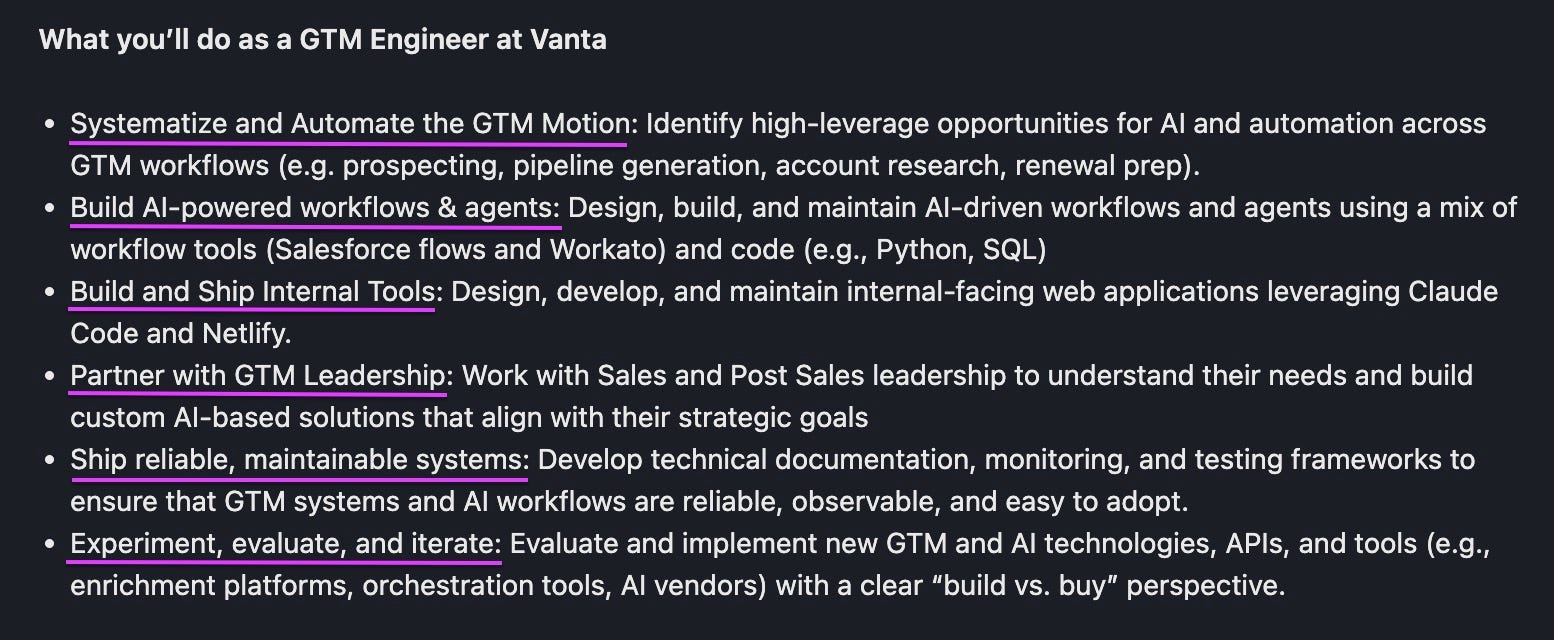
Some job descriptions are starting to get this right, and talk about GTM Engineers working on use cases beyond just pipe gen.
Vanta’s job description is a good example (GTM Engineer, AI):
And so is this JD from Descript that I shared last year.
The framing is less “Clay and spray” and more “internal AI product owner for the GTM team.” Some companies are putting “AI” in the title instead of “GTM Engineer” — which might be a cleaner entry point for orgs that don’t want the baggage of the word “engineer.”
The title may shake out.
But, what won’t change is the jobs to be done. I believe that in 18 months, ~every company will have this person embedded in their go-to-market org. And the companies that hire this person now—and give them real scope beyond outbound—will have a meaningful head start over their competitors.
If you’re looking to hire a GTM Engineer, or already have one, and their only objective is top-of-funnel (ie: doing “automated outbound”), you’re leaving a ton of value on the table. The faster your team realizes this, the further ahead you'll get.
Thank you for your attention and trust. I do not take it for granted.
See you next time,
Brendan 🫡
PS: Here are 6 things that caught my attention this week:
OpenClaw: The Viral AI Agent that Broke the Internet - Peter Steinberger | Lex Fridman Podcast
Stripe CEO, Patrick Collison, says: “There’s a reasonable chance that 2026 Q1 will be looked back upon as the first quarter of the singularity”
YouTube playlist (6 videos) of each ~20-minute session from the AI x GTM Summit
I think this has always been true, but has become especially true recently with the adoption of claude code and those things. great piece.
Advice for someone working in a founding sales role but dealing with a CEO who is hesitant to run automated anything? Hard to A/B test and iterate on data when the process is extremely slow and manual, and no results so far.