


If you were forwarded this newsletter, join 7,269 weekly readers—some of the smartest GTM founders and operators—by subscribing here:
Thanks for reading this hand-rolled, 100% organic, farm-to-table (human-written) newsletter.

Presented by Clay.
Bring AI agents, enrichment, and intent data together and turn insights into relevant, timely action. Start building for free.
& Supported by:

Attention → AI Agents for RevOps
Clarify → The Autonomous CRM
Nooks → Agent Workspace for Intelligent Outbound
Sumble → Buying signals from tech stacks, people data, & active projects
11x.ai → Accelerate growth with a digital GTM workforce

Hey, y’all!
Big month in tech/gtm-land so far. Apollo acquired Pocus. Rox acquired Persana AI. Inflection acquired Keyplay. Consolidation szn continues. Todd Bussler (CEO Champify) joined Clay’s Enterprise Sales team. Florin Tatulea joined ZoomInfo as GTM Engineer in Residence. And 46 more companies launched an “all-in-one sales tool.”
Meanwhile, Claude announced they passed $30B ARR (adding $11B in a month (!!!)). And their latest model is “too powerful to release.” Marketing play? Idk. Oh, and yesterday they launched agents too. Dario and crew are absolutely cooking.
Register for The Signal’s event on Tuesday: How GTM Teams are using MCPs and Claude/Claude Code.
I’m amped to unpack today’s topic.
For the last couple of years, with almost complete unanimity, the founders and revenue leaders I speak with agree that the old GTM playbook no longer works.
What’s more interesting is the conversation that follows. The “well then, what does work today?”
There’s a new playbook starting to emerge. I’ve seen it. And now that I see it, I can’t unsee it.
At its core, it’s an AI-native playbook. What it looks like is being written in real time. One way to think about it: by the end of 2027 “the 30 ways every GTM org should be using AI” will be very clear. But that playbook doesn’t exist yet—not fully.
A handful of these “30” are established today (eg: AI inbound, CRM enrichment, etc).
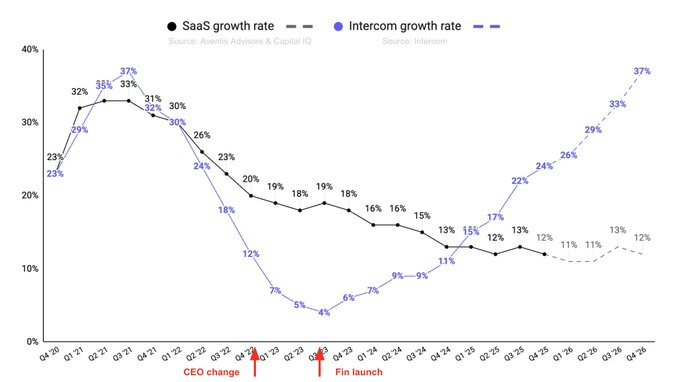
What’s most exciting to me, most energizing, is shining a light on the companies that are building the new playbook right now. These are companies that decide to reorg around becoming AI-native. When you look at Block (led by Jack Dorsey), Shopify (led by Toby), or Intercom/Fin.ai (led by Eoghan taking the reins again), it’s clear that even incumbents can—and have to—“re-found” themselves from first principles with the tools at our disposal today. I mean, my gosh, just look at this chart of Intercom:
And of course, there are companies that started in the last few years that are uniquely able to get way ahead and reach revenue milestones that we’ve never seen before, like Cursor, Lovable, Harvey, and others.
This week, one of the most AI-native orgs, Ramp, released an article worth unpacking. Written by Geoff Charles, Ramp’s CPO, the title is “How to Get Your Company AI Pilled.” My mind started racing to how GTM Teams can/should adopt this framework. So, I decided to steal… or I mean borrow… the piece and adapt it specifically to: How to get your GTM team AI pilled.
Here’s what we’re covering today:
The numbers behind Ramp’s AI transformation
AI proficiency is a learning curve, not a light switch (and what that means for your GTM team)
“Creative destruction” (your GTM stack’s shelf life will shrink)
Hub and spoke: how to organize your GTM team around AI
Give your GTM team a stage, not a mandate
Remove every constraint between your people and AI
What this means for every GTM org right now
Alright, let’s get into it.

The numbers behind Ramp’s AI transformation
Some context on what Ramp has actually done. Ramp’s AI usage is up 6,300% year over year. 99.5% of their team is active on AI tools. 84% use coding agents weekly. They shipped 1,500+ apps on an internal platform in six weeks, from 800+ different builders. Non-engineers now account for 12% of all human-initiated PRs on their production codebase, thousands per month, using Ramp Inspect, their home-built coding agent.
They did this by modifying their hiring process and talent management. They gave everyone unlimited budget to build, learn, and experiment. They created leaderboards. They reorged teams around the people who see the future. They celebrated wins at all-hands. They pushed every single person and leader to build.
This is a $32 billion company. Operating like a startup when it comes to AI adoption.
Now, most GTM orgs reading this are not Ramp. But the principles behind what they did apply to every revenue team trying to figure out AI.
AI proficiency is a learning curve, not a light switch
Geoff lays out four levels of AI proficiency at Ramp:
L0 (sometimes uses ChatGPT, hasn’t changed any workflows)
L1 (built custom GPTs, dabbled in Claude Code)
L2 (built an app that automates part of their job, committed code), and
L3 (systems builders who build infrastructure that levels everyone else up).
So for GTM teams, this might looks something like this…
L0 is the SDR who uses ChatGPT to rewrite a cold email. Fine, but not compounding.
L1 is the RevOps lead who has built custom GPTs for objection handling and started using Clay for enrichment.
L2 is the GTM Engineer (or the ambitious ops person) who has automated a signal-based outbound workflow end to end, from trigger to personalized sequence.
L3 is the person who builds the internal systems that make every rep more effective: the enrichment waterfalls, the scoring models, the automated QA on pipeline (infrastructure running revenue org, and agents in production).
Most GTM teams I’ve worked with or spoken with have a few L1s and maybe one L2. Almost nobody is at L3. And that’s the what to aim for on the learning curve.
As Geoff puts it: the job is to get everyone up the ladder.
Three things make that possible at Ramp, and they translate directly to GTM: start with tools that meet people where they are (low bar, high value), raise expectations as tools mature, and match the mandate to the tooling. If you tell your AEs they need to be using AI but your CRM doesn’t have an AI layer and your enrichment is still manual, you’ve burned credibility before you started.
“Creative destruction” (your GTM stack’s shelf life will shrink)
Geoff said that many of the tools Ramp shipped in January 2026 were already obsolete by the time the article came out in April, replaced by better versions, often from the same builders. They’re comfortable with a shelf life of weeks, not months.
Their data democratization journey illustrates this well.
Phase 1 was Notion AI over piped data.
Phase 2 was a Slack-based Snowflake research tool.
Phase 3 was encoding that research into coding agent skills.
Phase 4 is making data research interactive and self-improving. Each generation made the last one irrelevant.
Now apply that to GTM. How many teams are still running the same outbound stack they set up 12 months ago? The same sequences, the same enrichment logic, the same qualification criteria? In a world where Clay ships new integrations weekly, where LLMs get meaningfully better every quarter, where new agent frameworks launch every month, a static GTM stack is a depreciating asset.
The best GTM teams I’ve seen are treating their workflows the way Ramp treats their internal tools: build it, use it, learn from it, replace it when something better becomes possible. The teams still running “set it and forget it” automations from mid-2024 are falling behind.
Hub and spoke: how to organize your GTM team around AI
Ramp tried centralized first (one team builds everything), then decentralized (every team builds their own). Both failed. The answer was a hybrid: a small central team builds the platforms and plumbing, while functional teams build on top and feed the roadmap.
For GTM orgs, this maps cleanly. The “hub” is your GTM Engineer, RevOps, or a small AI/automation team. They own the data infrastructure, the enrichment pipelines, the integrations, the shared workflows. The “spokes” are your reps (XDR, AE, AM, CSM) building on top of that infrastructure for their specific use cases.
Ramp’s results from this model are worth noting. A risk analyst automated 16 hours per month of financial modeling. A sales ops lead replaced a spreadsheet-based comp model across three orgs in 48 hours. An L&D lead built a training simulator in 15 minutes. Someone in finance built a contract reviewer that saves 45 minutes per contract. None of them were engineers.
An AE can now build their own account research workflow. A CSM could automate renewal risk scoring. A demand gen lead can build a micro-campaign generator. These people don’t file a ticket. They find their own pain and build. The hub’s job is to make that possible by operationalizing and scaling those learnings. Or else they’ll just be one-off projects or shelfware.
Give your GTM team a stage, not a mandate
“Mandates decay. Culture is what remains.”
At Ramp, they built the culture through visibility. A Slack channel (#ramp-uses-ai) that now has 1,000+ members and spawned 40+ team-specific channels generating 20,000 messages per month. AI office hours every Friday with 40-50+ people showing up. AI onboarding for new hires, rebuilt four times as ambition grew. All-hands sessions where everyone from the CEO to a first-line operator demos what they’ve built.
The competitive dynamic this created was powerful. Ramp found that their top AI users are often their highest performers. AI proficiency compounds like any other skill: the more reps you get, the better you become.
Office hours help. Workshops help. But the single biggest unlock is getting someone to experience a real result on day one. The best teacher is the AI itself, by the way. :) For example, if you’re in a tool and don’t know how to do something, ask Gemini (top-right of Chrome) for help. It’s magic.
For GTM teams, this means don’t start with a training deck on “how to use AI for sales.” Start by getting your reps a tool that solves a real problem they have today. Account research. Prospect enrichment. Call prep. One win on day one does more than a month of enablement sessions.
You want your AEs sharing their AI workflows in Slack. You want your top-performing SDR showing the team how they built a prospect research agent. You want your RevOps lead demo’ing a new AI workflow at the team standup. Public building creates a flywheel that no mandate or training session can replicate.
Geoff said that on every team, there’s one person, the ambitious sales ops lead, the frustrated product operator, the eager data scientist who gets curious, gets sucked in, and becomes a contagion for their teams. Find those people. Make them visible. Give them resources.
Remove every constraint between your people and AI
Geoff says the number one way companies kill AI adoption is by treating it like a procurement decision. Budget approvals. IT reviews. Token limits. Connector requests that sit in a queue for weeks.
Ramp took the opposite approach. They treated AI usage as an infinite learning budget, killed token limits and access restrictions, and removed every IT bottleneck on connectors. Their cost math is worth repeating: token consumption per employee isn’t even close to double-digit percentages of their salary. If someone is 2x more productive with AI, you should be willing to spend their entire salary again in tokens.
Remove all friction across the GTM org. Let your sales rep try that new AI tool without requiring a long procurement process. Top-up your SDR who hit their Clay credit limit mid-month. Allow your RevOps lead to connect their CRM to an AI agent that IT is trying to block. Every one of these is a wall between your team and their next breakthrough.
What this means for every GTM org right now
Ramp didn’t start with a master plan. In Geoff’s words, all they had was a culture and talent, and they kept doubling down on what was working. And watched it compound.
That compounding came from the intersection of all these things reinforcing each other: better tools, higher expectations, more visibility, fewer constraints.
Get your GTM team to at least L1, then give them the tools and freedom to reach L2. Build a hub (even if it’s one person) that handles the infrastructure. Create a stage where builders are visible. Remove procurement friction. And most importantly, accept that whatever you build today should be better in 90 days. If your outbound stack from Q1 still feels state-of-the-art in Q3, you’re not moving fast enough.
The gap between AI-native GTM teams and everyone else is widening every quarter. And it’s not because of the tools. The tools are available to everyone. It’s the culture, the expectations, and the willingness to keep rebuilding.
The most important lesson from the whole article is the simplest one: just get started.
The best time to plant a tree? 20 years ago.
The second best time? Today.
By the end of 2027, the top-performing GTM orgs will look nothing like they do today. The ones that start building now will have a compounding head start that’s impossible to catch. You just have to keep building.

Top Posts of the Week (Claude edition) 👀
Claude Skill built for Hightouch’s GTM team: Automated account intelligence alerts. By Nikko Georgantonis.
That’s it for today. As always, thank you for your attention and trust. I do not take it for granted.
See you next time,
Brendan 🫡