


If you were forwarded this newsletter, join 5,722 weekly readers—some of the smartest GTM founders and operators—by subscribing here:
Happy holidays, y’all!
Thanks again for supporting the AI x GTM Summit last week. Still blown away by the turnout. You can see the stats from the event here: summit.thesignal.club.
(I vibe-coded this in Claude, so blame any bugs on AI)
I’m excited to continue to lean into content going into 2026. And I’ll be sharing some exciting updates on this front in January. :)
But, for today’s post, I wanted to reflect on the year of consulting I did and share some of the lessons from it. We’re all figuring out this new playbook together. I haven’t had this much fun in SaaS GTM in years (seriously).
If you haven’t started to take AI seriously, it’s not too late. Come on in, the water is warm, and the rabbit hole runs deep. 🐇 🕳️
Here’s a quote from a piece I wrote in June: My AI Journey: Not One Lightbulb Moment, but 100 Sparks that Gave Me Deep Conviction (& why you’re not behind on AI)
9 out of 10 experiments I’ve tried with AI failed (probably more tbqh).
I worked with 14 Seed-Series C companies in 2025 to help modernize their GTM strategy. And today, I wanted to share the 6 things I now suggest in every engagement, based on what we've learned.
Please steal/tweak/implement them in 2026.
Alright, let’s get into it.
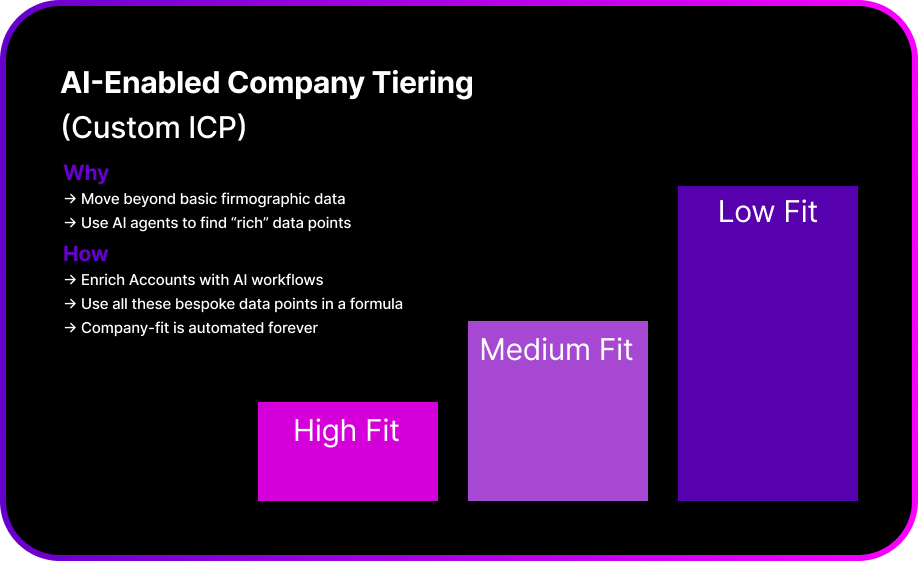
1/ AI-enabled Company Tiering (Custom ICP)
This isn’t 2019.
Stop using the same, basic attributes that everyone is using from their b2b database, like: location, industry, employee count, revenue.
Instead, use “rich” data points. AI can find those for you.
Examples of data points used for High/Medium/Low Fit (or A/B/C/F or 1/2/3/4 tiers):
Updated privacy policy page in the last 30 days (custom scraper/AI workflow)
$500M in online revenue and have lots of products being sold online (custom prompt)
Using snowflake, bigquery, databricks, or redshift (scraped from job descriptions via Sumble) and have 5+ data engineers
PLG SaaS company that has a price point below $100/month, and at least 1 Researcher at the company (custom scraper/AI workflow)
Then, layer in the basic data points. Things like location, industry, employee count, etc. still matter.
And finally, create a tiering system. AI is your best friend here.
This can (and often, should) be 100% automated in the background. So that once you set it up, any new company added to your CRM gets enriched and tiered, and updated in the right field(s) in your CRM.
2/ AI-enabled Contact Sourcing + Categorization (Buyer Personas)
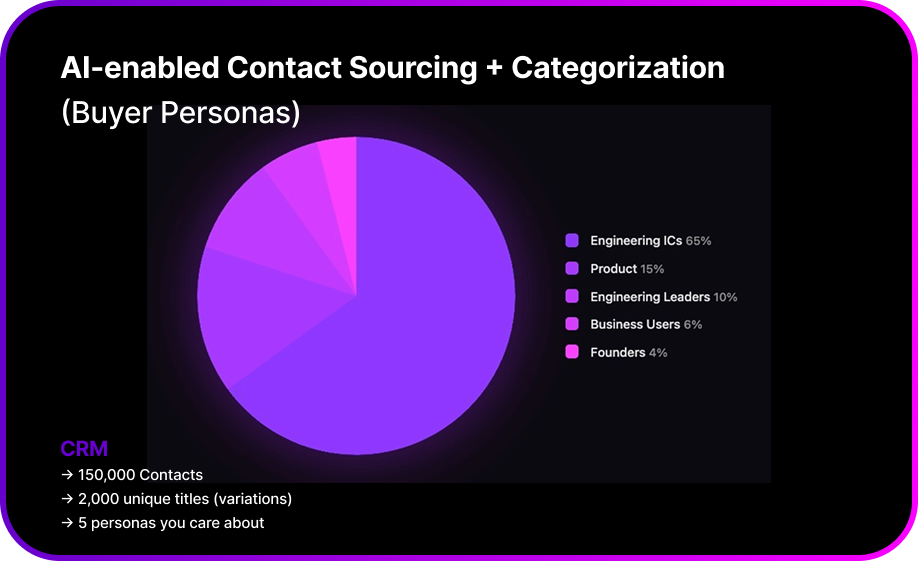
Build a list (with the help of AI) of titles that you want to get in front of. Each title should translate to a “Persona”. This is different than titles.
For example, for Cursor, you may have the following Personas (and want to run different messaging/automations for each) -
Engineering Leaders
Engineering ICs
Product
Founders
Business users
Build an AI workflow so that every person at a company is found, with their title, and tagged with a ‘Persona’ that is written back to your downstream systems (eg: CRM and data warehouse). You’ll use this persona for messaging (eg: ai prompts) and to determine the level of automation for certain plays. Also you can/should use these persona buckets for ABM, reporting, and attribution.
3/ Signal-based sales plays (evergreen)
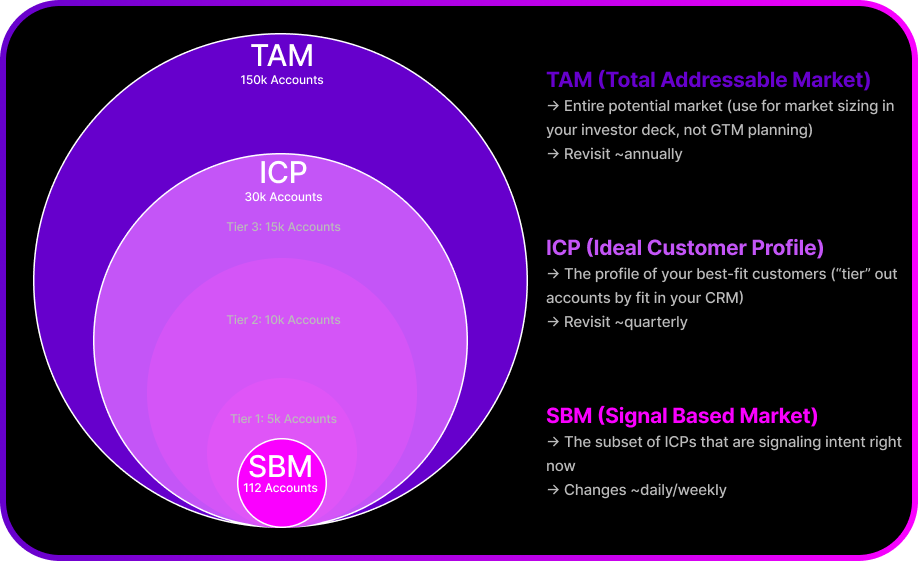
Come up with a stack-ranked list of signals that show buyer intent, for your product.
These are the companies/people who are most likely to say “yes” to a sales conversation if you reach out to them today.
Many of these signals/plays are the same as everyone else (website visitors, champion tracking, new hires, social/public listening, first-party data). And getting easier to build these with modern tools like Clay, Common Room, Pocus, Sumble, Unify, Warmly, etc. (and incumbents like Zoominfo and Apollo).
But the alpha is in the stuff that 99% of other companies aren’t doing (because it’s not relevant to them). When I’m consulting, I cannot come up with these ideas, because I don’t know the business well enough. I’ve noticed the best ideas usually come directly from the founder, or the head of sales, or the top rep. This is my “turing test” for a truly novel outbound experiment.
More on signal-based plays:
4/ AI-generated drafts of emails
You have to customize the prompt to match your style (give it examples). And I recommend trying to get each unique message to generate ‘snippets’ within a message.
Think of these as modular blocks used within a template. Things like:
- Signal-based hook (relevance/timing)
- Persona-based pain + value prop
- Segment-based social proofing.
- Call to action (“offer”) that is not asking for time (give value instead).
Six months ago, I would have said AI is not good enough to write emails. Today, it’s ~basically there. Try it.
But just know: the output will only be as good as the prompt and examples you feed it (garbage in, garbage out).
Tools like Lavender.ai and Octave are great for a more fine-tuned version. Instantly, Apollo, etc. also have baked-in AI copy features baked in now. These are getting better each month.
Claude is my current go-to writing companion.
5/ Reporting/Attribution
Honestly, a nightmare with the current tool stack.
This requires a lot of manual, tedious work to make this happen. For now, try to make it work with your existing dashboards. It’ll be annoying, and won’t work great. But, hopefully MCPs solve this over time.
But it’s the necessary evil. The “ops challenges” are messy right now, but will be solved in-product over time (by the tools). Until then, you need someone who has deep revops chops to be able to truly systemetize this stuff.
This is the area I’m most excited about in 2026. Tangentially, evals, q/a (testing), and feedback loops are the other areas that are very early, but I expect to improve a lot in 2026.
6/ Data orchestration (system of intelligence)
I still believe the most important problem to solve in GTM is choosing the right company and person at the right now (message matters less if you nail timing/pain-point).
I did a dedicated post on this at the end of 2024: The “System of Intelligence”
(I should probably should revisit at some point; @grok remind me to do this in the new year).
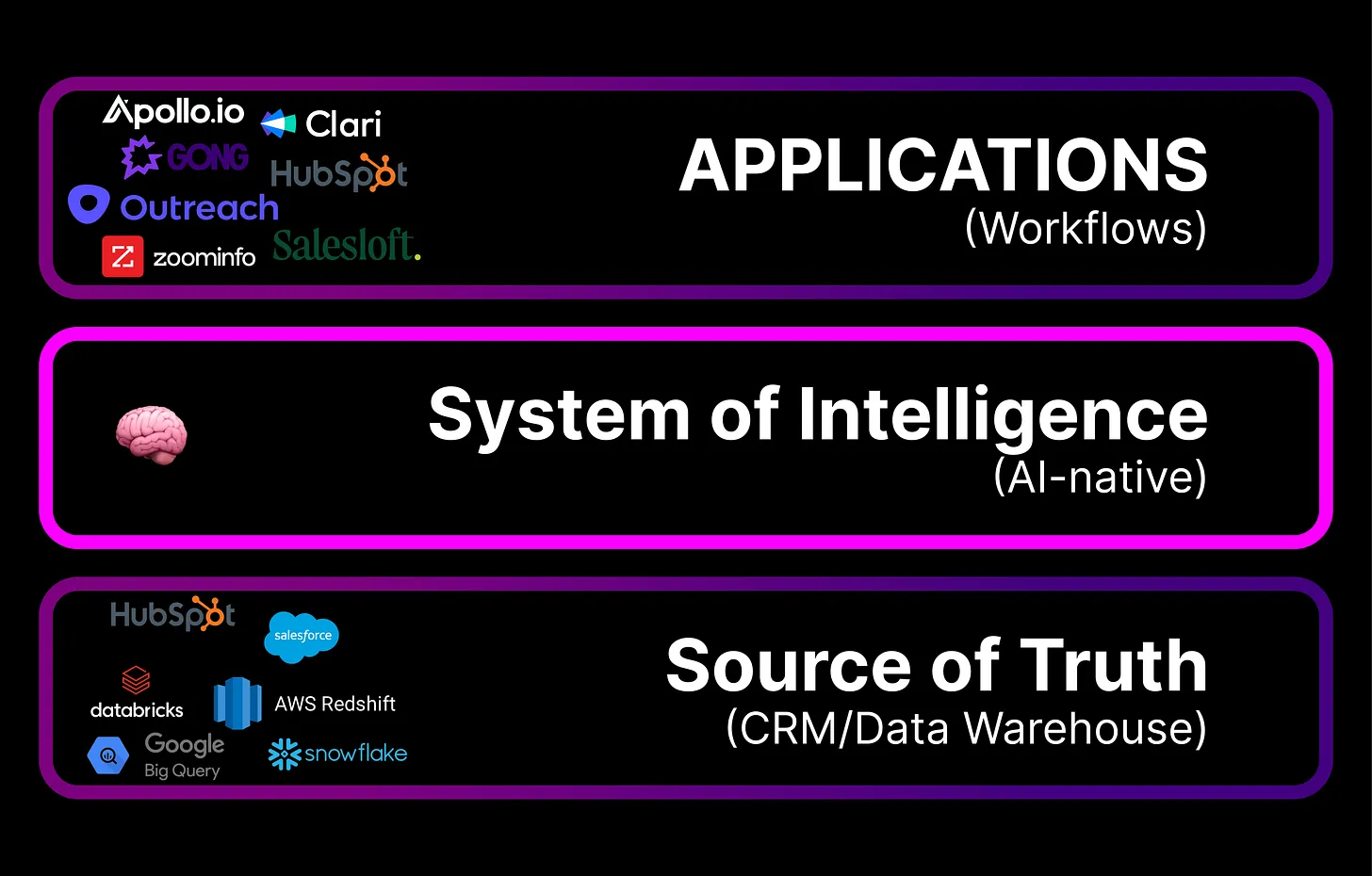
Clay, Actively, and others are trying to become this layer. And other tools too, to a lesser degree (eg: Common Room, Pocus, Unify, etc.).
But you have to have a foundational data strategy if you’re going to build an AI-native GTM system. Otherwise, you’re just running the same 2019 Predictable Revenue Playbook with AI sprinkled on top, which won’t help move the needle.
That’s it!
Those are the 6 areas I’ve seen the most positive outcomes from this year when modernizing your GTM motion for the AI-era.
My favorite pieces of content I consumed this week:
Executives need to roll up their sleeves and ship an agent themselves, or they’ll become obsolete in the age of AI GTM. If you do, you’ll be ahead of 98% of your colleagues (30-second clip by Jasn Lemkin on Kyle Norton’s podcast)
TikTok US, AI GTM Summit, Salesforce Acquisitions, Zoominfo Lawsuit (Thanks to Pranav and Austin for having me on GTMN!)
2025 LLM Year in Review by Karpathy
2026 Predictions by Jason Lemkin, Harry Stebbings, and Rory O’Driscoll
I’m still long (AI-enabled) SaaS
 Cailen D'Sa@cailenJust met a company that vibe coded an entire CRM to avoid paying for HubSpot or SFDC over the last year. It’s now become a burden to maintain and missing key functionality / third-party interoperability as they scale… They’re now migrating to HubSpot. App layer is fine.6:44 PM · Nov 29, 2025 · 389K Views135 Replies · 58 Reposts · 1.31K Likes

As always, thank you for your attention and trust this year—I do not take it for granted.
Happy holidays!
See you next time,
Brendan 🫡
Completely agree on #1. Still see way too many companies stuck on basic demographics (location, industry, employee count). To get started, don't just add MORE data points - add the NON-OBVIOUS ones that actually predict buying behavior. Then you need TWO scoring systems running in parallel: (1) Likelihood to buy score, and (2) ACV/LTV score. Consumption-based vs seat-based changes how you weight #2.
This is a great reminder that ‘AI GTM’ isn’t about writing emails faster—it’s about better inputs, timing, and signals. The tiering + signal-based plays section especially hit.