


If you were forwarded this newsletter, join 5,626 weekly readers—some of the smartest GTM founders and operators—by subscribing here:
Thank you for reading this hand-rolled, 100% organic (anti-AI-slop) farm-to-table newsletter.

Sumble is my favorite GTM technology that I’ve found this year (no joke). It was started by Anthony Goldbloom and Ben Hammer, who co-founded Kaggle (an ML community acquired by Google). They just came out of stealth, announcing a $38.5M fundraise last month. They’re not messing around.
Sumble’s platform uses LLMs and their own proprietary “knowledge graph” to create unique buying signals from company tech stacks, jobs descriptions and people. It has the most accurate and comprehensive tech stack data on the market. If you want to know what technologies your target accounts are using, check them out (sign up for free, and within 2 minutes you’ll see the power of it).
Here’s an example of how you might use Sumble.👇
Go to Sumble.com/the-signal today to get the Pro plan for free for 30 days (use your corporate email).
Hey y’all!
Great to be back with you on this fine Tuesday afternoon!
I have committed to publishing 2x per week here (while increasing the quality of the writing). I’m sharing this so that if you don’t want to receive The Signal in your inbox, no offense taken if you unsubscribe now. And, to hold myself accountable. :)
Grab your favorite beverage and settle in, because we’ve got 1,546 words hand-typed, on a subject that is very near and dear to my heart: signals!
Here’s what we cover in today’s post:
Background on signal-based selling
The great signal divide
The next evolution of signals and signal-based selling
-Alpha
-Niche signals
-1st party signals
-AI/agentic workflowsConclusion
Alright, let’s get into it.
The Commoditization of Signals, and What Comes Next
Background on signal-based selling
Back in November, I was running a company called Groundswell. We started in the PLG/product-led sales space—using product signups/usage as the highest intent signal there is (assuming you have a PLG motion). We never found breakout success (for several reasons that I documented here). Towards the end of our time, we tried to expand our offering to other signals. It was quickly apparent to me that we were entering the territory of the big players (ZoomInfo, Apollo, HubSpot/Clearbit) as well as a few other smaller, but well-funded/smart teams that were starting to work in this space.
Anyway, during that time, I coined the term “signal-based selling.” Actually, I first called it signal-based prospecting, as you can see by my AI-generated image in the first post I published on the topic back in December of 2023: Signal-based selling is the future | The ole’ “Predictable Revenue playbook” is dead.
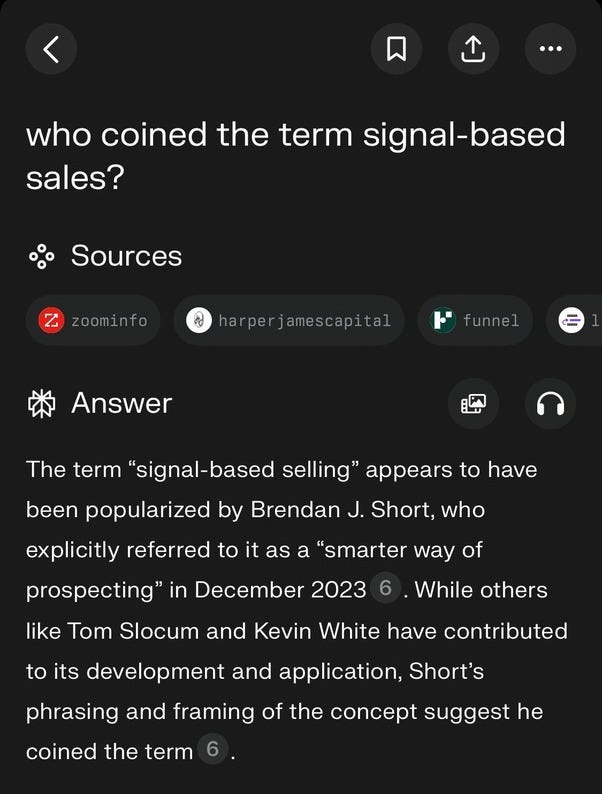
When I started talking about signal-based selling, I started to get a ton of messages from people asking me to explain what I was talking about. And that’s when I knew I had struck a nerve. I had found “message-market fit.”
Since then, several companies have emerged that are built entirely around this concept. And the big guys (Apollo, Clay, HubSpot/Clearbit, and ZoomInfo) have improved and fully adopted signal-based selling, which is cool to see.
But here’s my current take: not all signals are created equal.
The great signal divide
Generic signals—job changes, funding rounds, website visits—are becoming commoditized. Everyone has access to the same data from the same providers. And prospects can smell the automation from a mile away.
Just like back in 2016, it was novel to have Outreach or SalesLoft use “personalization tokens” in an email to inject {first_name}, {title}, {company}, or {industry}. Today, it’s obvious to a reader that a machine, not a human, wrote those.
The same thing will happen with generic signals. In 2026, I suspect that when a prospect sees a cold email that is based on {their new job}, {a website visit}, or {some other generic signal}, they’ll know that a machine (AI), not a human, found this signal and wrote this message.
But here’s my strong belief: niche, specific signals that indicate the right timing to reach out have real staying power. These are alpha. And that’s exactly where the best tools are differentiating themselves.
Signals can determine relevance and timing. And give you a reason to reach out to offer something of real value. But it’s hard to pull this off. Especially at scale.
You first have to build the foundational data layer. Come up with thoughtful signals. And then orchestrate data/signals to operationalize the plays across your GTM engine (systems and people). I know the pain first-hand. Because for the past 12+ months, I’ve spent a good amount of my time operationalizing these signals/plays at Seed-Series C companies that are transforming into AI-native GTM orgs.
The question isn’t whether to use signals—it’s which signals give you an edge, and which vendor can surface the ones your competitors can’t find.
I recently vibe-coded a dynamic comparison matrix for the top nine vendors (based on revenue) in the signal space and which signals they each support. Hopefully, it’s helpful if you haven’t purchased a signal-based selling platform yet.
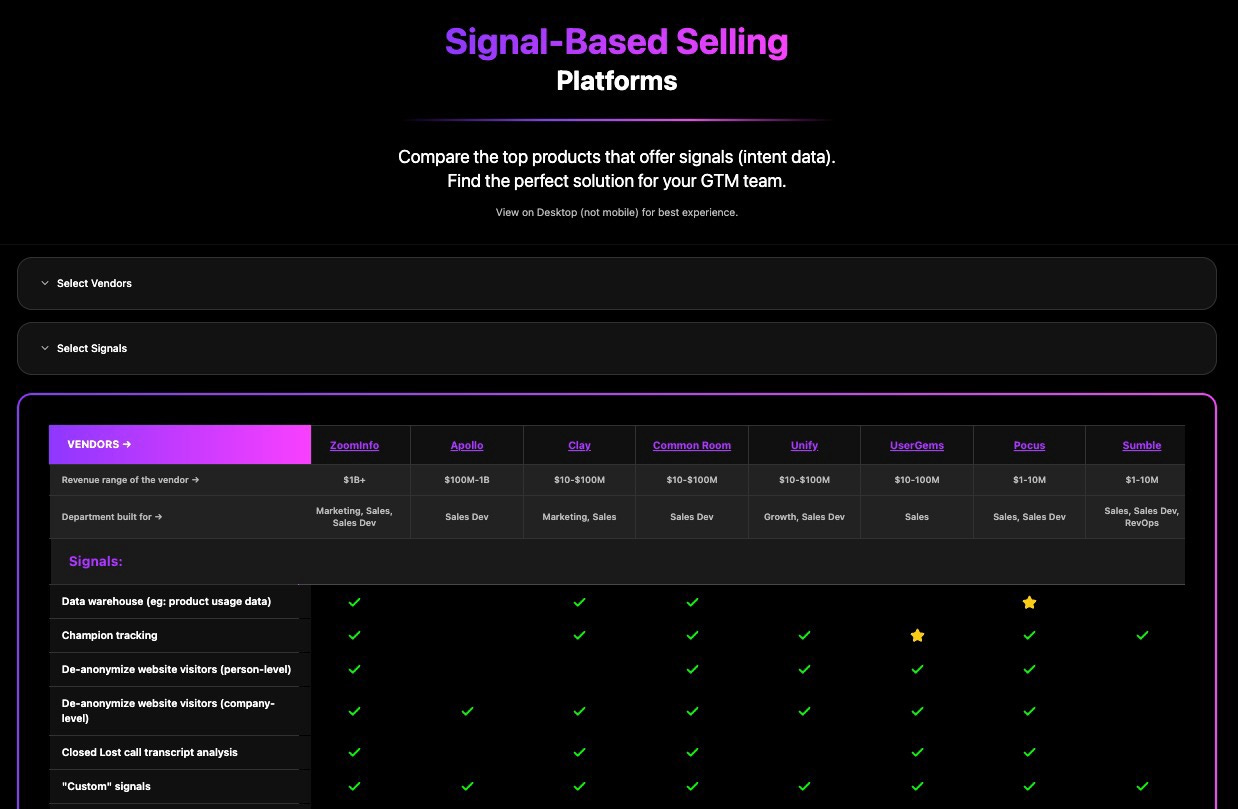
You can poke around this opinionated vendor comparison site here (use the filters!). Let me know what bugs you find or what I should add.
Okay, so what separates the winners?
The next evolution of signals and signal-based selling
→ Alpha
It’s a race to set up signal-based selling systems to gain a competitive edge (and even automate signal-based selling plays).
Looking ahead, how do you stand out once all of your competitors are using and acting on the same generic signals as you?
The alpha is in the creative, thoughtful experiments that only you can set up. And in choosing vendors who can surface signals that aren’t available everywhere else.
You can ideate with ChatGPT on what niche/specific signals your GTM team should test (it’s not bad!). However, I’ve noticed that the absolute best signals are ones so good that AI—or myself, as an external advisor/consultant—cannot come up with them. They have to come from within the company (almost always from either the founder directly or the top sales rep).
→ The more niche/specific, the better
When I ask a founder or top rep what makes a great sales call, they can immediately rattle off the data points that indicate a great company fit and timing. There’s usually something happening inside the org that makes buying right now a no-brainer. One or two concrete things. And here’s the critical piece: none of it lives in their CRM or legacy data providers. It’s what they manually ask on calls or dig up online. It’s very niche/specific to their space. That’s the interesting stuff. That’s the unexplored territory. That’s the alpha.
This is exactly why tools like Sumble are awesome. They use job descriptions to pull out tech stack data (and even determine internal projects, based on JDs). For instance, I used it to find companies with 5-50 engineers, using Pytorch or TensorFlow internally (AI/ML open-source models—indicates an Eng team is building models in-house), and are currently hiring ML/AI engineers.
I believe that these types of “rich data points” and signals have staying power. These types of signals are not relevant for any other company, except maybe some of your most direct competitors. But even then, how you technically find these signals at scale, how you choose to operationalize them, and what you say when you act on them (or having “taste” around how you actually apply these into your go-to-market motion) is going to be the next unlock.
And the companies that figure this out will have staying power in using them because it’s not going to get oversaturated like a signal that says, “Hey, I saw you just raised a round of funding,” or, “Hey, I saw you just started a new job.”
Ideally, these signals indicate good timing.
Here are 20 examples of niche/specific signals that indicate good timing.
→ 1st party signals
It’s also worth noting that some of these signals will be 1st party data. These signals, by definition, cannot become commoditized because they are your own company’s IP.
Obvious 1st party signals include things like product usage, engagement with marketing content, website visitors, closed-lost deals, people engaging with social content, inbound leads that never converted, etc. But again, peeling back the onion one layer deeper will get you ahead as these ‘basic’ signals (even 1st party signals) become oversaturated.
For example, you (or an AI) could review Gong recordings from closed-lost deals (greater than 6 months ago) and find deals that didn’t move forward because of a missing feature that you now have. Go back to them and update them. Plus, some stakeholders from those calls may now be at different companies that are in your ICP. They were fans of your product, so you should also reach out to them at their new companies.
There are lots of 1st party data sources that you can and should be looking at to identify creative and thoughtful signals to find people/companies that are the most likely to have a sales conversation with you if you were to reach out to them this week.
→ AI / agentic workflows
Yes, many of these niche/specific signals require AI workflows or “agent runs” to identify at scale, autonomously. You should be asking what works manually, then scaling it with an automated or agentic workflow (or combination).
Go ask your founder or top sales rep: “If you had 30 minutes, what would you look for online, in our systems, or ask on a call, to determine if the company is a good fit and the timing is right for them to buy?” You’ll learn a lot. It’s usually only one, two, or maybe three signals that you need to start. Once it works, you can scale and operationalize it across your greater GTM motion.
Conclusion
The signal-based selling market is splitting into two tiers: commodity signals that everyone has access to, and niche, timing-focused signals that create real competitive advantage.
The winners will be the teams (and the vendors—like Sumble) who figure out how to surface and act on the signals that actually indicate the right moment to reach out—not just the generic data points that get blasted into every prospect’s inbox.
Thoughtful, creative, taste-driven go-to-market is the future. Teams that proactively deliver real value to their prospects.
I’m excited to see the space evolve and continue to watch as this new go-to-market playbook unfolds right before our eyes. Thanks for being on this journey with me.
Corners of the internet I explored this week:
I came across an old essay (published in 2005) by Paul Graham, called Good and Bad Procrastination. It opens by posing a provocative question: “The most impressive people I know are all terrible procrastinators. So could it be that procrastination isn’t always bad?” One of the core ideas (derived from another talk from 1986) is to ask yourself three questions: 1) What are the most important problems in your field? 2) Are you working on one of them? 3) Why not?
The essay closes with this amazing line:
I think the way to “solve” the problem of procrastination is to let delight pull you instead of making a to-do list push you. Work on an ambitious project you really enjoy, and sail as close to the wind as you can, and you’ll leave the right things undone.
My goal right now is to follow my curiosities. To tinker. To let delight pull me, instead of being pushed by a stuffy to-do list. I hope this curiosity-driven exploration comes across in my words as you read them. And in the best case, I hope it infects you, inspires you, and motivates you to start working on the most important thing you could be working on.
PS: I wanted to crowdsource the spiciest GTM, so I asked: “What’s your most contrarian belief about GTM in 2025? A motion that’s actually working, a role you’re bullish or bearish on, a tool everyone loves/hates, a comp structure—anything.” There were over 150 replies (many of which were very thought-provoking).
That’s it for today.
As always, thank you for your trust and attention—I do not take it for granted.
See you next time,
Brendan 🫡
Seeing this as well at Grafana Labs - the commoditized signals still work assuming you can ‘stack’ them in a way unique to your business that results in a unique POV.