


If you were forwarded this newsletter, join 10,274 weekly readers—some of the smartest GTM operators & founders—by subscribing here:
Thanks for reading this hand-rolled, gluten-free, farm-to-table (human-written) newsletter.

Presented by:

Clay is the infrastructure GTM engineers build on. Start building for free.
& Supported by:

Attention → AI Agents for RevOps.
Clarify → The Autonomous CRM. Sell more, admin less.
Clearskies → The Context Layer for Revenue AI.
Nooks → All your outbound. One AI workspace.
Rox → Revenue Agents for the Global 2000.
Sumble → ML-powered data and account intelligence for AI-native GTM.
Terret → The answer-to-action engine for revenue teams.

The Signal Live Show: Grok Bots for GTM (Thursday, Sept 3rd)
•••
Grok Bots is the latest arrow to add to the (AI) quiver for GTM teams. If you want to learn how GTM teams are using it, come hang with us for our next Live Show (I have something in the works for live attendees that will be special 👀); there are 200+ registered already and I’ll cap it at 400. Save your spot now.
Hey y’all! 👋
I’m feeling energized after spending a few days in SF this week, for an event with Rox, OpenAI, Clay and XBOW, where I got to run some interviews :) I’ll share some of that content soon.
Today’s post explores the rise and fall of the SaaSpocalypse and the nuance of where we go from here. At the end of this post, I’m sharing a few links to things I’ve been exploring (tools, articles, podcasts) that I think are worth your time.
Alright, let’s get into it.
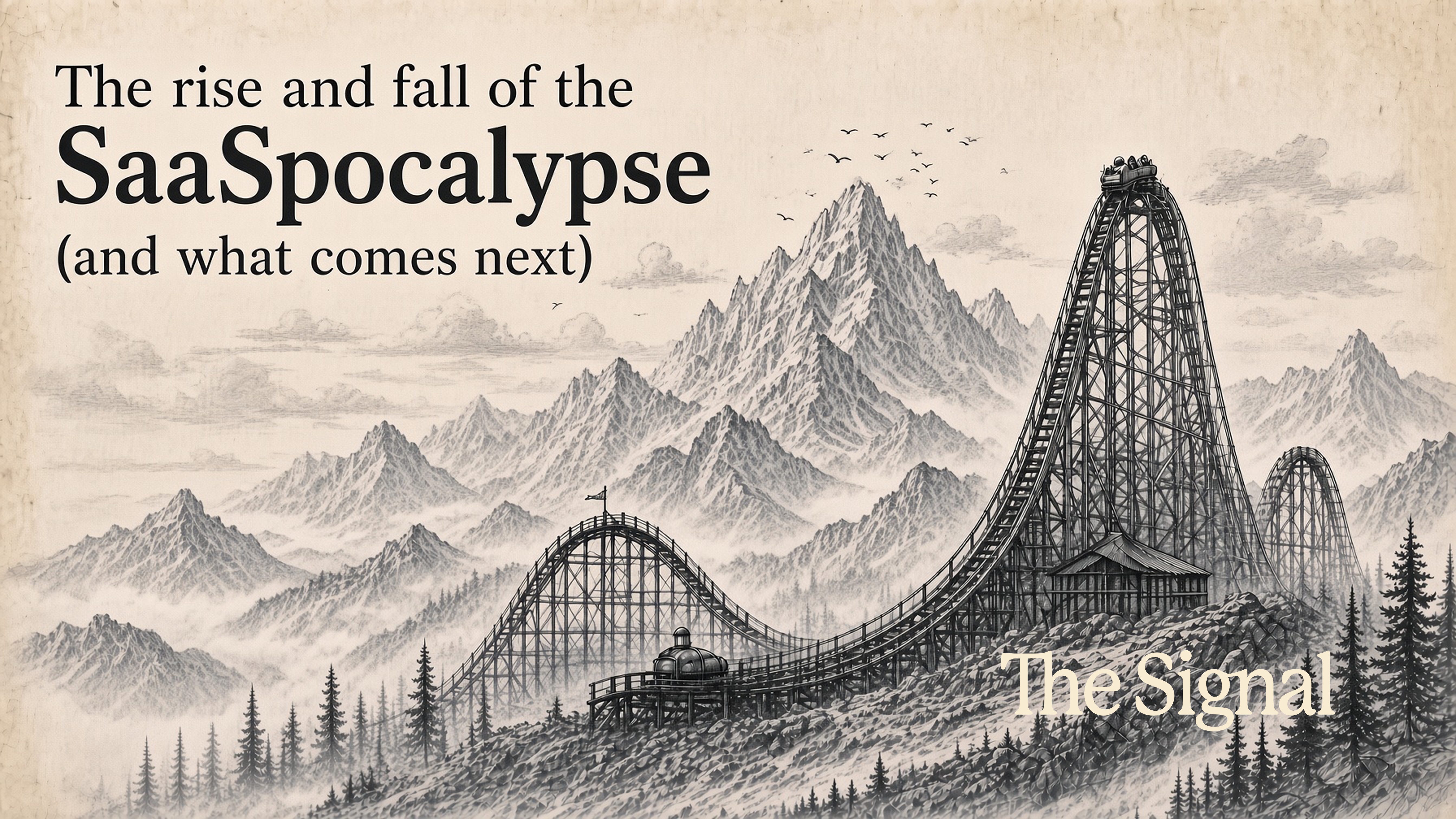
Six months ago, Anthropic shipped Claude Cowork (Jan 12). Notably, it wasn’t a new model. It was an agent for knowledge work.
Then, on January 30th, Ant shipped 11 Cowork plugins (sales, legal, finance, support, etc) and Skills as markdown files.
Four days later the S&P software index dropped 4%, wiping out over $285B in a day (ruh oh… that’s a lot of “churn”). By the end of that week, over $1T (yes, trillion) of software market cap evaporated. Jeffrey Favuzza said there was a “get me out” style sell-off. He went on to say the—now infamous—line: “We call it the SaaSpocalypse.”
The argument was logical. It went something like this: “anyone can vibe code something in a weekend and AI agents are the future.” Remember Satya Nadella’s SaaS eulogy in December 2024?
SaaS businesses are essentially CRUD databases with a bunch of business logic. The business logic is all going to these AI agents.
Even Chamath got back in the arena, launching a company promising to rebuild the enterprise stack at 80% of the features for 90% off. And Sam Altman said we were “entering the fast fashion era of SaaS very soon.” People cancelled a bunch of tools and vibe-coded replacements over a weekend.
Then, this week, this happened…

Turns out, what Bill McDermott (ServiceNow’s CEO) said two months ago was right:
The market thinks maybe I can do everything with a language model and build the software myself. But that’s not gonna happen.
Building software with LLMs is possible. Replacing mission-critical enterprise software at scale is a completely different story. Custom software costs more, takes longer, creates support challenges, and increases complexity. Companies like ServiceNow and Salesforce will integrate AI. They are not being replaced by it.
So maybe “source of truths” are safe. But… HubSpot had its worst day in a decade (down 19%) last week. And Datadog also dropped 19% (but is still up 72% on the year). And of course, Airtable sold to Bending Spoons at a discount (for $1.3B; previously valued at ~$12B).
So, it’s more complex than ‘all saas bad’ or ‘all saas good.’ Just last week, Atlassian also had its best day since the IPO (up 35%), Twilio popped 20%+, as did Cloudflare.
Guillermo Rauch (Vercel’s CEO) recently tweeted something that resonated with me:
The SaaSpocalypse is both understated and overstated. Over because the key systems of record and storage are still there (Salesforce, Snowflake, etc.)
Understated because the software we are generating is more beautiful, personalized, and crucially, fits our business problems better.
I have seen that “generating a first version of an app” is very different from “replacing a product people still want maintained.”
It’s a tale of two cities.
Spencer Skates (Amplitude’s CEO) summarized it well on TBPN:
…on SaaS, the key lesson: the software you’ve already built, that is no longer a moat. Because whether it’s someone vibe coding it, or someone going after it at a company, they can replicate it pretty quickly.
And so the new key moat is speed of innovation.
What the SaaSpocalypse has gotten right is - if you look at the median SaaS company, their innovation has actually slowed to a standstill. It’s crazy how little they ship in terms of net new products.
There’s only a moat if we’re able to deliver the most bleeding edge capability.
If 10 agents can do the work of 100 reps, you can’t sell 100 seats anymore, you can only sell 10. I like how Jason Lemkin put it: “SaaS is being starved, not killed.” And you could even take it a step further, as Tomasz Tunguz posed the question (way back in 2024, before anyone had a name for the crash): “What does a software seat mean when a human is no longer operating the software?”
That is a GTM problem.
Who is the user of SaaS in the AI era? The human or the agent? Both?
If your product only works when a human is clicking around, that is a problem. If your product is something an agent can call (API, CLI, MCP), you just inherited a new buyer. I wrote about this a couple months back: Your next buyer won’t be a human. In it, I wrote:
If your buyer is a person, you send cold emails. You run events. You build inbound funnels. You create content for humans to read, evaluate, and share internally.
If your buyer is an agent, none of those motions work the same way. You’re not going to send a cold email to an AI agent. But you are going to optimize for AEO (agent engine optimization, the next evolution of SEO). You are going to build support documentation that looks very different for an agent versus a person. You are going to build features and tooling designed for agent-first workflows rather than human-first workflows.
There isn’t a conclusion to the story yet. That’s the fun part of this moment in time! :)
We’ve never lived through something like this before. And if you’re you’re building, or taking products to market right now, there’s never been a more exciting time. I don’t know how it all unfolds. But, I do know everything is up for grabs. Everything is changing. Everything is computer AI.
It’s not about “get on the train or be left behind.” But more optimistically it’s “get on the train, it’s so much fun!” I’m bullish on AI. I’m bullish on software. I think the AI era ushers in the biggest boom in SaaS that we’ve ever seen. Not all SaaS will thrive (or survive, for that matter). But much of it will. And those who can navigate this nuance will be the winners of the next decade.
Other corners of the internet worth exploring this week:
Grok Bot for GTM “This is how I use Grok Bot for Enterprise GTM at SpaceXAI.”
2024: Clay is the bleeding edge. 2025: n8n replaces Clay. 2026: Claude Code replaces Clay. 2027: Clay is the bleeding edge. More here and here (I’m writing something on this subject that I’ll publish soon).
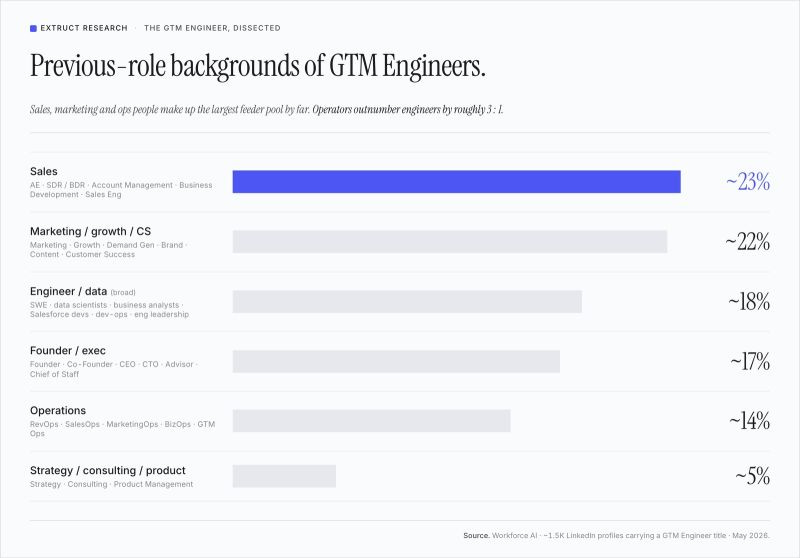
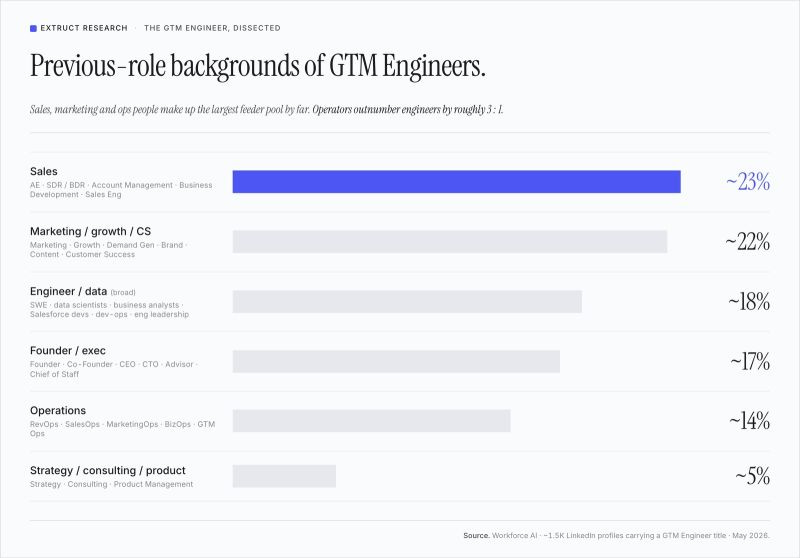
Cool data showing the backgrounds of GTM Engineers (post from Danny Chepenko):
Rox gathered 75 RevOps and GTM Engineers in San Francisco Tuesday night, and I did some interviews (sneak peek here). Bullish on in-person events in GTM these days!
How to stand out in the slopification of the timeline:
 David Senra@davidsenra“Everything seems fake now.” .@lulumeservey on companies paying for retweets on their product launches: “Every launch uses the same slop cinematic video, same template.” “Half of them, you go to the engagement—it's completely fake.” “You can just start to tell that the amount
 David Senra @davidsenraLulu (@lulumeservey) is the best in the world at what she does. She’s the go-to comms strategist for Silicon Valley and many of the top founders in tech trust her. She’s an advocate for going direct, has built a singular career and shares everything she’s learned. 0:00 From3:27 PM · Aug 12, 2026 · 636K Views283 Replies · 132 Reposts · 1.6K Likes


If you enjoyed this post, I’d be grateful if you send it to one person you think would also like it.
That’s it for today.
As always, thank you for your attention and trust. I do not take it for granted.
Have a great weekend, gtm legends.
Brendan 🫡
This is the part people skip when pitching AI in services. Cutting costs doesn't matter to clients if they never see it. I like the fixed-fee point too. It forces savings to actually show up as better service instead of just fatter margins.