


If you were forwarded this newsletter, join 7,624 weekly readers—some of the smartest GTM founders and operators—by subscribing here:
Thanks for reading this hand-rolled, 100% organic, farm-to-table (human-written) newsletter.

Presented by Clay.
Bring AI agents, enrichment, and intent data together and turn insights into relevant, timely action. Start building for free.
& Supported by:

Attention → AI Agents for RevOps
Clarify → The Autonomous CRM
Nooks → Agent Workspace for Intelligent Outbound
Sumble → Buying signals from tech stacks, people data, & active projects
11x.ai → Accelerate growth with a digital GTM workforce

Happy Friday, y’all! 👋
Things continue to ramp up (including Allbirds—yes, the shoe company—pivoting to an AI company and ripping 600% in a day lol). Plus, potentially the biggest day in AI so far this year: Claude, Codex and Perplexity all with massive drops.
Today’s post is a little shorter than usual, and a seed of an idea that I hope to flesh out more over the coming months. Reach out to let me know how you’re building your GTM motion to support AI agents as a new buyer.
ICYMI: Recap of our live event on Tuesday (including ~7 min videos of each of the 6 presentations) → 6 Ways GTM Teams are using MCPs and Claude/Claude Code Today
Six months ago, if you asked me what an AI-native GTM playbook looks like, I would have said: the same motions as 2022, but supercharged with AI. Better outbound. Smarter enrichment. AI workflows for ICP mapping and tiering. A GTM Engineer running workflows instead of an SDR manually copy-pasting from a spreadsheet. Same motions, faster/better execution.
I don’t think that’s the full picture anymore.
The more I build inside Claude, the more I notice something that should worry (or excite) every GTM leader reading this: I’m not buying the way I used to. I’m buying through agents. And I think a lot of your future customers will be, too.
Here’s what we’re covering today:
What “AI agents as buyers” actually looks like in practice
Why the GTM motions themselves change (not just the tools)
Meet your new buyer persona: “AI Agent Amy”
What to build for right now
The asymmetric bet
Let’s get into it.
What “AI agents as buyers” looks like in practice
I use Supabase as my database. I’ve never been to their website. I’ve never requested a demo. I’ve never signed up for a free trial through their marketing site. I discovered it, evaluated it, and started using it entirely through Claude.
Same story with Resend. And a growing list of tools.
And the data backs this up. Lavanya Shukla (formerly Head of Growth at Weights & Biases, now Managing Partner at Improbability.vc) published a piece called The Agent Flywheel that put numbers to what I’ve been feeling anecdotally.
When Claude Code adds email to a project, it picks Resend 63% of the time. It picks SendGrid 7% of the time. SendGrid has been around since 2009. Twilio paid $3B for it. They have a full enterprise sales motion, dedicated IPs, and 15 years of track record. None of that matters to an agent.
Resend launched in 2023 with zero users and now has 500K developers. Supabase went from 1M to 4.5M developers in 12 months. As Lavanya put it, “your product is no longer your UI. It’s your API.”
The companies I keep reaching for are the ones that are most integrated into the agentic workflow I’m already in. They have a robust MCP integration. They have a CLI that actually works. Their API is clean. Their docs are written for machines, not just humans.
I didn’t go looking for these companies. They were surfaced by the tools and workflows I was already building in. That’s a fundamentally different buying motion than anything we’ve seen in B2B SaaS.
Why the motions themselves change
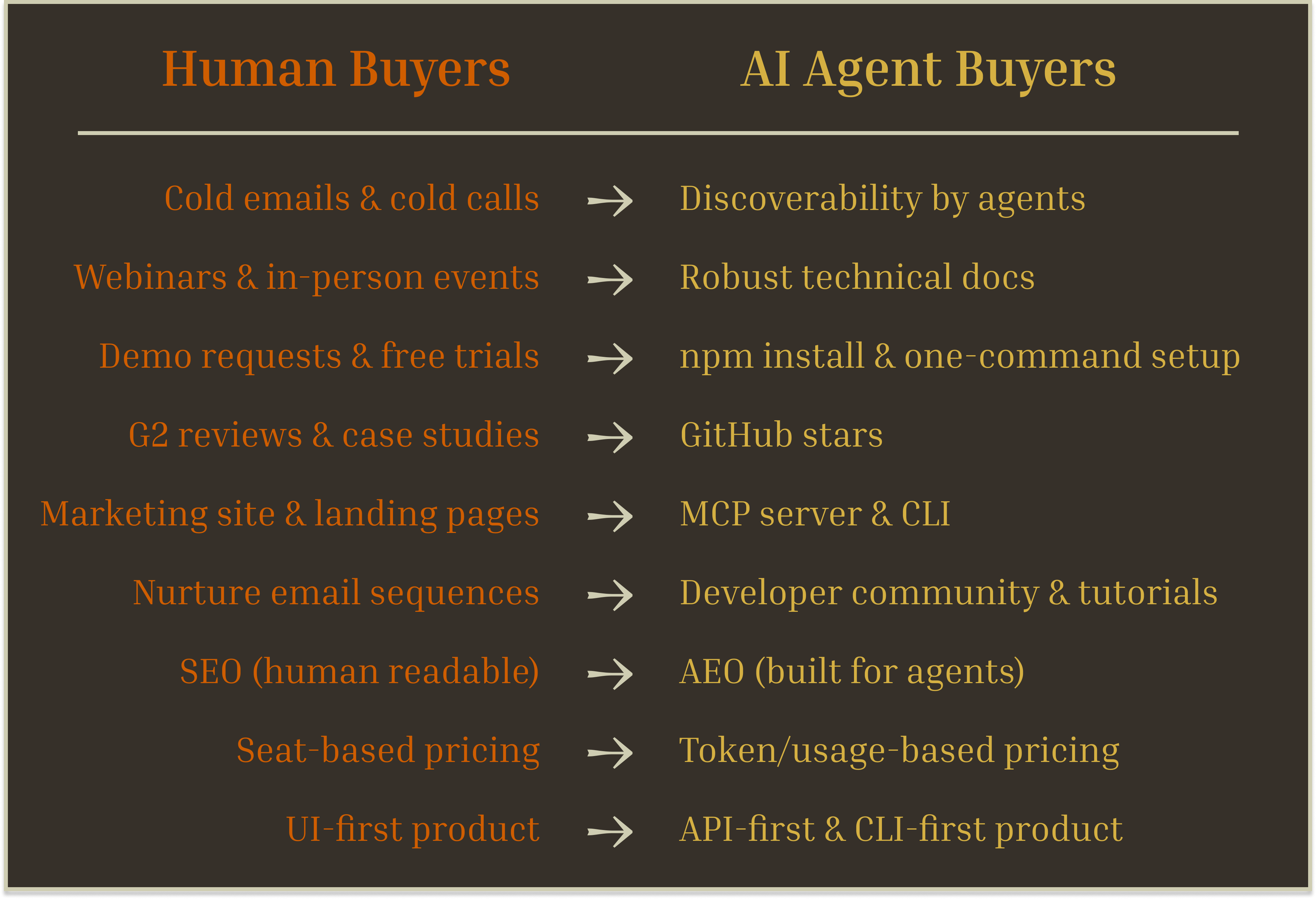
If your buyer is a person, you send cold emails. You run events. You build inbound funnels. You create content for humans to read, evaluate, and share internally.
If your buyer is an agent, none of those motions work the same way. You’re not going to send a cold email to an AI agent. But you are going to optimize for AEO (agent engine optimization, the next evolution of SEO). You are going to build support documentation that looks very different for an agent versus a person. You are going to build features and tooling designed for agent-first workflows rather than human-first workflows.
I should note: I don’t think AI Agent Buyers will fully replace Human Buyers—instead, it will be an additional buyer that GTM teams/workflows will need to support.
Here’s a visual we put together to show this “old world” vs. “new world” evolution:
Meet your new buyer persona: “AI Agent Amy”
Every GTM team has the slide. Marketing Mary. CIO Steve. Personas with names and headshots and buying preferences.
I think every company now needs to add a new persona to that deck. I’ll call her “AI Agent Amy.”
AI Agent Amy doesn’t read your blog posts. She doesn’t attend your webinars. She doesn’t click your nurture emails. But she does evaluate your API documentation. She does check whether you have an MCP server. She does look at your developer community to see if real people are building real workflows on your platform.
Right now, AI Agent Amy might account for 1% of your pipeline influence. Maybe less. The bet is whether that 1% becomes 10% in 12 months. Or 30%. Or more than 50%.
If you believe that agentic workflows are here to stay and growing (I do), then building for this persona isn’t optional. It’s an asymmetric bet with huge upside and very little downside.
What to build for right now
This is early. There is no playbook yet. But the pattern I keep seeing from the companies that are winning in agent-first workflows comes down to a few things:
A world-class API and CLI. Not an afterthought, not a v1 that barely works. The real thing, battle-tested.
Native MCP integrations. If your product doesn’t show up inside Claude, Cursor, or the agentic coding tools your buyers are living in, you don’t exist to this persona. Even Uncle Benioff is going this route (honestly, impressive to see). “Our API is the UI.”

Documentation written for agents, not just humans. This means structured, predictable, complete. Agents don’t skim. They parse. And here’s the uncomfortable truth from Lavanya’s analysis: agents will choose a slightly worse product if it’s easier to implement. From the agent’s perspective, a product it can execute is strictly better than one it can’t. Technical superiority means nothing if an agent can’t figure out how to use you.
Community-driven use cases. The companies winning here have active communities showing how to build real workflows on top of their tools. That’s the new word-of-mouth for AI Agent Amy. And it creates a flywheel: developers who succeed with your product publish their configs, other developers clone them, and your tool spreads across thousands of agent deployments at once. Each cycle makes the next one easier.
The asymmetric bet
I want to be clear: I am not saying AI is going to replace salespeople. I am saying AI is going to replace a growing percentage of buyers. The human on the other side of the deal is still there. But the discovery, evaluation, and initial adoption? That’s increasingly happening through agents and agentic workflows, not through your website’s pricing page.
If you believe that trend compounds over time (like I do), then right now is the time to start building for it. Not that you need to overhaul your entire GTM motion tomorrow, but the companies that start now will have a meaningful head start on everyone else in 12 months.
Andrej Karpathy said it best:
“It’s 2026. Build. For. Agents.”
If you’re building new, creative GTM approaches specifically geared toward AI agents as a buyer persona, I want to hear about it. Reach out. I’d love to showcase what you’re building in the coming months.

As always, thank you for your attention and trust. I do not take it for granted.
Other nuggets from the week:
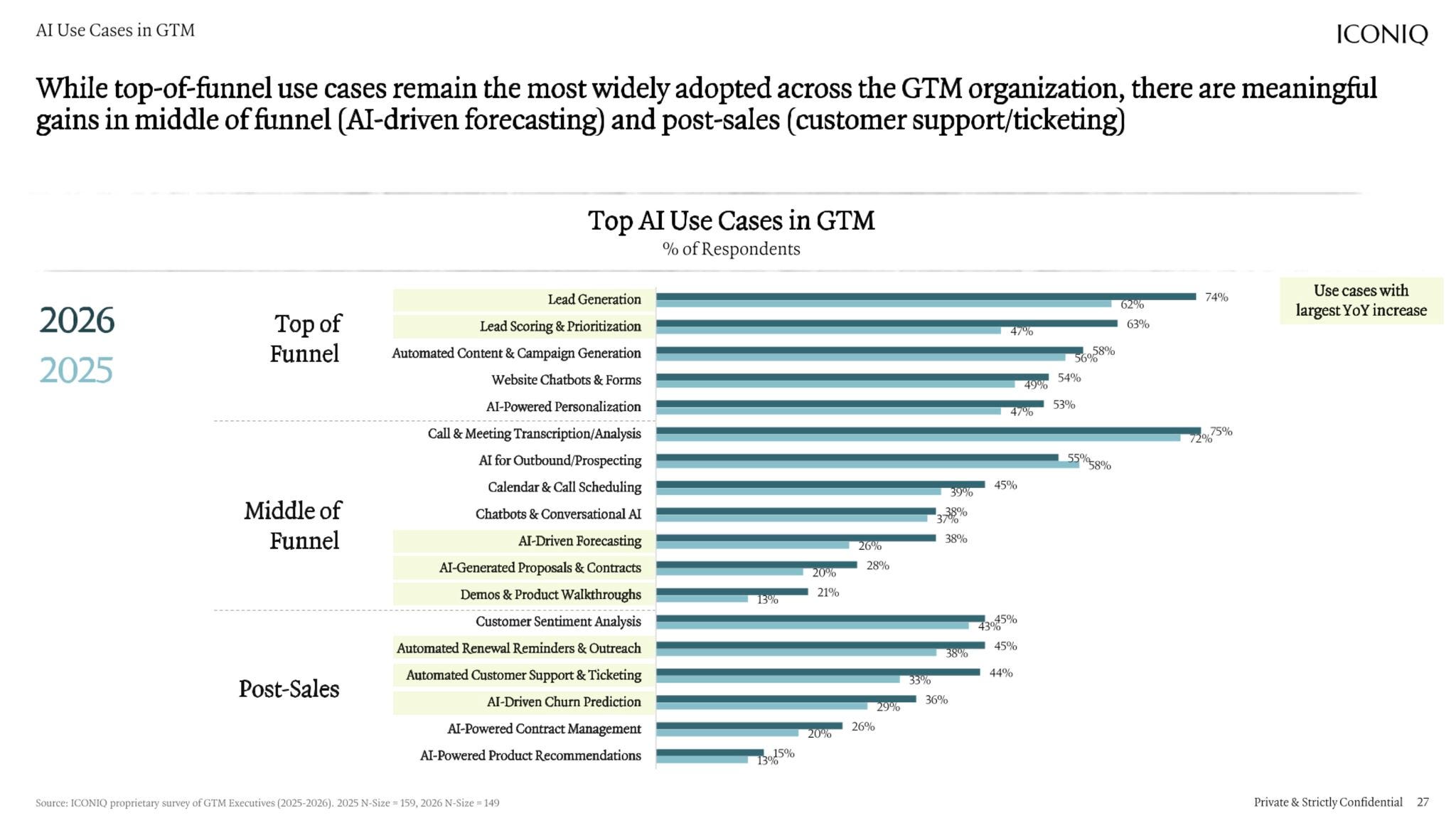
Kyle does it again, arguably the most AI-native CRO on planet earth: What World-Class AI in GTM Looks Like
Bret Taylor of Sierra on AI agents, outcome-based pricing, and the OpenAI board - on Cheeky Pint (with John Collison, co-founder of Stripe):




Have a great weekend!
See you next week,
Brendan 🫡