


If you were forwarded this newsletter, join 11,677 weekly readers—some of the smartest GTM operators & founders—by subscribing here:
Thanks for reading this farm-to-table, 100% organic (human-written) newsletter.

Presented by:

Clay is the infrastructure GTM engineers build on. Start building for free.
& Supported by:

Attention → AI Agents for RevOps.
Clarify → The Autonomous CRM. Sell more, admin less.
Clearskies → The Context Layer for Revenue AI.
Nooks → Revenue infrastructure for reps and agents.
Rox → Revenue Agent for the Global 2000.
Sumble → High precision GTM data + intelligence.
Terret → The answer-to-action engine for revenue teams.
As a solopreneur, I started working more with agents at the start of 2026. A few months ago (largely thanks to becoming Grok Bot-pilled), I started seeing agents as co-workers.
It went from “I’m using AI to do a task” to “the AI is doing the task for me.” From reactive helpers waiting on my prompt to proactive workers (with tools) executing on my behalf.
And I wanted to explore this transition in the context of a large B2B GTM org. Which jobs go to agents? Where does one start? What are the variables to decide how to delegate work?
So, Adam Schoenfeld (of Adam’s GTM Report) and I developed a framework to answer exactly this question: Where should agents work in your GTM org? The matrix will evolve (and we’d love your feedback!) but I think GTM leaders, and ICs, will find it useful.
Here’s what we’ll cover today:
The GTM Agent Jobs Matrix
The agent maturity ladder
When to skip the ladder
Going deep on one example job: deal execution
How to get started this week
Let’s get into it.
The GTM Agent Jobs Matrix
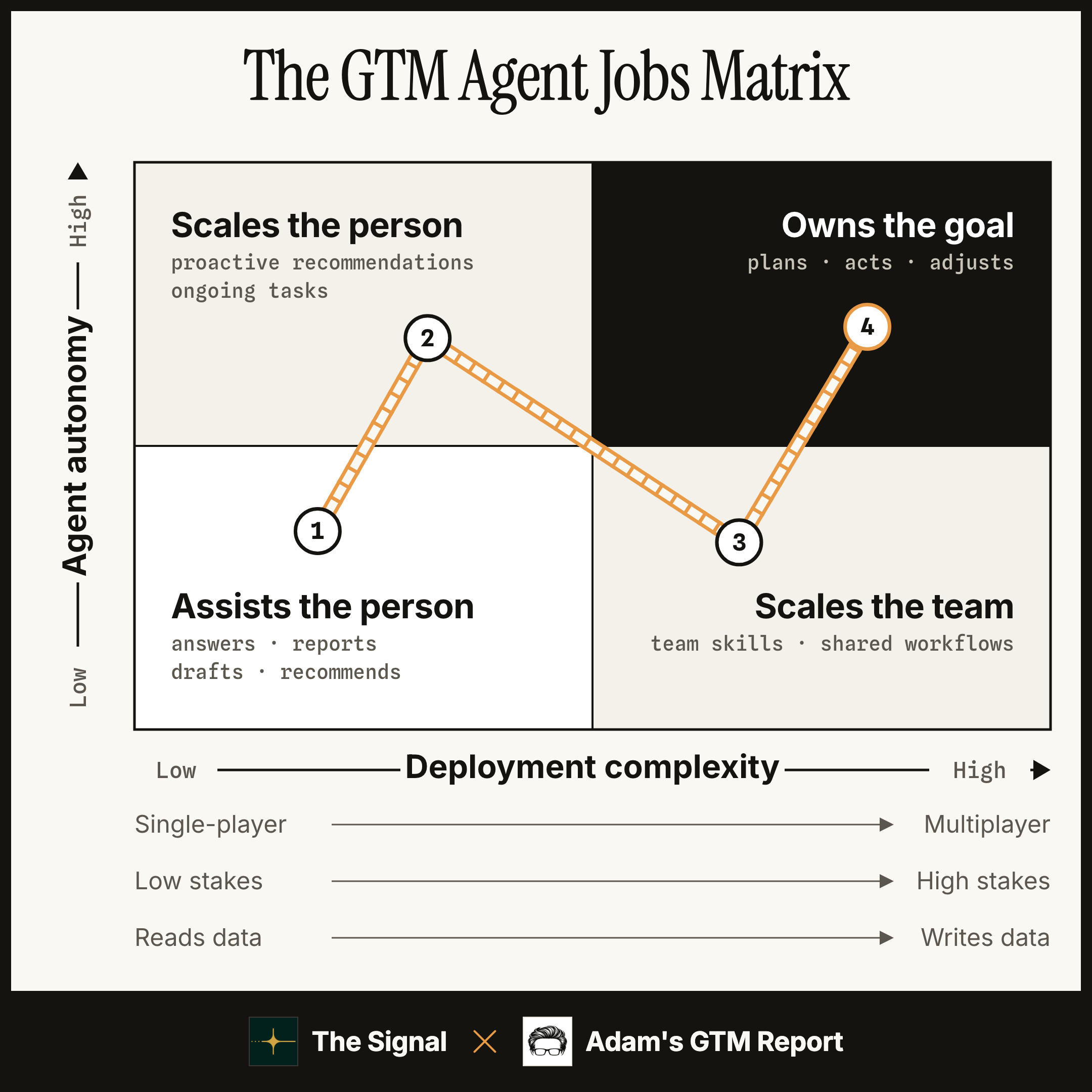
The Y-axis is agent autonomy: how much the agent decides and does on its own.
The X-axis is deployment complexity, defined by three things: 1) single-player vs. multiplayer, 2) low vs. high stakes (what a mistake costs), and 3) read vs. write access (whether it only reads your systems or can change data).
The four quadrants are:
Assists the person: You ask and it helps. You find what works and then you do the work yourself.
Scales the person: What works runs on its own after every call (or at night), and suggests your next move.
Scales the team: What works for one person becomes skills and workflows the whole team uses.
Owns the goal: The agent does the work itself, up to owning a goal/outcome.
The agent maturity ladder
Most people look at a 2x2 and assume up and to the right is the goal. “Owns the goal” is the most powerful quadrant, but the riskiest place to start. An agent running your paid media or enterprise deals is a mistake if your org hasn’t earned its way there for that specific job.
I think of the matrix as a ladder. Usually, each job climbs the four quadrants in order, one rung at a time: 1) prove it with a human checking everything, 2) let it run for one person, 3) roll it out to the team, 4) then hand it the outcome and let it do its thing (full agent autonomy).
🔔 Join The Signal’s Live Show tomorrow: Friday Nov 20th—Adam Schoenfeld is coming on at 9am PST to talk through our framework live! Streaming on 𝕏, YouTube, and LinkedIn Live.
When to skip the ladder
Not every job needs to start at the bottom.
The cost of a mistake determines how quickly you might move up to the top right quadrant. (By the way, certain jobs will never get to the top-right, and that’s okay.) Example: an inbound AI SDR for your SMB segment. Those leads are low value one by one, and in a lot of GTM teams, nobody’s working them at all (or they’re worked slowly/poorly). An okay agent replying in 30 seconds beats nobody replying for two weeks. Errors are cheap here, so you could jump straight to the top-right for an inbound AI SDR for your SMB leads. Your enterprise leads… you still want the human very-much so in the loop (eg: like Drew, GTM Eng Leader at Vercel said on X yesterday).
So: if errors are cheap and no human is doing the work today, jump straight to high autonomy. If it’s work your reps already do well, or the mistake cost is high for something, then climb the ladder one rung at a time.
Usually you’ll start at the bottom-left. And most of the jobs touching revenue (prospects) directly fall in this bucket. Deal execution is a good example.
Going deep on one example job: deal execution
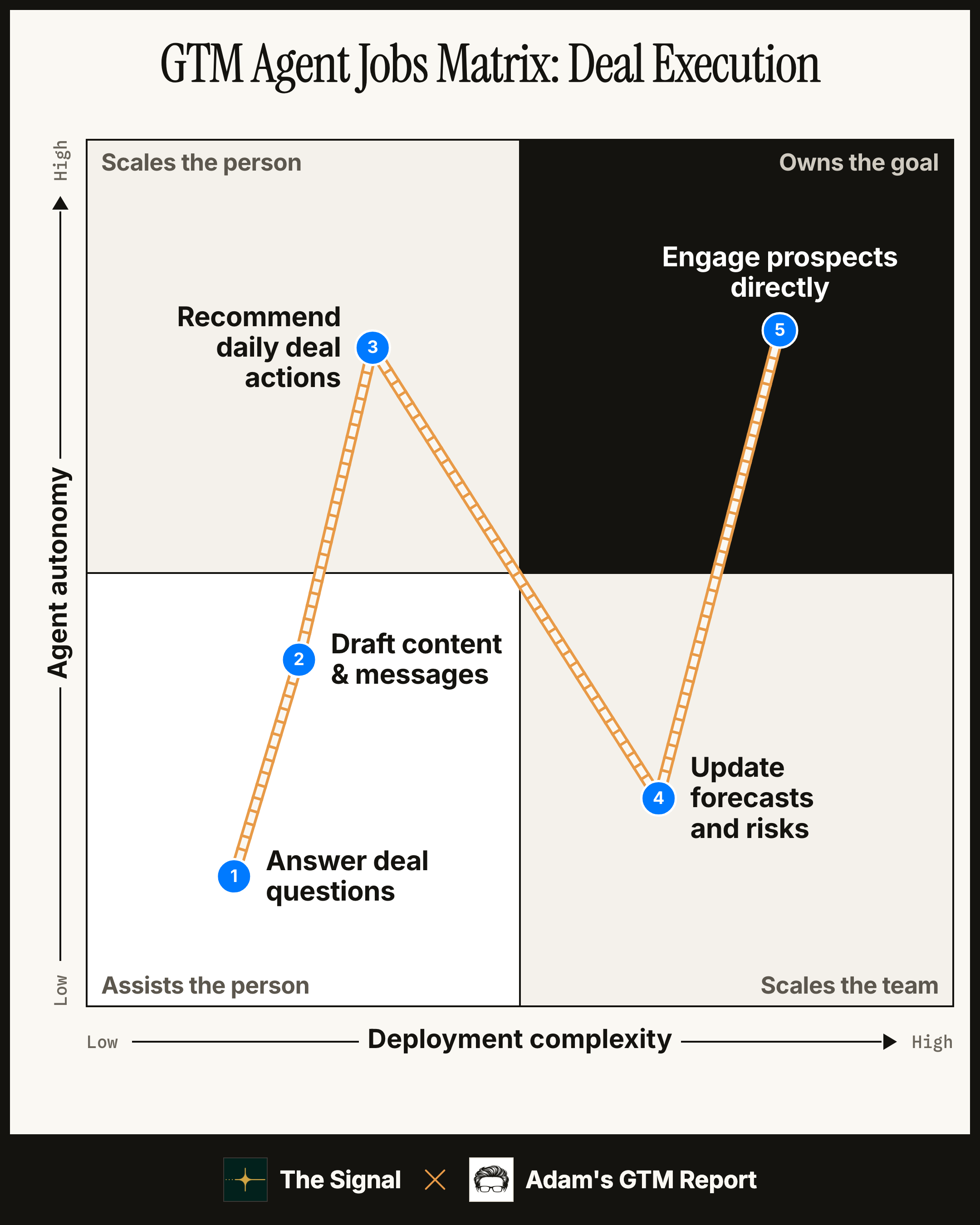
Deal execution is high stakes and your best AEs already do it well, so start small and climb the ladder over time. One path might look like this:
Answer deal questions (assists the person). The agent answers the rep’s questions from the CRM, calls, and emails, with sources. Think: ChatGPT connected to your tooling via MCPs. These are all internally-facing content (for the rep to look at)
Draft content and messages (assists the person). Decks, proposals, and follow-ups using CRM data, calls/slack, and your context layer. This is externally-facing content, but the reps reviews everything manually before sending.
Recommend daily deal actions (scales the person). Every morning it recommends next steps, preps meeting briefs, and flags at-risk deals. Basically steps 1 and 2, but autonomously (proactive).
Update forecasts and risks (scales the team). After every call it updates CRM fields and flags risk. Managers still make the forecast call, because the board reads it. But everything that’s been proven by the individuals is now scaled across the team.
Engage prospects directly (owns the goal). The agent works the buyer in the rep’s name between meetings: answering questions, following up, booking meetings. There is very little of this in enterprise sales today, but it exists in other places (like an inbound AI SDR in the SMB segment).
You’ll notice the ladder dips between scaling the person and scaling the team. That’s by design. Every time you deploy an agent, it has to re-earn trust before you scale it. One rep might trust an agent to run their morning brief. But when it’s writing to the CRM for 50 reps and feeding the forecast your CRO takes to the board, you better believe a human is going to be back in the loop to prove its reliable, before letting it run autonomously at scale.
As we talked about in Tuesday’s post on micro-campaigns: only automate something once it’s working manually.
Like... what does your best rep send after a sales call that works? Great. Now have that generated after every call. That works? Great. Now roll it out to the whole team.
Three more ladders (as examples).
Each example shows a “ladder” to go from low-risk “assistants” to higher-complexity, autonomous agents. We want to keep expanding with your feedback. Below are the other three we have built out so far.
Paid media (7 steps). Drafting ads, then analysis, daily optimization recs, and creative refreshes. The team step is shared audiences, where ops approves lists because a missed suppression can reach customers. The top-right owns the budget.
Outbound SDR (6 steps). Prospect research, then daily emails for approval. The team step is picking every SDR’s accounts from signals, where a bad signal wastes every rep’s day. Then replies, volume sending, and owning the meetings target itself.
Inbound SDR (5 steps). Drafting replies, then prepping every new lead. The team step is qualifying and routing, where a wrong route leaves a hot lead waiting. Then answering, booking, and selling, and finally owning the inbound target.
We’re going to map out more jobs, so if there are any in particular you’d want to see, reply to this email and let me know!
How to get started this week
Pick one job, not ten (don’t try to boil the ocean). Pick one that moves your number (eg: if you don’t have tons of inbounds, you shouldn’t work on an Inbound AI SDR… duh).
Think about whether the area of the business is high stakes or low stakes. Cheap mistakes and nobody doing it today? Go high autonomy. Otherwise, start bottom-left.
Start from what works manually. What your best rep is doing manually, and finding success with, is a great great place to start.
Climb one rung at a time. As you scale, it’s okay to have a human-in-the-loop again (expect “the dip”). That’s normal.
Map your own ladder. Yours will look different from ours. These are just some examples to get your juices flowing.
Here is a (non-exhaustive) list of other jobs you can hire agents to consider:
Assists the person.
Draft replies for an SDR to send.
Prep an AE before each demo.
Draft custom decks for AEs.
Generate a forecast for sales managers.
Scales the person.
Research & enrich new leads.
Run live roleplays for sales training.
Scales the team.
Review & route inbound leads.
Update the CRM from sales activities.
Owns the goal.
Launch signal-based outbound end-to-end.
Qualify & book inbound leads (AI SDR).
Conclusion
I’m super bullish on agents in GTM (probably everyone is). But most of the industry is racing to deploy as many agents as possible, as fast as possible. The teams that I’m seeing actually get results are the ones who focus on the most strategic part of their business first, and work their way up the ladder of maturity.
This framework will keep evolving, and Adam and I want to hear where it breaks for you. Reply and tell me which jobs we placed wrong (or what’s missing). I want to hear what’s working in November of 2026.
That’s it for today.
Again, join The Signal’s Weekly Live Show tomorrow at 9am PST; we’ve got another epic line-up for y’all (including Adam to jam on this framework). Streaming on 𝕏, YouTube, and LinkedIn Live.
As always, thank you for your attention and trust. I do not take it for granted.
See you next time,
Brendan 🫡
PS: If you liked today’s post, send it to one person who would enjoy it.