


If you were forwarded this newsletter, join 11,641 weekly readers—some of the smartest GTM operators & founders—by subscribing here:
Thanks for reading this hand-rolled, grass-fed, 100% organic (human-written) newsletter.

Presented by:

Clay is the infrastructure GTM engineers build on. Start building for free.
& Supported by:

Attention → AI Agents for RevOps.
Clarify → The Autonomous CRM. Sell more, admin less.
Clearskies → The Context Layer for Revenue AI.
Nooks → Revenue infrastructure for reps and agents.
Rox → Revenue Agent for the Global 2000.
Sumble → High precision GTM data + intelligence.
Terret → The answer-to-action engine for revenue teams.
📣 We’re finalizing 2027 sponsors; reach out if you want to learn more.
Back in October 2024, a new approach to outbound blew my mind. It was the most surprising thing I had seen in all of my consulting work: small, weird, hyper-targeted campaigns that were actually generating pipeline. I came up with a name for this approach: micro-campaigns.
This week I was explaining them in a talk at Demand Day, and I realized how much this wild strategy has changed since I published the concept—after all, 2 years is 2 decades in dog AI years. The gap between unsuccessful outbound teams and successful outbound teams is getting wider every day.
So, today’s post is a 2027-ready update with everything you need to know about micro-campaigns: how to scale outbound in a way that actually generates (quality) pipeline.
Here’s what we’ll cover:
More emails, fewer replies: A tragedy
How micro-campaigns could 100x your meetings-booked rate
The 3 parts that make a great micro-campaign
How to segment your market in 2027
Three case studies (from my personal experience)
How to run your first micro-campaign this week
Using AI to increase quality, not quantity
Let’s get into it.
More emails, fewer replies: A tragedy
Generating pipeline is harder than ever before.
Reps now send about 140 emails a day, up from 40 in 2016. Reply rates have dropped—like NVIDIA’s stock price recently—down from 8% to about 1% (if you’re good).
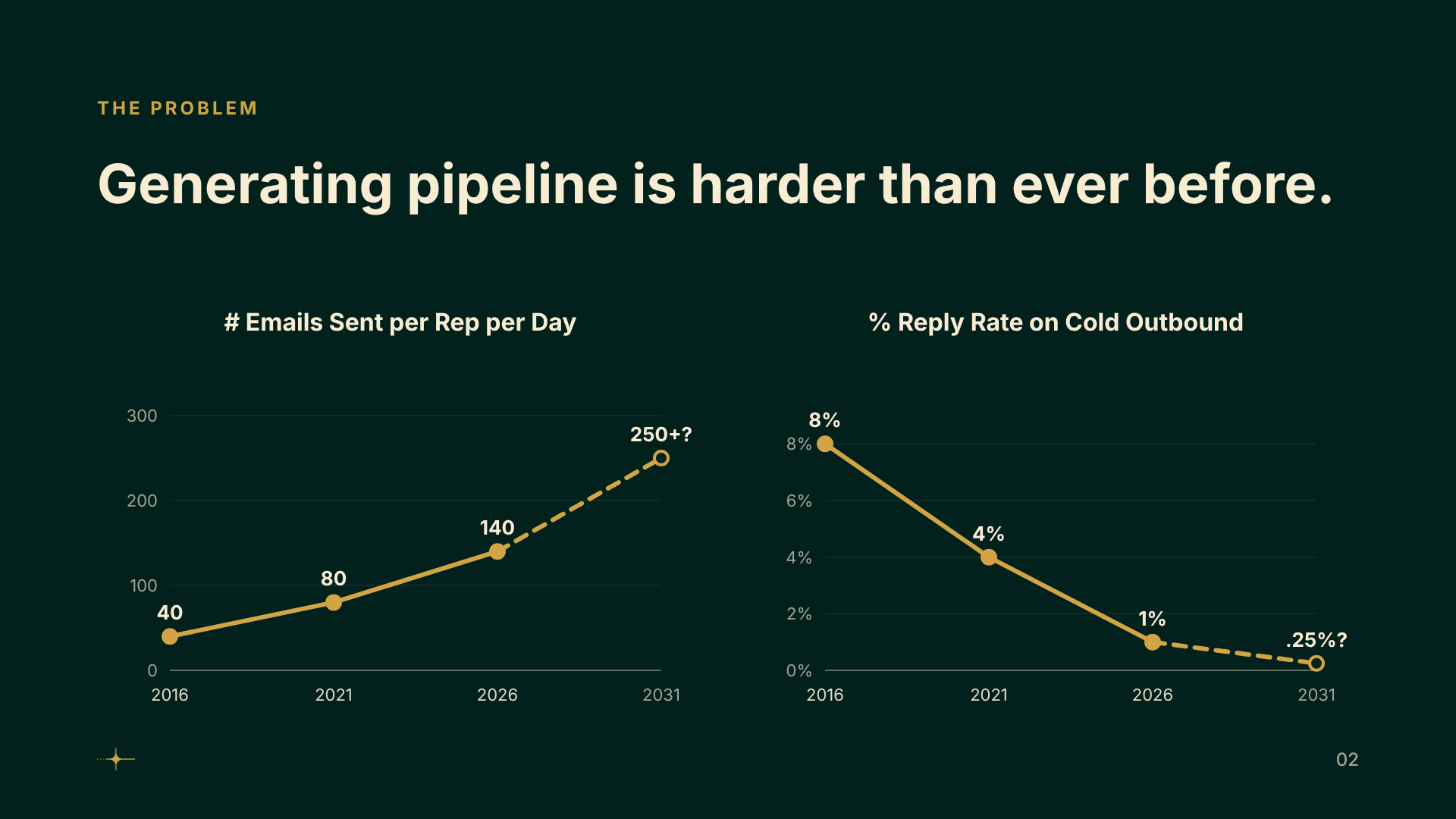
Most teams are trying to solve this problem by increasing volume. More sequences, more inboxes, more AI pErSoNaLiZaTiOn, more AI SDRs. Which pushes reply rates down further (for the whole industry) and forces volumes to increase even more. It’s a vicious cycle. And if the trend continues (and I suspect it will), we’re heading toward something like 250+ emails a day per rep, and a sub-0.25% reply rate, by 2031.
All of this is downstream of a broken approach to list-building.
And that’s how you get the slow death of the Predictable Revenue playbook. The solution is not increasing the quantity of outreach. Instead, the goal should be to increase the quality of your outreach.
How micro-campaigns could 100x your meetings-booked rate
So, what’s the alternative? Well, this is the approach that blew my mind back in 2023 and 2024. The best companies were running a totally new playbook: small lists, filtered by rich data points (that you can’t find in a B2B database), and timing signals (usually from custom-built AI/agents).
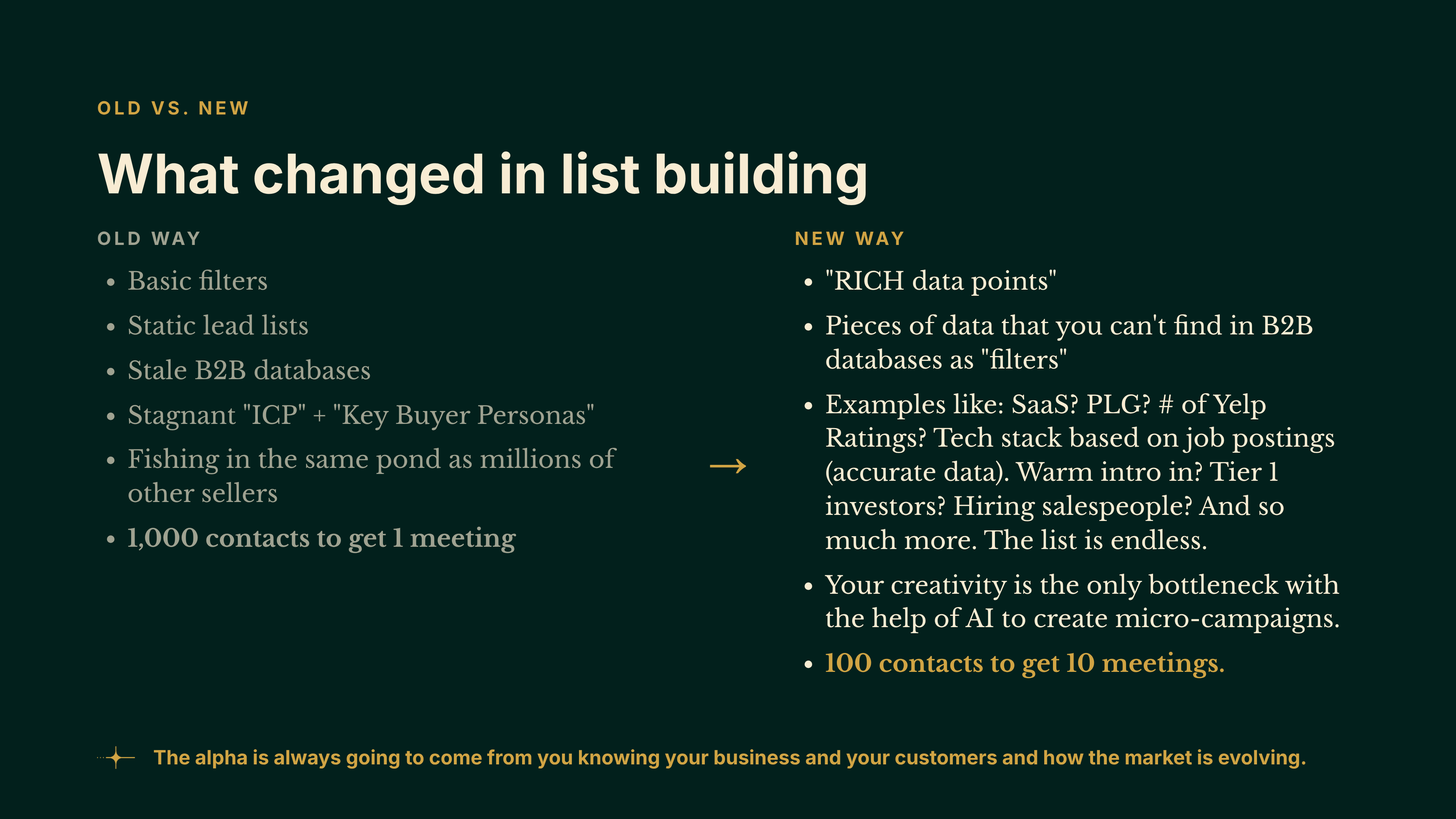
The old way of building lists: basic filters, static lead lists, stale B2B databases, a stagnant “ICP” and “key buyer personas” slide, and fishing in the same pond as millions of other sales teams. The old way: reach out to ~1,000 contacts to get 1 meeting.
The new way: “rich” data points you can’t find in a B2B database, used as filters. Is the company SaaS? PLG? How many Yelp ratings do they have? What does their tech stack look like based on their job postings (far more accurate than any database)? Do you have a warm intro in? Tier 1 investors? Are they hiring salespeople? The options are endless. With AI, your creativity is the only bottleneck. The new way: reach out to ~100 contacts to get 10 meetings.
AI can (and should) scale your experiments. But the leverage is in you—the human—having the taste, discernment, and creativity to think of and choose the right experiments to run. The alpha is always going to come from you knowing your business, your customers, and how your market is evolving.
The 3 parts that make a great micro-campaign
Technically, you could call any small campaign a micro-campaign. But when I coined this term, I could tell that the ones that worked always had 3 key elements:
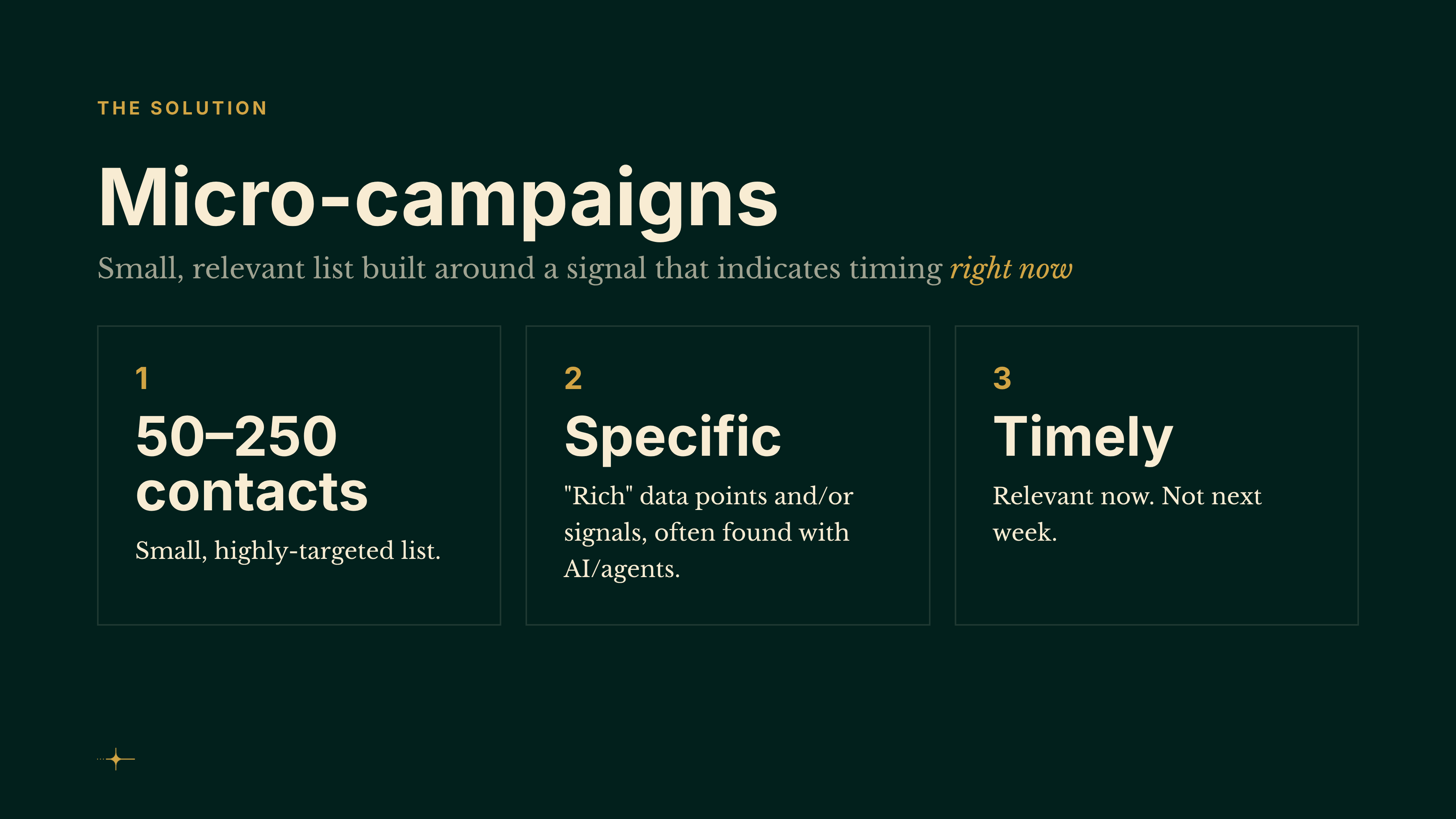
Small: If you don’t have this, it’s not a micro-campaign. I generally say 50-250 contacts.
Specific: A random list won’t work. The group should be selected based on very detailed filters, “rich” data points, and buying signals. (Again: These won’t be default attributes in your basic B2B database - you’ll usually have to purchase unique data sets or build them yourself with manual research or AI/agents.)
Timely: Each list is relevant this week. That means it might not be next month.
How to segment your market in 2027
Most teams plan around two slices of the market. I recommend adding a third. And I’ve even developed my own term to explain it: your Signal-Based Market. This is basically a clearer way to apply that old idea that 3% of your market is actively buying at any given time (I think this old B2B sales proverb comes from… Mark Twain? Okay… it was actually Chet Holmes in The Ultimate Sales Machine).
TAM (Total Addressable Market): the entire potential market. Use it for market sizing in your investor deck, not GTM planning. Revisit it about once a year.
ICP (Ideal Customer Profile): the profile of your best-fit customers. “Tier” out accounts by fit in your CRM. Revisit it about once a quarter.
SBM (Signal-Based Market): the subset of your ICP that is signaling intent right now. This slice changes daily or weekly.
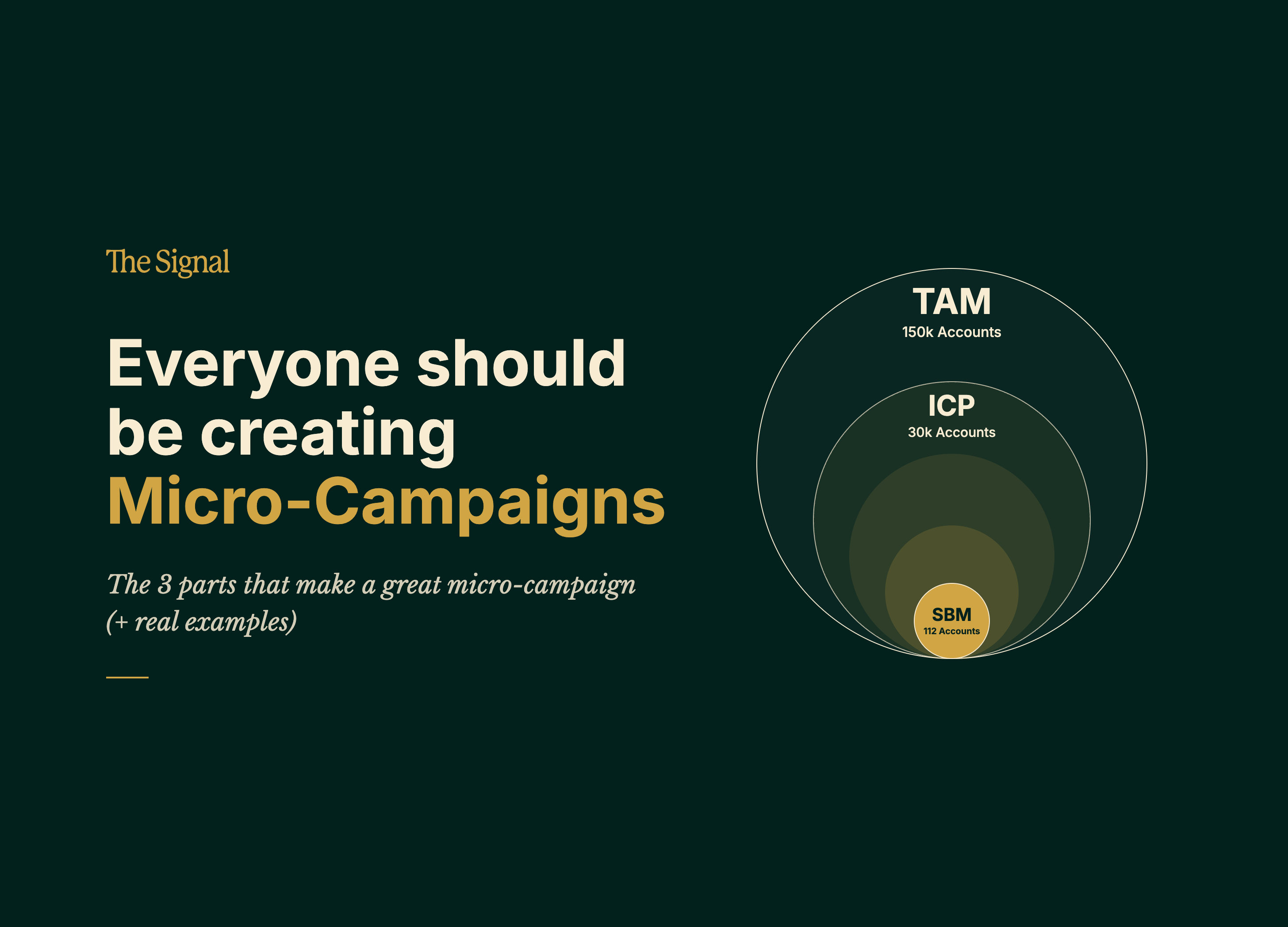
In the example below, a 150k-account TAM narrows to a 30k-account ICP, split into three tiers. The SBM is 112 accounts.
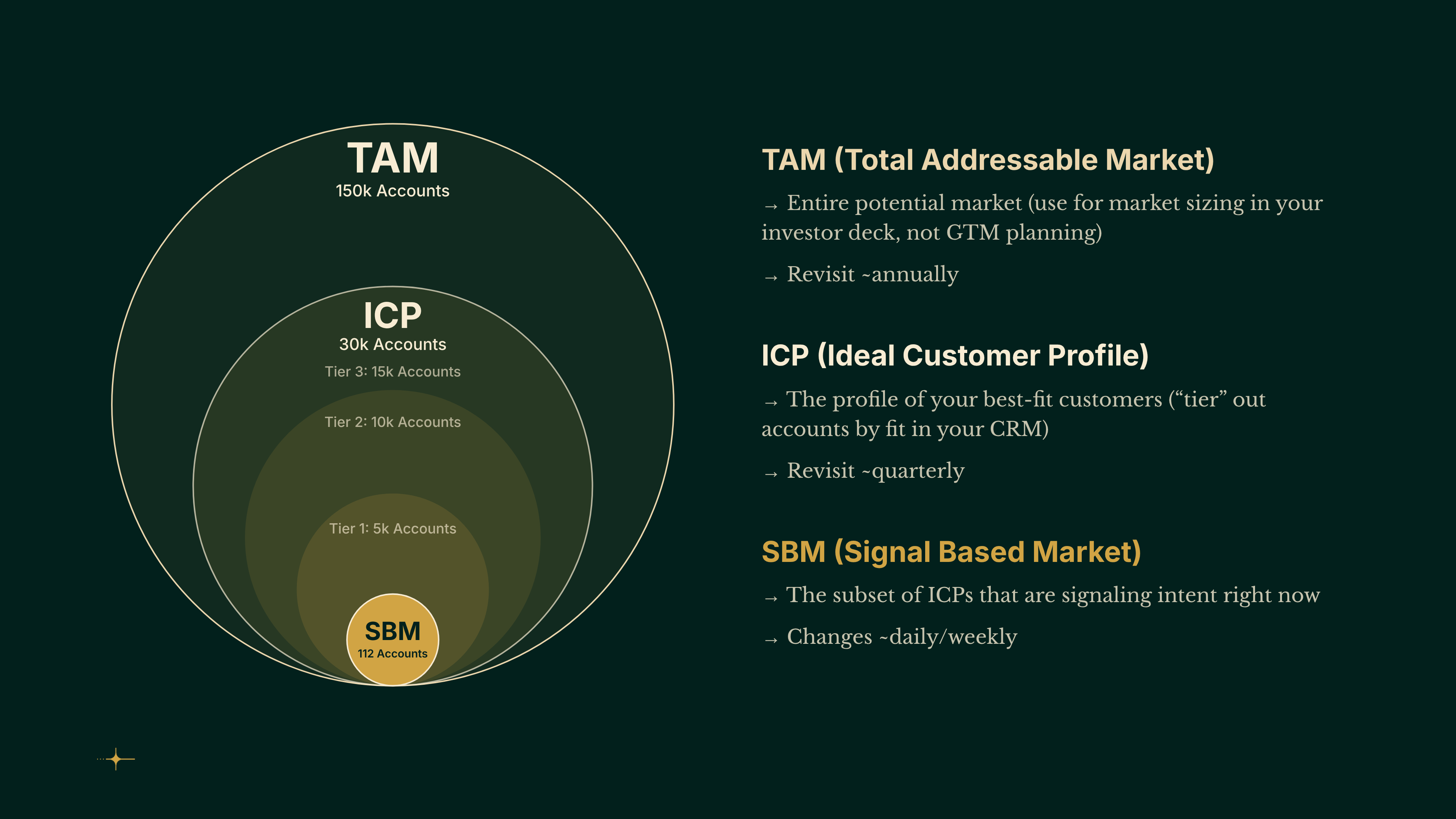
Another way to think about this: Your TAM tells you who could buy. Your ICP tells you who should buy. Your SBM tells you who wants to buy right now.
People in your SBM are most likely to take a sales conversation this week (if you reach out). Micro-campaigns are how you engage your SBM.
Three case studies (from my personal experience)
Want to see how much more effective targeted outreach is? Let’s walk through a few real-world I’ve seen.
Example 1: Buying a used Tesla
If I’m in the market for a used Tesla and someone sends me a generic, non-personalized email, text, or call about a bunch of used Teslas that just arrived at a lot near me in Austin, I’m going to say ‘yes, I’ll come check them out.’
The inverse is also true. If I’m not in the market for a used Tesla, someone can send me the perfect email. Mention our common connections. Recommend the best restaurants in Austin. It doesn’t matter how personalized it is. I’m not going to the car lot (because I’m not in the market for a used Tesla).
Relevance is 10x more important than “personalization.” You have to get the timing right. Most outbound gets this backwards: all the effort goes into the message. Because AI has created a “personalization easy button.” And not nearly enough time, thought, and tokens(!!!) go into choosing the right companies/people to reach out to.
Example 2: A security company and a privacy policy page
I worked with a company in the security space. They wanted to get notified when a Tier 1 account updated its privacy policy page.
Most companies email their entire user base when they update it, which means someone in their company is currently buried in a wave of opt-outs and (probably grumpy) requests about the change.
So you have an obvious opportunity to reach out: “Saw you recently updated your privacy policy page, I bet you’re drowning in requests. We help handle those (among other things). Want to learn more?”
Given how valuable this signal is, we built a custom scraper to watch all of their tens of thousands of named accounts in Salesforce, and even set up an automated email workflow. Of course, only a few accounts will trigger every week - but you should be capturing every single one.
Example 3: Recruiting firm
I also worked with a recruiting firm. They wanted to know when any target account in your CRM opens up a job rec for a role that you could help fill. So you want to get notified of those, or better yet, have a micro-campaign automatically created and sent on your behalf to any hiring managers (who open up recs) each day.
The outreach (aka “offer”) is to permissionlessly send that hiring manager, say, 5 good-fit candidates, and tell them you have more great candidates if they want to chat. It’s important for this micro-campaign to send quickly, because if you wait a month, that hiring manager may have already made those hires (so a great email 30 days late won’t convert).
Fun fact: they stopped consulting with us after this because they decided to hire a full-time GTM Engineer because the CEO…and I quote…“saw the light” after seeing results of our work.
How to run your first micro-campaign this week
If you want to run a micro-campaign this week, here’s the sequence I’d use:
Interview your best reps. Talk to your best 1–2 reps and your founder. Ask how they know when an account is ready to buy.
Choose a signal. Pick one, based on those conversations.
Build the list. 50–250 contacts.
Write short, timely outreach messages. Mostly, just explain why you’re reaching out now. (If you’ve done the first steps, this part is easy.)
Ship fast. Optimize for speed over perfection (channel your inner wabi sabi here).
Experiment and iterate (think in bets). You should expect that most micro-campaigns will fail. That’s okay. Build a portfolio of bets to find your winners.
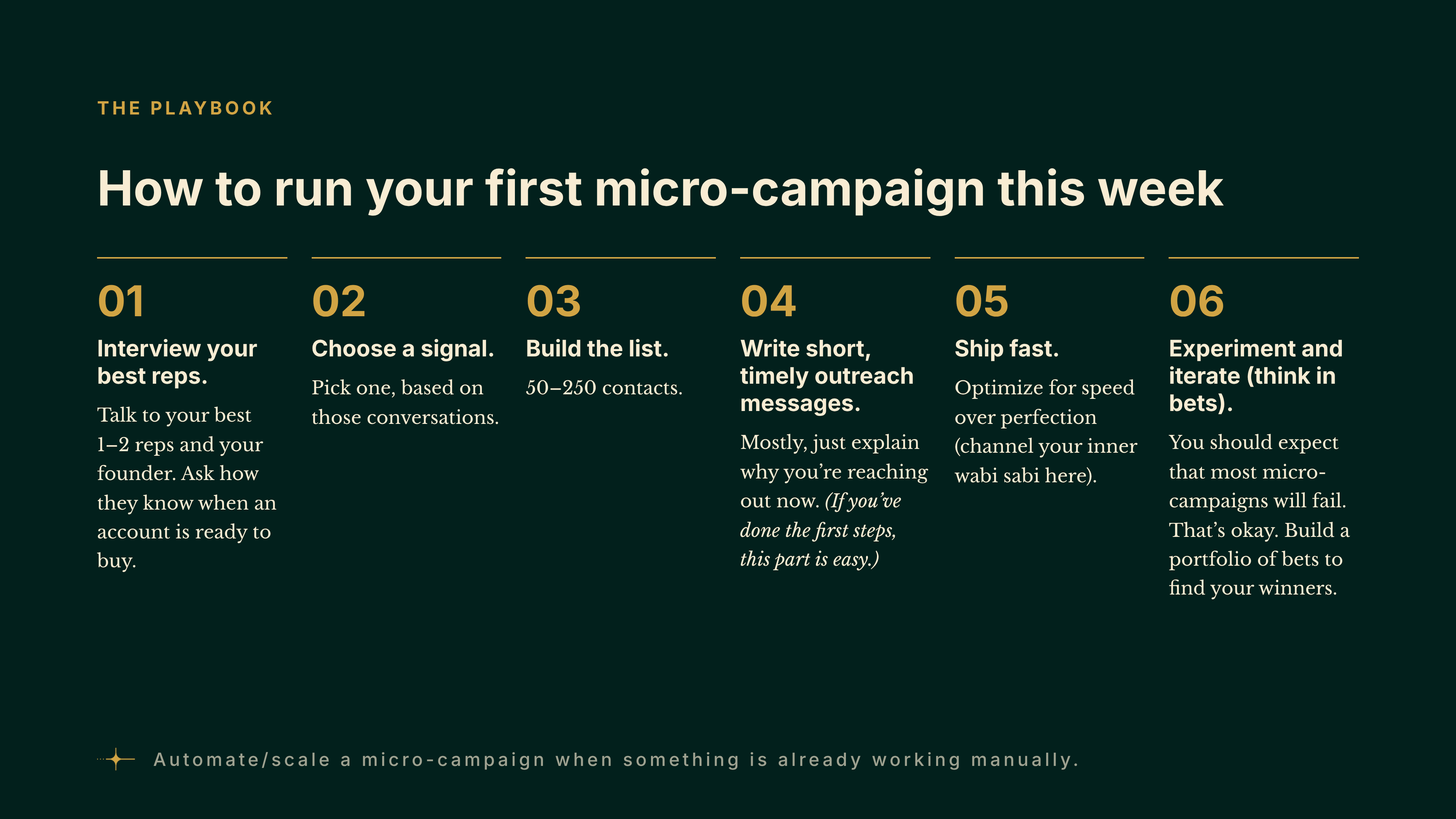
Your best reps are likely already running micro-campaigns, just one by one. That’s why Step #1 is so important. Only automate and scale a micro-campaign once something is already working manually.
Using AI to increase quality, not quantity
I’m super bullish on micro-campaigns. Why? Because the whole GTM industry is obsessed with using AI and automation to do more, more, more, so the idea of sending fewer emails to smaller lists is a non-starter at a lot of companies (like your competitors).
Which creates an opportunity for you: While everyone else races toward 250 emails a day per rep, at a sub-0.25% reply rate, the teams running micro-campaigns send fewer, better-timed—aka: more valuable!—messages to people who are actually in-market for their solution.
(Plus, if you end up hitting your entire TAM—aka Spam-your-TAM—instead of your SBM… you might not get another shot with them because you’ve burned your company’s brand perception.)
If you’re successfully running micro-campaigns (or have tried them and they didn’t work), reply and tell me. I want to hear what’s working in November of 2026.
That’s it for today.
Join our Live Show on Friday at 9am PST; we’ve got another epic line-up for y’all. Follow The Signal on X and turn on notifications.
As always, thank you for your attention and trust. I do not take it for granted.
See you next time,
Brendan 🫡
PS: If you liked today’s post, send it to one person who would enjoy it.
Edited by Jonathan Yagel.