


If you were forwarded this newsletter, join 11,509 weekly readers—some of the smartest GTM operators & founders—by subscribing here:
Thanks for reading this hand-poured, organic (human-written) newsletter.

Hey y’all!
Back in February, I wrote about Nooks expanding beyond the dialer, announcing a workspace where agents and reps collaborate.
Today, General Catalyst’s Customer Value Fund is committing $500M in non-dilutive growth capital to Nooks. Plus, Nooks is launching Node, an AI personal assistant for sales, and bringing its products together as the Revenue Agent Platform.
I sat down with Dan Lee, Nooks’ co-founder and CEO, for today’s sponsored deep dive.
My takeaway is that sales is the next job category to inflect (we’ve already seen coding, support and legal). And Nooks’ bet to start with the execution layer of the seller (across every motion), expanding out to agent collaboration, has earned them the right to use that foundation to run agents across the entire revenue lifecycle.
Here’s what we cover in today’s article:
Sales is the next job category to inflect
Why start with the channels sales reps own?
From opening moves to the endgame
Announcing: Node
Will AI replace salespeople?
What would prove this right
Let’s get into it.
Sales is the next job category to inflect
As I wrote about last week, AI adoption is coming in waves. Coding came first because you know in seconds if the code works. Support came second because you know in minutes if the ticket got resolved. But a sales cycle can take quarters, which is a big part of why we haven’t seen sales productivity catch up with spend …yet.
Dan thinks sales is next to inflect.
As this visual depicts, AI capability and spend are way up, yet sales productivity hasn’t kept up. Why not?
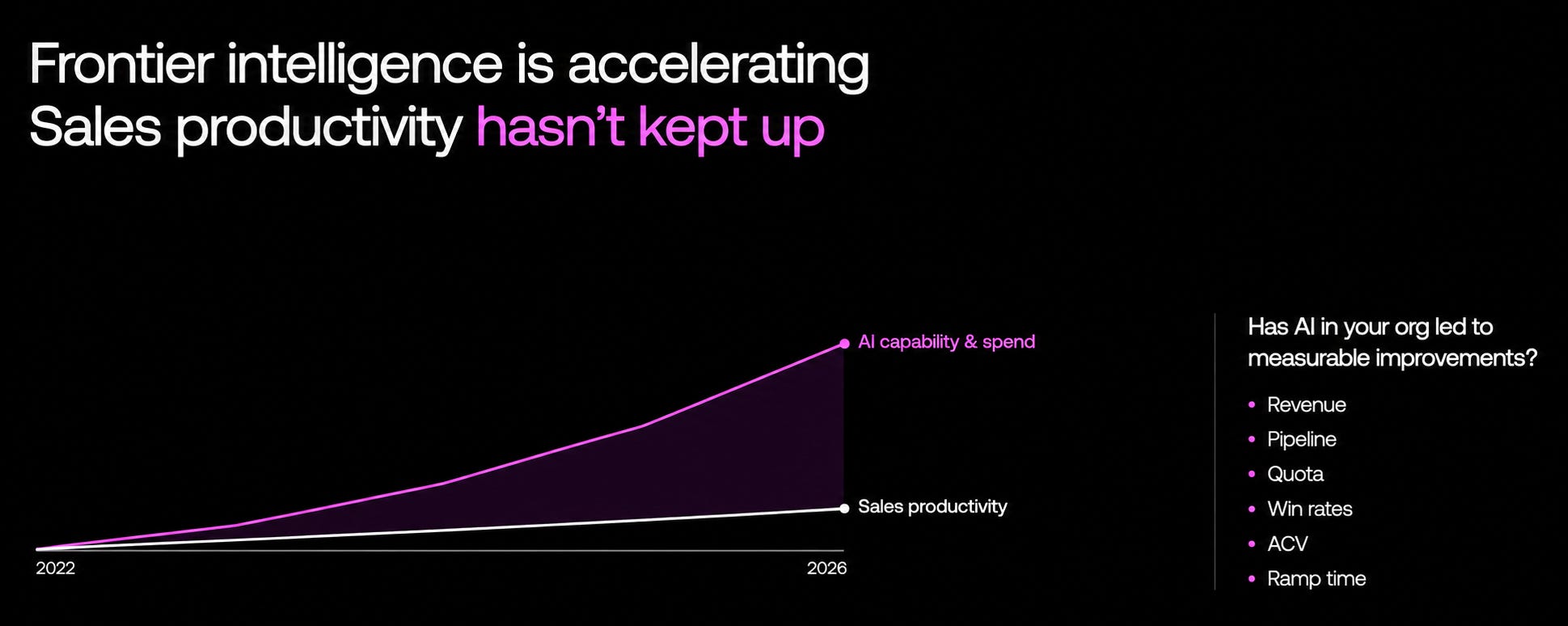
Has AI in your org led to measurable improvements? In my conversations, most sales leaders agree that AI has not had a measurable improvement compared to spend.
Which is crazy. For as much as we see AI x GTM projects talked about online. And how much I personally know/feel the power of these models. The reality is, we haven’t yet seen the quantifiable improvements.
Here’s how Dan described where we are right now:
Sales, revenue per rep, pipeline per rep, they might have increased in some cases, but not that much. The job [of sales] doesn’t look that different. The job of software engineering [on the other hand] is completely different.
Dan believes that is going to change. And in order for it to happen, Nooks is building three things they deem necessary for the AI-era:
1. Teams need an execution infrastructure.
As an example, an agent’s output only counts if it reaches a buyer. Getting it there is last-mile plumbing (deliverability, phone data, connect rates), and most teams shouldn’t build it themselves.
2. Agents need a context layer.
Context is what an agent knows about the account and the people in it. It only helps when it’s tied to an outcome, since the same product-usage data means one thing to a PM and another to a rep.
3. Agents need a learning loop.
Any model can write an email, but writing a good one takes feedback. Nooks learns from which suggestions reps accept or reject and how buyers respond, then simulates the prospect before it picks the next move.
Why start with the channels sales reps own?
Dan explains selling with a chess analogy. First, you have to understand the board: who the players are, what they care about and how they relate to each other. The hard part is that you can’t see the board. So you gather lots of data, then you come up with a hypothesis and a strategy. Finally, you make the moves (you make the call, meet at an event, send a gift, etc.).
And then, account scoring is looking at thousands of boards and deciding which games you want to play.
Dan shared with me:
Our bet has been to start with the channels that the sales rep owns, because that’s where we can learn from the person deepest with the account.
If we can have agents that learn how to play, like a rep, that can: understand the board, can come up with the best strategy, and can actually go execute it… then this is actually not just used by a sales rep. But it’s actually used across all the different pieces of the revenue lifecycle, because normally a sales rep only owns some of the pieces.
Those pieces are typically spread across the entire company creating big coordination problems.
As just one example, Dan asked me: “Why does a marketer decide which ad someone sees? Shouldn’t the sales rep know better, since they know that account and that person?”
He went on to explain that the answer today is that it’s too hard for a rep to manage ads on top of everything else, and that departments exist because people only have so much mental capacity. Agents have a different limit.
He said sales reps are the deepest with the customer. And the best ones develop a mental model that’s informed by all the deals they’ve run.
I think one of the biggest things that separates the best rep from the medium reps is that the best rep is simulating the prospect. They’re thinking, if I send this email, who are they going to forward it to?
He went on to say:
Agents can see way more deals than a single rep has run or listened to, and agents are actually really good at simulating prospects.
What’s unique is that Nooks has the data on what has and hasn’t worked for reps, because it owns the channels reps use. It sees what reps do and how the customer reacts.
With that data, Nooks trains an agent on the best rep and scales that across all other reps.
From opening moves to the endgame
We started with outbound pipeline, but you use these same things for inbound, for deal execution, for account management, for coaching.
—Dan Lee (CEO, Nooks)
Back to the chess analogy: Nooks’ products started by helping teams with their “opening moves” (first via calls, eventually every type of opening move). Then they expanded to reps and agents doing opening moves. And now, they’re going beyond “opening moves” into discovery, demos, deals and renewals. For Nooks customers, that means you can see results at the top of the funnel first, then extend the same system to later stages, where results take longer to show, without starting over.
The outbound agents show how far this has moved past the dialer. They can find prospects, do deep research, build org charts, draft emails and create call scripts. And AI sequencing is now free inside the suite, as a tool for humans and agents.
The platform now includes Deal, Outbound, Expansion and Coaching Agents, with Inbound Agents coming in Q1 2027.
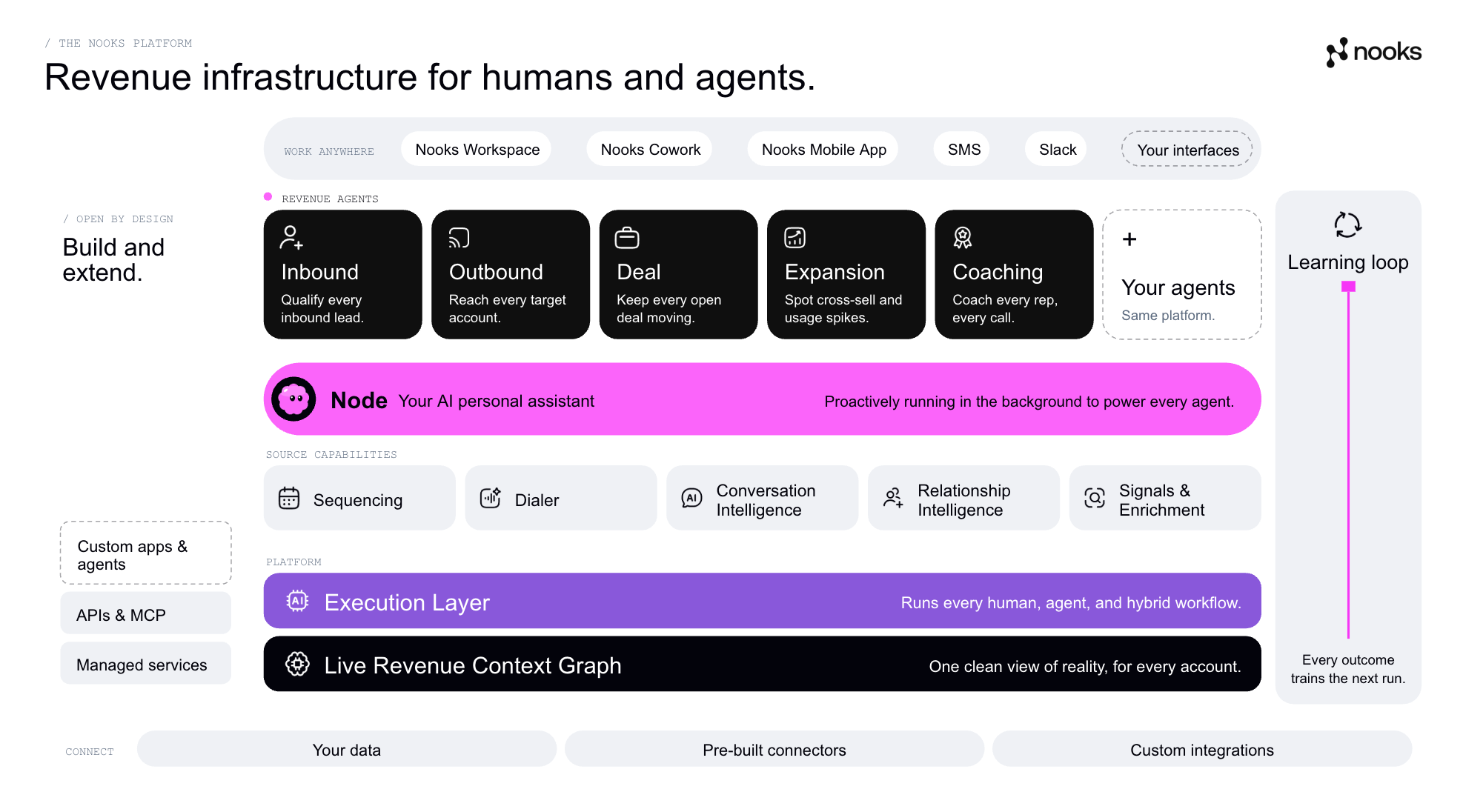
Nooks’ platform is also, notably, open by design.
You can use Nooks through its web, desktop and mobile apps, or through Slack, MCP and its API. That means reps can work with Nooks from inside other agents (eg: coding tools), which matters if your team has already built its own setup. That puts Nooks in the infrastructure camp for anyone building in-house (see: build your intelligence, buy your infrastructure).
Announcing: Node
Nooks is also launching Node today.
I would describe it as an EA for every rep: a proactive agent that starts with the full context of every account and deal, including what was promised on the last call, which stakeholders have gone quiet, and what has worked on similar deals. Node drafts the next move, and the rep approves every send. What stands out to me is that it’s also multiplayer. As Dan told me, it can “work with your sales manager’s Node to tell them, ‘Hey, I need you to go multi-thread this account’.” It will start with deal management through Nooks’ Deal Agents, then expand across the rest of the platform.
To many, Nooks is still perceived as simply “the best dialer,” but builders are realizing it also has infra for building AI-native GTM systems. It appears this capital, and the launch of Node, is a large bet on a much bigger vision that, I believe, will chew into the labor market. (I wrote about this a year ago: The $100B+ Winner in GTM Tech Will Sell Labor, Not Software).
Will AI replace salespeople?
Dan says 12 million people in the US sell for a living. So I asked him if AI will replace that labor market. His answer is that there’s a range. In the case of AI in support (eg: Decagon/Sierra/Fin/etc) or AI in law (eg: Harvey/Legora/etc), Dan told me you don’t want more support tickets or lawsuits, but you do want more sales. So when AI makes support or legal more efficient, teams often get smaller. When AI makes a seller more efficient, the math can go the other way (see: Jevons paradox). Nooks itself has nearly 100 open roles on its GTM team.
I don’t think everyone will blindly hire more sellers. Some will use the efficiency to stay flat (or cut). Dan shared a framework for whether you hire more sellers or just get more efficient depends on three questions:
Are you TAM constrained?
How competitive is your market?
How difficult of a sales/persuasion problem is it?
In any case, Nooks is building for this range. Every company will land at different points on that range across its segments.
My take: Dan is pro-rep and pro-AI, and I think that’s correct.
Dan also expects AI agents to sell better than many reps do today, within the next one to two years, while the best reps working with agents raise the ceiling.
The counterargument to “hire more reps” is that companies want more revenue, not more sales activity, and buyer attention is finite. Cheaper selling doesn’t automatically mean more sellers. I expect this to play out differently by segment, which is why the (nuanced) framework above is so helpful.
What would prove this right
Nooks’ numbers show 96% of agent emails go out without edits, and it doubled meetings booked per rep on its own team in three months. Cursor’s lean SDR team booked 300 meetings in two months, after their pilot showed a 4x increase in qualified pipeline, using Nooks. I personally have gotten to know the Cursor team, and they’re definitely building a very AI-native org. So the fact that they bet on Nooks as part of their tech stack is a big signal to me.
Sales is going to inflect at some point. If the win rates don’t move (outcomes), more meetings (inputs) won’t be enough. But if Nooks can close the gap between AI spend and AI productivity by having reps and agents working the same “board,” they have a real shot at being one of the companies that defines the next wave of GTM.
Reach out to Nooks to see how they can help your revenue team (and let them know The Signal sent you). I’m excited to continue to watch what Nooks builds next!
As always, thank you for your attention and trust—I do not take it for granted.
See you next time,
Brendan 🫡