

If you were forwarded this newsletter, join 10,215 weekly readers—some of the smartest GTM operators & founders—by subscribing here:
Thanks for reading this hand-poured, 100% organic, farm-to-table (human-written) newsletter.

Presented by:

Clay is the infrastructure GTM engineers build on. Start building for free.
& Supported by:

Attention → AI Agents for RevOps.
Clarify → The Autonomous CRM. Sell more, admin less.
Clearskies → The Context Layer for Revenue AI.
Nooks → All your outbound. One AI workspace.
Rox → Revenue Agents for the Global 2000.
Sumble → ML-powered data and account intelligence for Ai-native GTM.
Terret → The answer-to-action engine for revenue teams.

Hey y’all! 👋
I am testing out a new format on this fine Friday: A weekly roundup. This week, I’m explaining one of the hot topics in the GTM space (triggered by a Paul Graham tweet), plus a few links to things I’ve been exploring (tools, articles, podcasts) that I think are worth your time.
Let me know if you think I should do this each week, or if you’d prefer no round-up. (Reply to this email, I read each response).
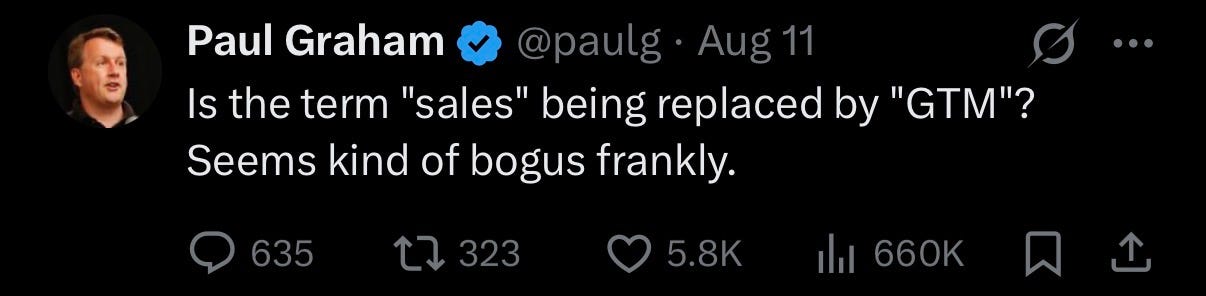
Paul Graham, the godfather of startups, dropped 13 words that absolutely obliterated the timeline earlier this month.
I think there are pros and cons of the term “GTM” gaining traction.
The good
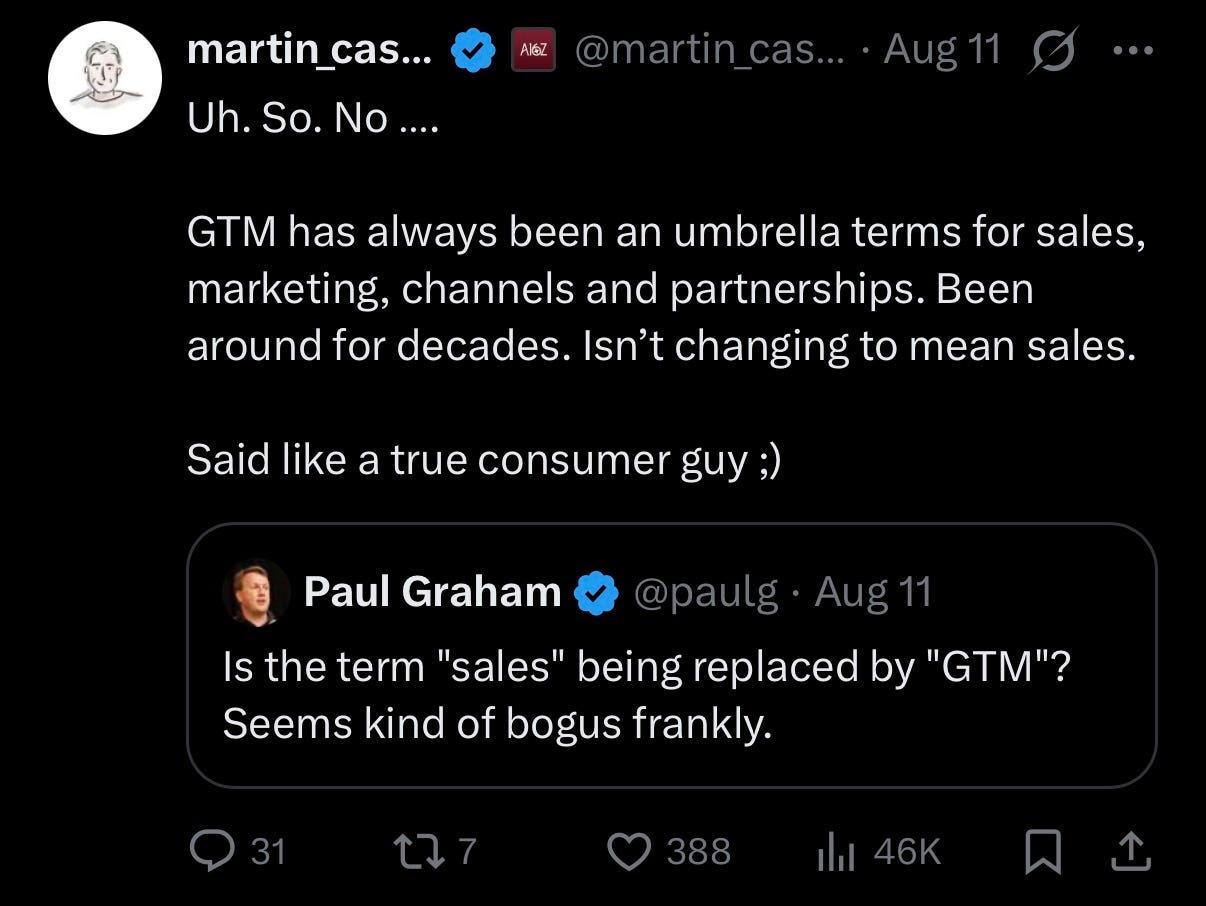
Traditional sales was one subset of the overall go-to-market function. And at a startup, sellers are doing more than just selling. They’re also doing their own sales engineering, demand gen/sales development, running event follow-up, building enablement/playbooks on the fly, etc. “AE” (or “sales rep”) is limiting to the actual role. So it makes sense that startups would call their founding sellers “GTM”. I agree with Chris Balestras (who places lots of early sales hires at startups):

And even in large companies, “go-to-market” is a broader umbrella term.
From Stripe’s guide on What is a go-to-market strategy? How to create a GTM strategy for startups:
“Go-to-market” (GTM) refers broadly to the overall commercial framework a company uses to bring a product or service to customers, though in practice it is heavily centered around sales and marketing functions. While sales and marketing execute the core tactics, a complete GTM strategy is broader and cross-functional. It connects product positioning, pricing models, distribution channels, customer success, and revenue operations into a unified plan to acquire and retain buyers.”
Here was my way of explaining this…

The bad
Some people are using the title of GTM because they’re embarrassed to call themselves a salesperson (or AE).
First, because it’s low status, I guess? (I don’t see it that way :)). And, secondly, because prospects don’t want to talk to a ‘salesperson.’ Same reason we came up with ‘Account Executive’ or ‘Sales Development Representative.’ No one wants to talk to the ‘slimy used car salesman.’ But modern sellers are not slimy used car salesmen at all. I like how Irene Madrid put it:
Modern GTM means understanding yoru customer’s business before you ever pitch a product. Thinking like the CEO of their company. Getting obsessed with solving real problems, not just signing the deal.
So, maybe some people see this rebrand as warranted to escape this stigma? (I don’t think that’s necessary).
And here’s the final angle: some agency bros hijacked the term. “Lead gen” (aka cold email services) has become synonymous with “GTM” in some circles. A lot of people doing “meeting booking” as a service pivoted to doing “GTM work.” You can charge 50% more overnight, with that one rebrand. But this is brutal for the space. It undermines the value of what GTM actually means. It’s definitely not another name for “outbound.”
Conclusion
No matter where you fall on the argument(s), there’s no denying that “go-to-market” as a term is being used more today than ever before.
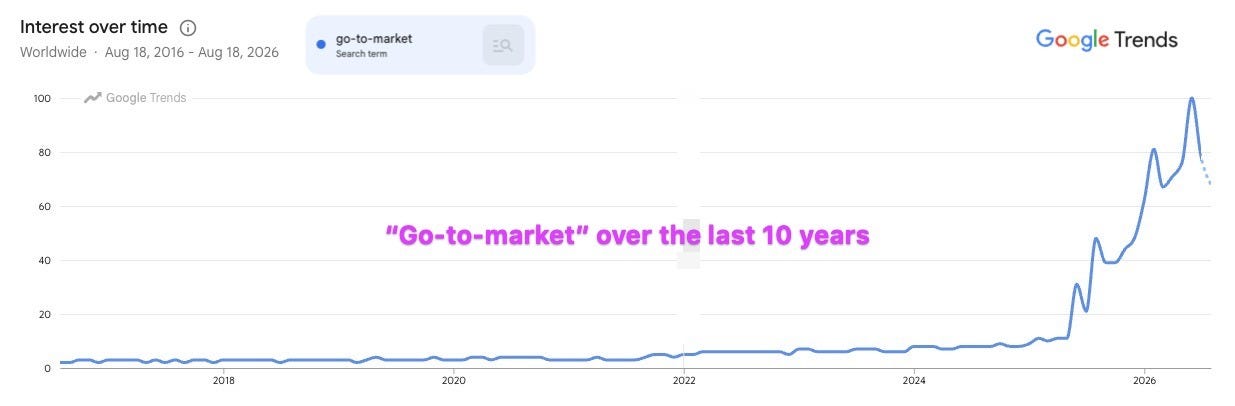
And, while there are many definitions (and hijackers of the term), I think it’s helpful for everyone to, eventually, get on the same page and use the term the same way.
So, what do you think of this trend of calling salespeople ‘GTM’? Reply with your thoughts! I read all responses.

Other corners of the internet worth exploring this week:
Grok Bot launched this month. I’ve been using it a ton every day (for LinkedIn triage, editing, research, light design, “Chief of Staff” mode, Substack analysis and more). It’s the wildest AI experience I’ve had since Claude Code in December. Think of it like Claude Cowork meets Slack (but instead of humans, it’s bots that you create, and each one has computer use).
Clay instituted an official AI Writing Policy that I think everyone should adopt (or create their own version). It’s soo so good (9k+ likes on the post, so I guess a lot of others agree).
Lot of founders and revenue leaders are trying to figure out what a GTME/Growth Engineer should do (and if they should hire one). Much of the things they’re doing are newly unlocked things, thanks to AI. Here are some examples: 21 things a growth engineer does.
A rare, and fascinating, interaction with Dario on X (responding to Gavin Baker’s comment that “Anthropic believes they could be the ONLY company left in the world”) → “I don’t usually spend much time on social media but I wanted to engage here because it really brings out the heart of an important conversation.”
Ben Thompson (on Invest Like The Best) says the real money in AI is being made by Meta, not OpenAI or Anthropic: “The biggest impact of the models, the biggest monetization right now is probably not in Anthropic or OpenAI. It’s the incremental gain that is happening for Google and Meta.” And says Zuck shouldn’t be ashamed of the beautiful business model of ads, and that OpenAI should have done ads to support their consumer business sooner. (The entire conversation is worth a listen, or wherever you listen to your podcasts)
In a leaked letter to Stripe’s investors explaining its acquisition of OpenRouter ($7.5B), Stripe founders say the singularity started January 1st 🤯
X/Twitter open-sourced the algorithm for the “For You” page.
Last but not least:

That’s it for today.
As always, thank you for your attention and trust. I do not take it for granted.
And let me know if you liked this edition (reply to this email!) and consider forwarding it to one person, it means the world to me.
Have a great weekend, gtm nerds!
Brendan 🫡
PS:
(Bonus nugget; the most beautiful website I’ve come across in a long time):
Our lives and homes are filled with things that once inspired similar awe. I tried to collect those feelings, in quotes…from people for whom what is now ordinary was brand new. A friar who met the inventor of eyeglasses, a founding father on the new smallpox vaccine, a woman in Iowa on her family’s first indoor bathroom. To look at a modern apartment through their eyes:
Click through it here: Ordinary Abundance.
