


If you were forwarded this newsletter, join 8,417 weekly readers—some of the smartest GTM operators & founders—by subscribing here:
Thanks for reading this hand-rolled, 100% organic, farm-to-table (human-written) newsletter.

Presented by Clay.

Bring AI agents, enrichment, and intent data together and turn insights into relevant, timely action. Start building for free.
& Supported by:

Attention → AI Agents for RevOps
Clarify → The Autonomous CRM
Nooks → Agent Workspace for Intelligent Outbound
Sumble → Buying signals from tech stacks, people data, & active projects
11x.ai → Accelerate growth with a digital GTM workforce

Hey, y’all! 👋
I ran Operations & Enablement for the Global BDR Org (~125 people) at Zoom Video in 2020-2021. But a lot has changed with Sales Enablement since then.
So, I was excited to catch up with Mercy Bell, who ran Enablement at Webflow and has spent 15 years in RevOps + Enablement orgs and consulting with large, complex teams at Meta, Outreach, Retool, and more. And is a Stanford alum. I believe that most (not all, but most) of the best Sales Enablement folks came up as sellers themselves (Mercy started as an SDR at Google, then AE at Kahuna).
She made an off-handed comment during our conversation that I haven’t been able to shake: we are putting more care into architecting environments for our AI agents than we are into developing the humans who still run our go-to-market motions.
That’s what we’re going to unpack today. Specific frameworks, best practices, and programs. All backed by science (yes, science! from psychology research papers and old textbooks). Here’s what we cover:
What enablement actually is (retrieve, recall, resist)
Why the 2010s Enablement playbook is dead
The agent parallel
Why sales teams will get incredibly small
Self-determination theory and why it matters for GTM
Four programs every GTM org needs to build for humans
Alright, let’s get into it.
What enablement actually is (retrieve, recall, resist)
Mercy defines enablement through a framework of three R’s.
The first is retrieve. Can your people find what they need? Information, content, competitive intel, whatever. This is the systems and tools question, and it’s the one most companies default to solving. It’s also the easiest. RevOps can own a lot of this.
The second is recall. This is harder. Can your reps, in the moment, pull up the right heuristic, match tone to context, read the room, etc.? As Mercy put it: “What they need is to be able to recall. The human brain takes in so many factors. The fact that when the call got picked up, they heard the tone of voice was a little low energy and they matched it. They understand that person’s seniority level and role means a certain kind of shifting of how you position a question.”
Recall is the stuff that separates your top performers from everyone else. It’s pattern recognition built through repetition, not a knowledge base article.
The third is resist. Judgment. Impulse control. Knowing when not to oversell, when to walk away from a deal that doesn’t fit ICP, when to shut up and listen. “Discernment and judgment is mostly about what we don’t do, not what we do,” Mercy said.
This framework matters because, in my observation, most enablement teams spend the majority of their time on retrieve and almost no time on recall or resist. They have it inverted.
Why the 2010s Enablement playbook is dead
If you built an enablement team in the last decade, it probably had a content person, a systems person, and a trainer. That structure made sense when the playbook was stable, the tools moved slowly, and compliance meant keeping an LMS fresh.
That world is gone.
There’s absolutely no way to apply the 2000s, 2010s model of enablement around compliance and documentation to what’s being built and deployed inside every go-to-market org right now.
When she was interviewing for in-house roles, she kept asking: what would I be coming in to do? The answer was always “activate the field.” But a layer deeper, it was everything. Systems. Behavior change. How humans work alongside the technology they’re now riding on top of.
The people who are still doing last-mile training and keeping content fresh? They’re going to get replaced. The ones who survive will go one of two directions: into systems and operations (GTM Engineering, RevOps), or into coaching, recall-building, and leadership development.
The era of the generalist enablement hire is over, and if you’re not sure whether you need an enablement person, the right move is to diagnose the root cause first (it might be a product marketing gap, ICP clarity, or managers who can’t coach) and then hire a specialist to solve that, not a generalist to cover everything.
The agent parallel
Every founder and sales leader wants to scale GTM with AI and automation. I write about this constantly. Mercy expanded my perspective here.
Think about how much care goes into building a good AI agent. You’re constructing context windows. Giving examples of what good looks like. Reviewing outputs one by one, grading them, explaining why one was good and another bad. You’re architecting the entire environment for that agent to succeed.
Now ask yourself: are you doing the same for the humans on your team?
“We’re applying all this compassion and diligence to architecting environments for agents to do their best work,” Mercy said. “We’re not doing the same for the human beings. Most people I know right now are burnt out, anxious, a little bit confused about what their world is.”
Execution is a sales team’s moat. So, leaders need to get honest about where their people actually are. Not just their AI strategy or tech stack. Their people.
Why sales teams will get incredibly small
Mercy thinks that in 5-7 years, sales teams will be incredibly small, and managers will be true player-coaches, still carrying a book but spending far more time developing their people. Investment in human skills will go way up, especially where deals are complex and relationship-driven. The art of the one-on-one will matter more than the dashboard.
“The renaissance of enablement is world-class enablement of frontline leaders to do things like the art of the one-on-one,” Mercy said. “That is actually an art form. And it’s also science.”
Self-determination theory and why it matters for GTM
If you accept that investing in humans matters, the next question is how. Mercy’s framework draws from research that’s been around since the 1960s (I told you we were going to be looking at old research papers today!).
Self-determination theory (SDT), developed by Edward Deci and Richard Ryan, identifies three universal psychological needs that drive motivation across cultures, generations, and roles.
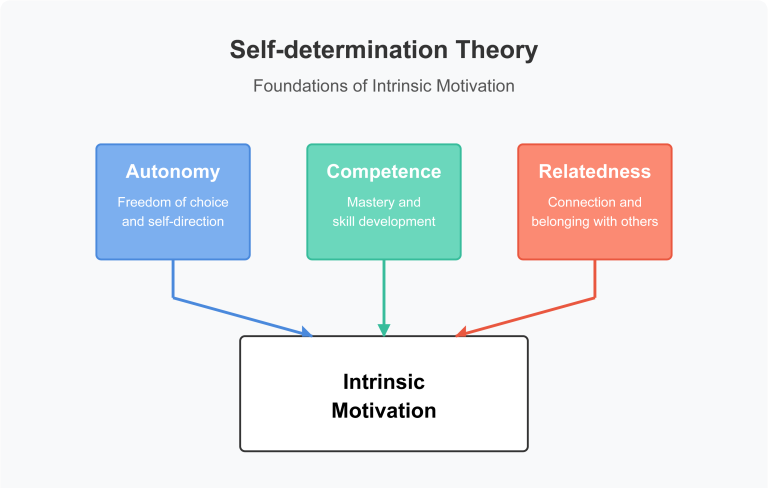
Autonomy is the need for meaningful choice. Not doing whatever you want, but feeling like you’re directing your own work.
Competence is the need to feel effective. This one has a trap. “Everyone gets a sensation of competence when they use AI,” Mercy warned. “It’s addictive. But that feeling of competence isn’t the same as actual competence.”
Relatedness is the need for genuine human connection. This is the one Mercy is most passionate about. “All of this tech can feel so isolating.” Teams and managers that foster real connection outperform, and it’s not a fuzzy concept. It’s neuroscience. Dopamine. Serotonin. The real stuff.
SDT also provides a motivation continuum. On one end: amotivation (no drive). Then external regulation (I work to get paid or avoid punishment). Then increasing stages of internalization before you reach intrinsic motivation, where someone does the work because they love it.
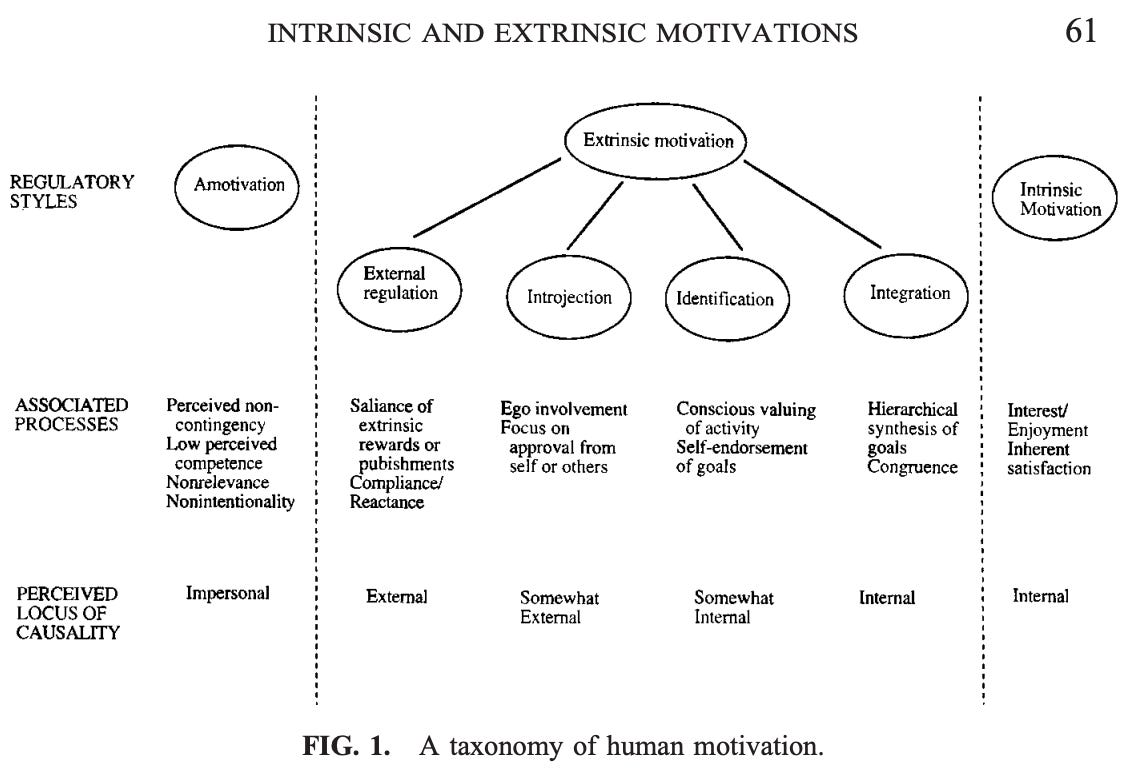
“The companies that are crushing it right now are almost exclusively in that identified-to-integrated range,” Mercy said. “You can’t run your business on fear right now.”
So if those are the psychological needs, what do the actual programs look like?
Four programs every GTM org needs to build for humans
Mercy outlined a four-program architecture for developing the people running your GTM motion.
1. Ramp (not “onboarding”)
“Onboarding” implies someone hops on board, and then they’re done. Ramp is the gradual process of bringing a human from “can’t do anything” to “can hit the number.” Neuroscience shows us that when something is new, the brain is at its most open and receptive. That window closes quickly.
Mercy suggests to build ramp around the customer journey, not the product. Tell the story of the customer from lead to renewal. Frame everything from the customer’s perspective.
And don’t do role plays in the first two weeks. Instead, “train their ear.” Capture a ton (like 60-70+) great clips of real sales calls where just the prospect is speaking. Play it, stop it, ask them what they heard.” Build the recall muscle early. This is hard work. There is no agent for it. And it’s worth doing specifically at companies with “high-trust sales cycles,” where the stakes of getting it wrong are six (or even seven) figure deals being lost.
2. Product and solution depth
Most companies train on product at the same altitude for every role. An AE, an SDR, and a solutions engineer need to know different things at different depths. Get specific about who needs to know what.
3. Skill development
Develop the fundamentals. Discovery. Giving a great demo. Negotiation. These are muscles that need consistent repetition, not a quarterly drop-in from an outside trainer. “The human brain requires repetition and feedback. It’s got to be an always-on thing.”
4. Leadership development
This is the one that gets punted to L&D and then mostly ignored. But everything above gets delivered by frontline managers. If those managers aren’t being developed, none of the rest works. How do you give hard feedback? How do you coach in the moment? These skills come from ongoing, repetitive development, not some random, one-time certification.
In 18 months, the best GTM orgs won’t just have the best agent infrastructure. They’ll have the best human infrastructure, too. The same rigor they’re applying to context windows and evals, they’ll be applying to ramp programs, coaching systems, and leadership development. Sales orgs that invest in both layers (agents and humans) are going to run circles around the teams that are over-indexing on agent infrastructure and overlooking human infrastructure.
That’s the Renaissance of Enablement.

Thanks to Mercy Bell for sharing her frameworks and for being the kind of practitioner who reads academic papers for fun (legend). She’s spent 15 years inside RevOps + Enablement orgs. If you’re looking for guidance on how to build an Enablement program in 2026, you should reach out to Mercy, she’s an awesome human.
Thank you for your attention and trust. I do not take it for granted.
See you next time,
Brendan 🫡
PS: Want to share The Signal with a friend? Send them this to skim: Best of The Signal