


If you were forwarded this newsletter, join 9,591 weekly readers—some of the smartest GTM founders and operators—by subscribing here:
The go-to-market industry has spent decades getting very good at one half of the job. We can tell you why you lost the deal. We can tell you which rep is sandbagging, which region is slipping, and which competitor keeps showing up in your closed-lost. What almost none of it does is change what happens on the next call. Exposing a problem is much easier than solving it.
Justin Shriber, Terret’s CEO, has been thinking about this problem space his whole career. He started at McKinsey, where he watched clients drop suitcases full of cash for root-cause analysis, only to watch the deck get put on a shelf to collect dust. Later, he ran large sales orgs at Oracle and LinkedIn and saw the same thing from the other side. Finding the answer is the easy part. Getting a rep in a different time zone, who only talks to HQ 2x/year, to change behavior on a live deal is the hard part.
What Terret is building aims to close this gap—between the right answer and someone acting on it.
And that’s why I’m excited to explore this topic (which is even more relevant in the AI era) in today’s sponsored deep dive on Terret.
Here’s what we cover in today’s post:
Background: building “Cursor for sales”
F1 analogy: the analyst, the pit crew, and the driver
The closed-loop system (and why MEDDIC is dead)
Build vs. buy: why governance, not effort, is the real argument
Alright, let’s get into it.
Building “Cursor for Sales”
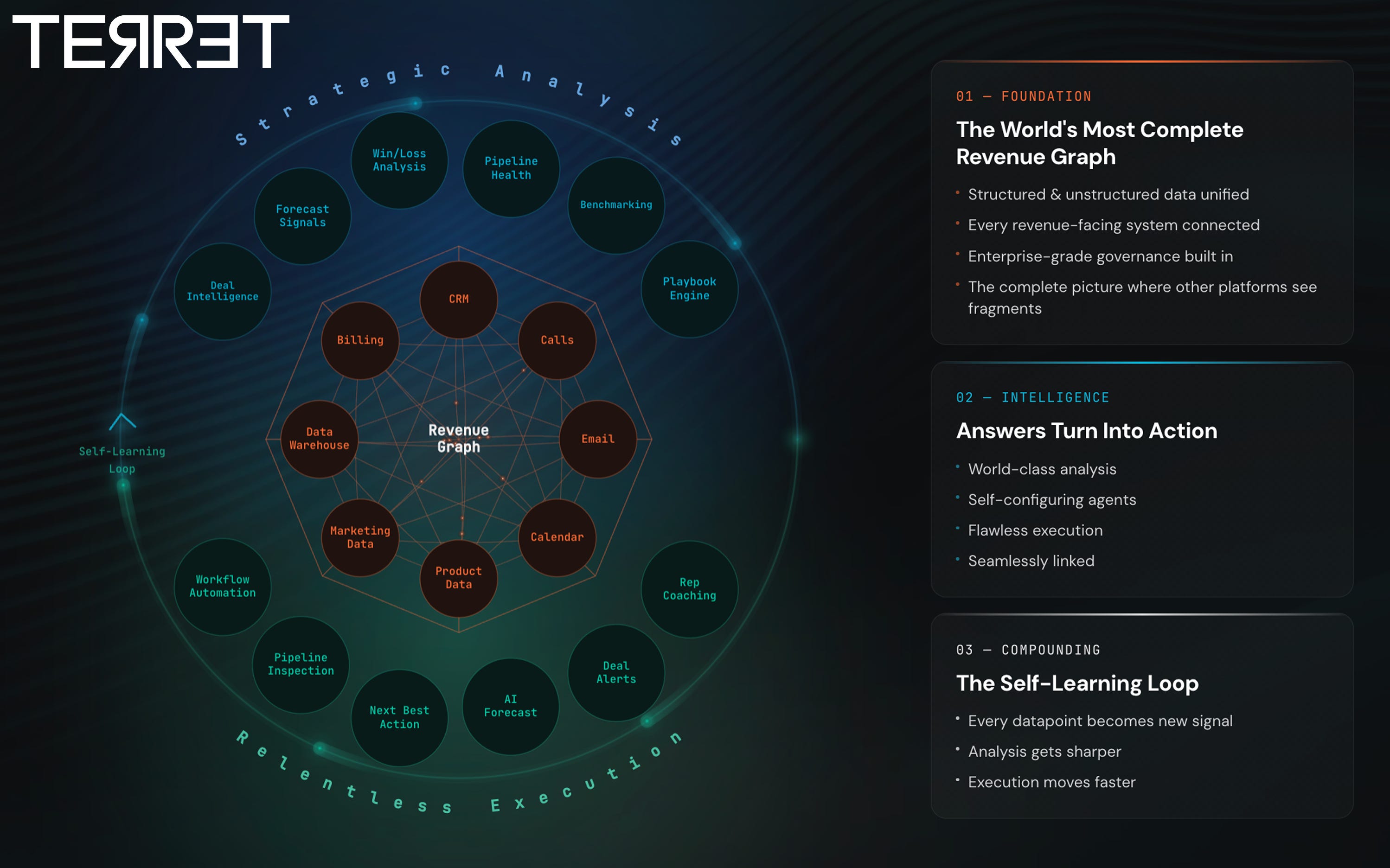
Terret didn’t start here. The company began doing forecasting and conversation intelligence, the same category as Clari or Gong. Somewhere in that work, Justin realized the forecast wasn’t the valuable thing they’d built. The valuable thing was the platform underneath it. Because they were born in an agentic world, they’d built an AI-native system that pulled data from every revenue-facing source and used inference to join and normalize it, without a six-month warehouse project. Today, people call that a context graph or a revenue graph. Terret had one running years before the term got popular.
Once you have this, forecasting becomes just one of many use cases. The same loop runs on whatever question you point it at: why the forecast slipped, why pipeline is stalling in a segment, why one rep’s deals progress twice as fast as everyone else’s, why a product line isn’t landing. Terret is more generalizable than any single point solution. In a recent conversation, Justin told me:
I wanted to build “Cursor for sales.” Cursor doesn’t have one narrow kind of code that you write. And that’s what I was trying to create. Get to the right answer, but then implement it to the point where you actually have a working solution that is delivering a result or an outcome.
Cursor doesn’t lock you into one narrow kind of code. It sits a layer above. Similarly, Terret wants to sit a layer above forecasting, coaching, or competitive intel, to take revenue teams from answer to action.
Terret can stand up a demo on a customer’s own data in 48 hours using just CRM and conversation intelligence, run a POC with real results in two weeks, and fully deploy in a month. Their goal is to show a CRO something about their business that they didn’t already know within those first 48 hours.
F1 analogy: the analyst, the pit crew, and the driver
Justin shared a metaphor to explain how they differentiate in the market.
1. The McKinsey Analyst (”Ask”)
Imagine dropping a McKinsey consultant into your revenue org who has read every email, every document, every CRM update, and listened to every call, with perfect recall. That’s the revenue graph paired with a trained LLM. Ask it why win rates in EMEA dropped last quarter and it can actually answer, because it can pull the lost deals from CRM, the call transcripts from your CI tool, the email threads stuck in individual inboxes, and the product usage from wherever it lives, then normalize all of it. CI tools can’t do that alone. CRM can’t. And building your data warehouse to do it will take half a year and still stumble over unstructured data.
The hard part isn’t the question. It’s that sales has a deterministic half and a non-deterministic half. Art and science. The numbers are deterministic. The why behind them is not. LLMs are great at the why and bad at the numbers. Ask one how much you closed in North America last quarter and it’ll give you a different figure each time, then fold the second you push back. (We’ve all questioned our LLMs and heard them say: “You’re absolutely right! Sorry about that, it’s 12% MoM.”).
Terret’s forecasting legacy is what let them solve this. Forecasting is a quantitative problem, so they already had a deterministic approach to generating numbers. They give the model prescriptive instructions, then run a series of checks to confirm it computed what it was told to. The result is a system that gets the number right every time and explains the why behind it.
2. The F1 Pit Crew (”Operationalize”)
The analyst tells you what to do. The pit crew makes it real for everyone else. This is where playbooks, rep scripting, and the rest of the artifacts get built and pushed out at scale, with no human assembling slides. An answer (even a great one) is worthless if the “insight” just collects dust in an Enablement Playbook in Notion. The pit crew turns it into a motion the whole team can run.
3. The Driver (”Activation”)
The first two get you a great answer and a living playbook. Activation is making sure the artifacts actually get used, which is where most of this falls apart. Hand a rep a script and you have no idea whether they followed it. Terret watches rep behavior against the script, grades it, and feeds specific, evidenced coaching to both the rep and the manager so everyone moves the same direction.
This is the end of enablement as we’ve known it, and the start of what Justin calls “micro-enablement” moments. I ran ops and enablement for a 100+ BDR org at Zoom Video a few years ago, and the model was brutal even then. You’d launch a new product into a new market, run a training, and maybe half the team absorbed it. And the information would go stale a month later, buried in a portal nobody opened again. Micro-enablement flips this on its head. Instead of one stuffy session at SKO with hungover reps in an 8 a.m. ballroom, you get a script before the call, a 30-second grade after it, and a coaching point from your manager that same week. A rep gets more reinforcement on one playbook in a week than the old model delivered in a year, and every touch builds on the last.
Other things you can build when you have an analyst, pit crew, and driver in one continuous loop:
Run a win analysis on EMEA over the last four quarters, and 3 minutes later you’ll have a root-cause analysis and competitor battle cards of how to overcome them.
A living playbook built from your best reps actual language that your top closers use, not language a product marketer invented.
Before a call, the agent scripts an opener pulled from top reps, anticipates the objections she’s likely to hit, and adapts to where the deal is and who’s in the room.
After the call she gets a scorecard (she scored an 8 out of 10) with evidence of what she did well and what to fix.
At the end of the week her manager gets a coaching sheet across every deal.
[A side note worth mentioning: Justin thinks the CRO role is about to change shape completely, and he frames it as a shift from Leonard Bernstein to Miles Davis. The old great CRO was Bernstein. A score, a rehearsed orchestra, everyone hitting their notes, and the team that played the written music best won. The market moves too fast for a score now. Miles Davis ran a loose framework and improvised as the music moved under him. “If you were Lenny Bernstein, one of the greats, your career is done,” Justin told me. “You can’t compete in sales like that anymore.” Harsh, but I think this is directionally correct.]
The closed-loop system (and why MEDDIC is dead)
Years ago, when I was running a company, one of my taglines was: “Actions > Insights”. The last decade of GTM was the decade of smarter/better/more “insights.” Endless Looker and Tableau dashboards, scorecards galore, and endless Salesforce reports. All of it sitting there waiting for a human to notice and act. My company wanted to automate the action instead of it sitting in a Tableau dashboard. When I said this to Justin (Actions > Insights), he (graciously) corrected me: “Insights plus actions is the way to build a revenue system today.” He’s right. Insights alone are shelfware. Actions without the insight behind them are guesses. You want both, wired together.
That wiring creates a closed loop. Terret’s agent sits on the calls. When a new objection comes up that isn’t in the playbook, it captures how other reps handled it, and by the end of the day, that response is in the bank. The system knows which questions got asked in deals that closed and which got asked in deals that died, and it feeds that back into the playbook automatically. The playbook isn’t a document someone updates quarterly. It’s a living, breathing thing that learns from what actually works.
Justin believes MEDDIC is dead too. It’s the qualification framework that came out of PTC in the mid-1990s, the one John McMahon is known for, built in part because PTC didn’t have a real product yet and needed rigor to compensate. It’s a great framework. It’s also 30 years old. Why run a static rubric from 1995 when the system can build you a qualification model from what your own closers actually do? Terret can fully automate MEDDIC if you want it, score against it, and suggest the next move. The better version is your own MEDDIC, derived from your top performers, not from a consultant’s template or an enablement manager’s best guess.
Build vs. buy: why governance, not effort, is the real argument
The obvious question from a CRO or a founder is, why not just build this myself with Claude and a few MCP connections? Justin shared what he’s seeing and why building in-house is not the right choice for most companies.
The first problem is governance. Your revenue data lives in systems with completely different access models. Email is user-based. CRM is hierarchical. If you MCP a model directly into each of them, you’re pulling data across those boundaries and trusting the LLM to decide what any given person is allowed to see. That’s a bad bet to make with customer data and competitive data. Terret builds the revenue graph with permissioning baked in, resolved against your CRM hierarchy, so the governance holds.
The second problem is cost. Ask a model to stitch together data from five systems on the fly and you’ve asked it to rebuild a small data warehouse on every single query. That’s how you burn tokens and end up with an unpredictable bill. Terret pre-packages the exact slice of data a given question needs, so the model gets a micro-payload instead of everything. That’s also why Terret can charge a fixed price instead of consumption-based pricing, which is the line that makes the CFO lean in.
The third is concentration risk. Build your stack on one model provider and you’re betting that provider wins. Terret runs a cocktail of models on the back end, swaps in whatever’s best as it ships, and manages that risk for you. You’re not married to one vendor’s roadmap.
None of this means building is always wrong. Stripe builds. Cursor builds. Ramp builds. But there are maybe twenty companies on earth with the engineering depth to build a true in-house solution for their revenue team (and keep maintaining it). For everyone else, building a context graph, a governance layer, and a multi-model router from scratch is a bad use of the next nine months. For reference, doing the same thing on something like Agentforce is a 6-9 month project with dedicated engineers on permanent integration duty. Terret needs your CRM, your email and calendar, and one RevOps person to keep an eye on it.
(Read more here: How to Think About Build vs. Buy in the AI Era | “Build Your Intelligence. Buy Your Infrastructure.” With Owner.com’s CRO, Kyle Norton. And Terret is a great example of infrastructure you should buy to build on top of.)
The takeaway
Terret’s main goal is to be more powerful, cheaper, and faster. Powerful because the analyst, the pit crew, and the driver run as one loop instead of three disconnected tools. Cheaper because of fixed pricing and one vendor instead of <several others> + a warehouse + an integration team. Faster because a playbook that used to take a product marketer six months now takes three minutes (and updates itself).
The answer was never the hardest part in sales. What was: getting the answer into a rep’s hands at the moment they need it, knowing whether they used it, and if it worked. Terret is the first thing I’ve looked at that treats that as the actual product instead of an afterthought. I’m excited to continue to watch what Justin and the team at Terret build in the space.
PS: Below is a 4-minute walkthrough of Terret that I recorded:
If you want to learn more about Terret, reach out to their team (and be sure to let them know The Signal sent you).
That’s it for today.
Thank you for your continued attention and trust. I do not take it for granted.
See you next time,
Brendan 🫡