


If you were forwarded this newsletter, join 9,076 weekly readers—some of the smartest GTM operators & founders—by subscribing here:

Happy Sunday!
During a consulting project in 2024, I was trying to find companies using PyTorch, TensorFlow (and other open-source ML frameworks), plus at least one full-time AI/ML engineer in-house. The technographics solutions I was using weren’t giving accurate or deep enough results. I found Sumble and haven’t looked back since.
As I’ve gone deeper with Sumble (and gotten to know the team* behind it), what’s most compelling to me isn’t their features; it’s the underlying data itself. Most vendors can tell you a 70,000-person enterprise “uses Grafana.” Sumble specifically tells you it’s the Platform Engineering team, what they’re building right now, and who leads it. (You can also use Sumble directly inside Claude or ChatGPT). Getting to that level inside a large, messy org is genuinely hard, and spending time with the team made clear why they can pull it off: they treat this as a machine learning problem first and a GTM product second.
*the founders (Anthony and Ben) previously founded Kaggle (in the AI/ML space), which was acquired by Google.
But the core focus of today’s piece is on their newly launched Account Scoring Skill, arguably one of the most important jobs to be done in go-to-market (it determines which accounts to focus on and how to engage them, which is the whole game). It’s something that’s been around for a long time, but I’ve always had beef with “scoring”, because salespeople never trusted these “scores.”
The pitch made sense on paper: score every account and contact, rank them, throw ‘em over the fence to your reps, and expect the list to get worked. 6sense and Demandbase grew into 9-figure businesses off that promise.
But, the old model was a black box. The new one is transparent (which matters even more as you deploy agents).
This shift and the downstream implications are massive. And the RevOps (and GTM) leaders building Account Scoring in this new way are getting results that are compounding across their GTM orgs. This is why I’m excited for today’s sponsored deep dive with Sumble.
Here’s what we cover:
The black box problem
The old way of account scoring, and what has changed
The new rules of account scoring
Score → reasoning (proof) → action
Why data matters more for GTM teams using automation and agents
Lessons learned from the field
Where this goes next
Alright, let’s get into it.
The black box problem
Account scoring has been broken for a long time, for three reasons.
Opaque
Lack of data/context
Out of date (only gets updated ~1x/year)
I’m going to steal a section from a recent Sumble blog post, which is worth reading by the way (Account Scoring Should Explain, Not Just Rank):
“A score earns its place only if a rep can read it, trust it, and act on it. A good score doesn’t hand a rep a grade, it points them at their first move. Every number Sumble provides is backed by the people, teams, and projects behind it.”
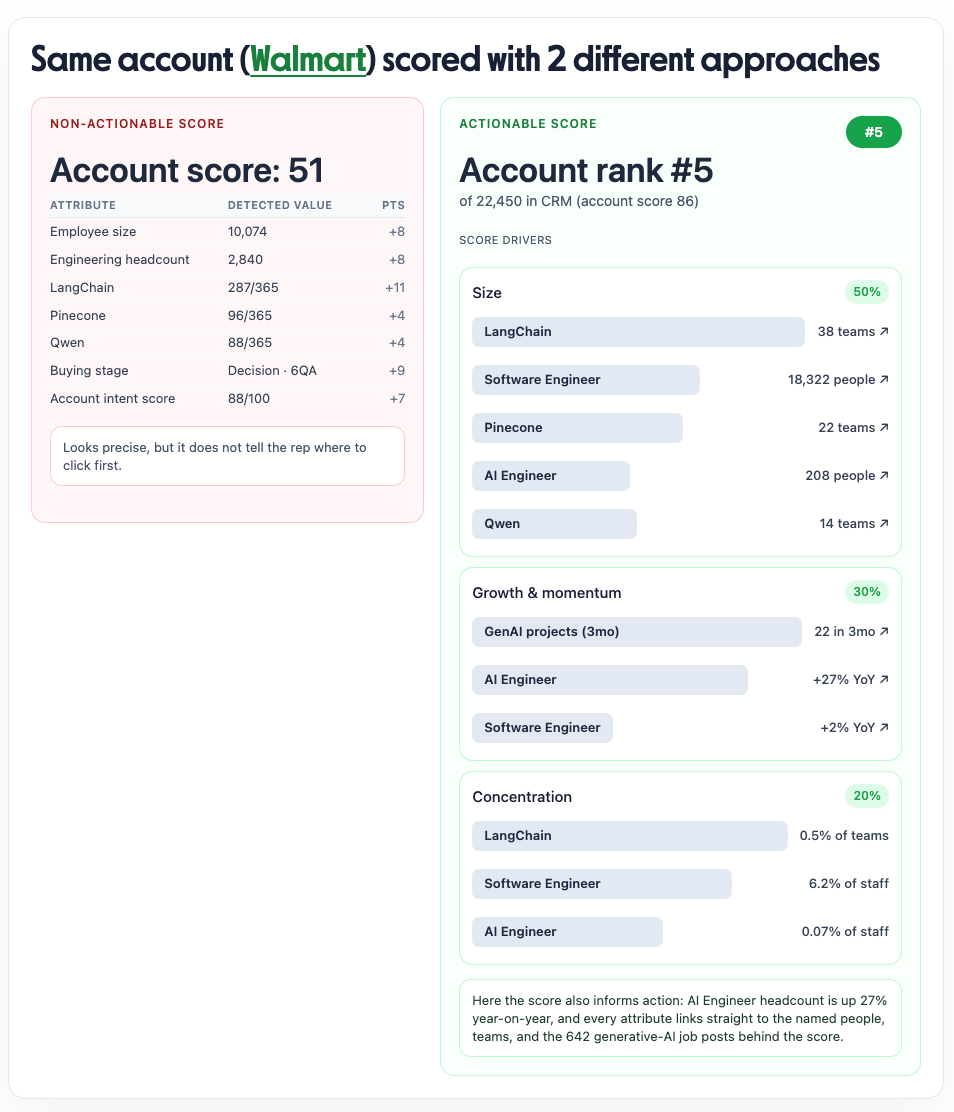
We’ve all seen a CRM that has an account score of “92” or “A3” as a custom field. But what is a sales rep supposed to do with that? Add them to the “A3 sequence”? No. And worse, because the rep doesn’t know what it means, they don’t trust it, so it doesn’t get actioned, and the scoring model does not improve over time. I’ve seen this vicious cycle countless times.
Tl;dr: GTM teams have been building Account Scoring that sellers don’t understand/trust/use, running on data that can’t separate a great account from a big one, only refreshed once a year.
The old way of account scoring, and what has changed
The thing that actually changed is the data you can build a model on.
The old models ran on the data we had, things like industry, location, employee count, and if you’re feeling fancy, latest funding. Those are blunt data points. They put JPMorgan, Apple, and every other big logo at the top of every list. Sometimes that’s right. But more often than not, it isn’t. Thanks to AI (and magical tools like Sumble), we can get—what I call—”rich” data points. They call it “derived data”.
Not “how many employees.” But instead, things like: how many SDRs, and is that number growing, and how fast year over year. Not “what’s their tech stack,” but which three technologies appear in combination, which tells you something a single tool never could.
The cadence of updating an account score has also changed. It used to be a project you did during annual planning, in a spreadsheet, and then mostly left to collect dust in a Notion folder. By Q2 it was stale. That cadence is part of why “account fit” got treated as a separate, frozen thing from “is this account in market right now?” (which is what sellers actually need). When you only re-score annually, fit is the only thing you can really model, because timing changes faster than your once/year planning. But a model running on live data re-scores continuously. So when a relevant signal fires, the account moves up the list on its own. You don’t wait for the next annual review to notice that one of your accounts just posted 10 reqs for SDRs. That collapses the wall between fit and timing, because timing is now just another input the model watches in real time. (Spicy take, I know).
The new rules of account scoring
Anthony, Sumble’s CEO, has looked at 40+ different companies’ approaches to account scoring. I was catching up with him recently, and he told me the same mistakes show up again and again. Here’s the playbook he’s shared that the smartest RevOps are running:
Show rank, not score. What does a 92 actually mean? Nothing a rep can use. But “your fifth-best account” means something immediately. A raw score is an abstraction. What sellers really want is a ranked ‘call-down’ list (with context).
One model, segments applied after. A common mistake is building separate models for SMB, mid-market, and enterprise. Don’t. Run one model across everything, then slice the ranked output into segments afterward.
Score size by role, not by headcount. Total employee count rewards the wrong thing. Walmart has 2M employees, and you almost never want to hand Walmart points for that. If you sell to sales teams, the size variable that matters is how many SDRs and how many AEs they have, not how many total people work there.
Use concentration, not just absolute counts. If you sell dev tools, 100 DevOps engineers at a 400-person company is a far more interesting account than 100 DevOps engineers at a company with 100,000 employees. The ratio tells you how central your category is to that business.
Pro-tip: Anthony’s preferred decomposition is three buckets: size, growth, and concentration. Size handles the JPMorgans. Growth surfaces the fast climbers. Concentration tells you how much the account actually needs what you sell.
Keep funding out of the model. People love putting funding in. But, it breaks things. Funding only applies to venture-backed companies, so JPMorgan scores a zero on it and every Series B startup gets a bump. The result is a model that artificially inflates venture-backed accounts. And the useful part of “they raised a lot” already shows up in variables that touch the whole universe, like growth rate. So, score growth and drop funding.
Calibrate against your golden accounts, then trust the eye test. Feed the model your closed-won list, or an aspirational target list, and tune it so those known-good accounts rank where they should. Sumble’s Skill sets the initial weights (out of the box) and fits it towards that golden set, then humans adjust from there. The adjustment is where trust gets built. That loop (model proposes, operator corrects) is how you turn the best rep’s tacit instinct into something the whole team can run.
If you want to build this yourself, you should check out this amazing (truly) resource Sumble put together: A step by step guide to world class account scoring in under two hours.
Score → reasoning (proof) → action
A score has to carry its own story. When an account ranks high, you should be able to click straight into why. If SDR headcount drove the score, you should be able to see the 36 SDRs by name. If the model says they use Marketo, you should be able to open the exact job description where that shows up. The score isn’t the end of the work. It’s the starting point for prospecting.
The Sumble team was showing me how it worked, and we came across a real example, in Sumble’s own account model: Sigma was ranking above Deel (a much larger account). On headcount alone, Deel should win. It has the bigger sales org. But Sigma’s reps were hammering the product, thousands of queries in the last few weeks, and 11 days ago Sigma posted a job to replace legacy SaaS tools and migrate logic into their data warehouse, naming Salesforce and Clay in the post. There’s a live project at Sigma that’s directly relevant to Sumble’s product. Deel may be the bigger potential ACV, but Sigma is the most likely buyer this week.
The old approach forced you to choose: a fit score that loved Deel, an intent score that loved Sigma, and a rep left to reconcile two numbers on her own. “A man with two watches never knows what time it is.”
The newer approach bakes both into one ranked answer, with weights you can see and move. Turn the size weight up and Deel climbs. Turn it down and Sigma does. The point is that the trade-off between “how big” and “why now” is made deliberately, in the model, once, instead of being silently dumped on every rep to have to decide dozens of times a day.
Old way: Sigma is an “84”.
New way: Sigma is “high usage, a live warehouse-migration project, sufficient sales team size, and here are the people to call.”
Why data matters more for GTM teams using automation and agents
Every CRO is trying to figure out how to scale GTM with AI & automation, instead of headcount.
In the age of agents, the data underneath your go-to-market motion matters more than it ever has. A rep can open with “saw you’re moving onto Databricks, here’s how we’re different” only if the underlying data is trustworthy. When a human sends that, a wrong guess is a little embarrassing. When an agent starts sending at scale, a wrong guess is your brand, multiplied across every account it touches.
Account scoring is the first branch in that decision tree. Picture 5,000 accounts in your ICP, ranked. Your “Tier 1s” get white-glove human attention, dinners, ads, and an AE who knows their name. “Tier 3s” should ‘only’ get automated outreach via agents. Both tiers are valuable, so both need to be right.
Data accuracy impacts so much downstream, things like:
Multi-threading
Health scores (expansion/retention)
Best path into accounts
TAM and whitespace modeling
Territory design
Messaging
Champion monitoring
Risk detection
New markets
If you get the scoring layer wrong, every one of these inherits the error since it’s the first branch in the tree.
Lessons learned from the field
Anthony has been doing forward-deployed engagements with their enterprise customers (some of the best software companies in the world, like Nooks, Atlan, and others), partnering with internal RevOps teams to build robust Account Scoring systems.
In my opinion, the company that sells a thing should be the best at using it. For Sumble, one of those things is account scoring.
Here are two customer stories and the takeaways.
Nooks ran Sumble’s Account Scoring Skill to build a model that both the RevOps team and sales team trust and can action. In the words of Michelle Idertogtokh (Senior Manager RevOps & Strategy at Nooks):
We stood this up in days, not the weeks-to-months projects of this caliber usually take: ICP definition → enriched, segment-calibrated, evaluated, deployed, and written back into HubSpot, in a few working sessions using their Claude skill in Cursor.
Easily some of the highest-leverage GTM work I’ve done.
And because the model runs across all of Sumble’s data, not just the accounts already in their CRM, it surfaced their whitespace: roughly 300 high-ranking accounts that weren’t in their CRM at all. That’s about two additional reps’ worth of territory, found for free as a byproduct of scoring the accounts they already had.
Atlan wanted something custom. They were a data catalog moving toward a semantic layer for AI, so the accounts they cared about were companies doing heavy AI and coding-agent work, the ones where they could point an agent at the right data store. They didn’t want a generic fit score. They wanted to score accounts on “AI readiness.” The model handled it, because the inputs are rich enough to define readiness in a way a binary tech-stack flag never could.
The mechanic behind all of it is a Skill. You point Claude/OpenAI at Sumble’s open-source skills repo and complete a quick setup. After that, it interviews you: who’s your ICP, what’s your email domain, do you want to read from Salesforce or HubSpot or just pull the account universe from Sumble. Then it pulls the data, builds you a local app with sliders for every weight, and lets you watch accounts move as you tune. Every score deep-links back to the raw evidence. There’s a whitespace view for the accounts you’re missing, and an evaluation view that works as a sanity check. Set up your own account scoring in under two hours.
Where this goes next
Sumble has the data infrastructure and the technical team to pull off what’s required to build s-tier account scoring models for the AI-era.
I’ve talked directly with Sumble’s team a lot on this topic and have read all their internal documents/blogs. They’re thinking very deeply about this topic, and I believe have started to crack a new way of doing account scoring. (Note: they’re working on several other deep Skills—beyond the account scoring Skill we explored today—like CRM hygiene, contact enrichment, account research and more).
Account scoring is now a live system that sits at the front of every routing decision you make, human or agent. An explainable model, calibrated to the accounts you’ve actually won and the instincts your best reps already carry, tells you exactly where to point your people and where to trust your automation. That’s the difference between a ranked call-down list reps actually work, and another “92” or “A3” sitting in the CRM that nobody touches.
PS: If you end up trying the Skill, let me know how it goes! And if you want to learn how to improve your team’s account scoring, chat with the team at Sumble—they’re all smart/awesome humans.

Thank you for your attention and trust. I do not take it for granted.
See you next time,
Brendan 🫡