


If you were forwarded this newsletter, join 10,199 weekly readers—some of the smartest GTM operators & founders—by subscribing here:
Thanks for reading this hand-poured, 100% organic, farm-to-table (human-written) newsletter.

Hey y’all! 👋
In November of 2024, I published an article titled “The Anti-AI SDR Company Coming Out of Stealth.” It was about Rox, led by Ishan Mukherjee (who exited his previous startup to New Relic). Fast-forward about two years, being anti-AI SDR turned out to be the right approach.
I wanted to follow up on that first deep dive that I wrote, especially in the context of so much that has changed across the GTM landscape, and get an update on what they’ve built since coming out of stealth. So, we’ll call this a deep(er) dive post. As a reminder, sponsored deep dives give me an excuse to go deep on products (and spaces) that I’m interested in writing about, even if they weren’t paying me (don’t tell them this ;)).
Rox is a revenue agent platform. They’re probably the fastest-moving company I’ve seen in the GTM tech space. “Cracked,” as the kids say. In under 24 months, Rox has gone from an unknown company to a force to reckon with. They’re building in SF and have raised over $80M across their Seed and Series A rounds from tier-1 investors (Sequoia, GV, and General Catalyst). And today, they’re launching Teams, the self-serve entry to their revenue agent platform, that any size team can use.
I’m excited to revisit what I wrote about ~20 months ago, unpack what Rox has been up to since then, and talk about where they’re headed from here.

Let’s get into it.
One of my favorite Paul Graham quotes is from a 2012 essay How to Get Startup Ideas. In it, PG says:
Live in the future, then build what’s missing.
Ishan and Rox are doing exactly this in the GTM world. They’re building for a world that does not yet fully exist, but is starting to emerge, and—if they’re correct in their bets—they’ll be perfectly positioned to support this new world with how they’re building Rox.
What I covered in my first deep dive
To recap, here’s what I said about Rox back in Nov of 2024 when they launched out of stealth:
1. Account-based agents. Rox’s central idea is account-based agents for quota-carrying reps. Traditionally, we think about task-specific agents or assistants (eg: an email-writing assistant, a research bot, a CRM plugin, etc). Rox flips this on its head. Instead of having agents for different tasks, Rox provides one dedicated agent per account. These agents scour public data, third-party data partners, and first-party tools like your CRM and data warehouse. Think: agents working 24/7 across every account in a seller’s book of business.
2. Software that gets smarter with time. I joke that gtm tech gets worse the more you use it, not better (looking at you, Salesforce… after several years of usage, it starts to look more like a 59-year old Mike Tyson trying to fight a 27-year old YouTuber… tired and past its prime). But, with Rox, it gets smarter the more you use it. Over time, the tuning kicks in and the more context you share with it, the better it will get.
3. Results, not “demoware.” I still remember what Ishan said when I congratulated him on their fundraise: “It doesn’t matter. What matters is: do reps find it useful? Does it make them more productive? And hopefully the productivity is significant enough where it changes the fundamental unit economics of the market. That’s pretty much our sole focus.”
4. Anti-AI SDR. My dumbed-down explanation of the product at the time was: “Perplexity/Claude Projects + Clay-lite + a slick workflow layer (plus… it uses dark mode—my kinda people).” It’s built for quota-carrying reps. Rox is explicitly anti-AISDR. It’s not trying to replace the human touch with automation, the way some are (and now walking it back). Their approach is to empower reps by helping them save time on: information gathering, wrangling, and all the other things that take time away from reps spending time IRL with customers. Fast-forward about two years, and this turned out to be the right approach.
5. Supercharge your best reps. Rox’s arbitrage is around the fact that reps don’t spend time in Salesforce anymore. And, maybe more interestingly, the data is not all in Salesforce anymore, but instead moving into the data warehouse (this is a very big deal). As the AI-era continues to unfold, I believe this data problem becomes even bigger, and the data architectural decisions will, therefore, become more important for GTM teams.
Building for humans AND agents
I was re-reading Rox’s Manifesto while doing research for this piece, and thought this excerpt was worth sharing to help (re)set the table today:
Our mission at Rox is to secure and grow the world’s revenue. We build revenue agents that either augment or automate the entire revenue life-cycle from inbound, outbound, deal management to renewals. Coding, Support and Legal agent categories are already maturing and are driving drastic productivity benefits. We believe Revenue agents will do the same.
Innovation in this vertical requires us to re-invent the way humans AND agents work from the ground-up across the data platform, the agent harness and the UI. As we explore the frontier, we will continue to post our learnings along the way for the community and incorporate our research into our product.
They even have a dedicated Research Program to help accomplish this audacious goal (seems their plan to deploy that $80M isn’t just on a bunch of google ads and SDRs), to solve the problem around why revenue agents are uniquely hard to build:
Revenue agents operate in one of the messiest data environments imaginable. A seller’s world spans CRM records, email threads, meeting transcripts, call recordings, LinkedIn profiles, company news, and dozens of other signals, all constantly changing.
What is Rox building?
Here’s how Rox describes themselves: “Rox is a revenue agent platform. Rox agents do the actual work of a sales team, like finding and researching prospects, running outreach, managing live deals, and handling renewals.”
Here’s my take: the old revenue stack is getting torn apart. And the best AI-native GTM teams are building a new stack to scale their revenue from $1M to $1T. This new stack makes legacy CRM and SaaS obsolete, designed for Revenue Agents to do more of the actual revenue work: everything from generating pipeline, helping execute deals, forecasting through renewals.
Anyone can hack together an agent over a weekend that demos well. But, deploying (and scaling them) into production in an enterprise revenue org is incredibly hard. To do it, you need three layers:
Data: one unified foundation across every source
Harness: makes agents reliable
Agents: actually do the work for sellers
Let’s unpack each one and how Rox is tackling it.
Data (warehouse-native)
If you’re a GTM nerd (you’re reading this little newsletter, so you probably are), you’ll probably enjoy this video of Shriram Sridharan (Co-founder & CTO at Rox) explaining the history of the database (Siebel in the 90s), to cloud (Salesforce in 2005), to warehouse (today).
Shriram goes on to share the journey of modern GTM teams and how their data setup is impacted by layering AI into their system(s).
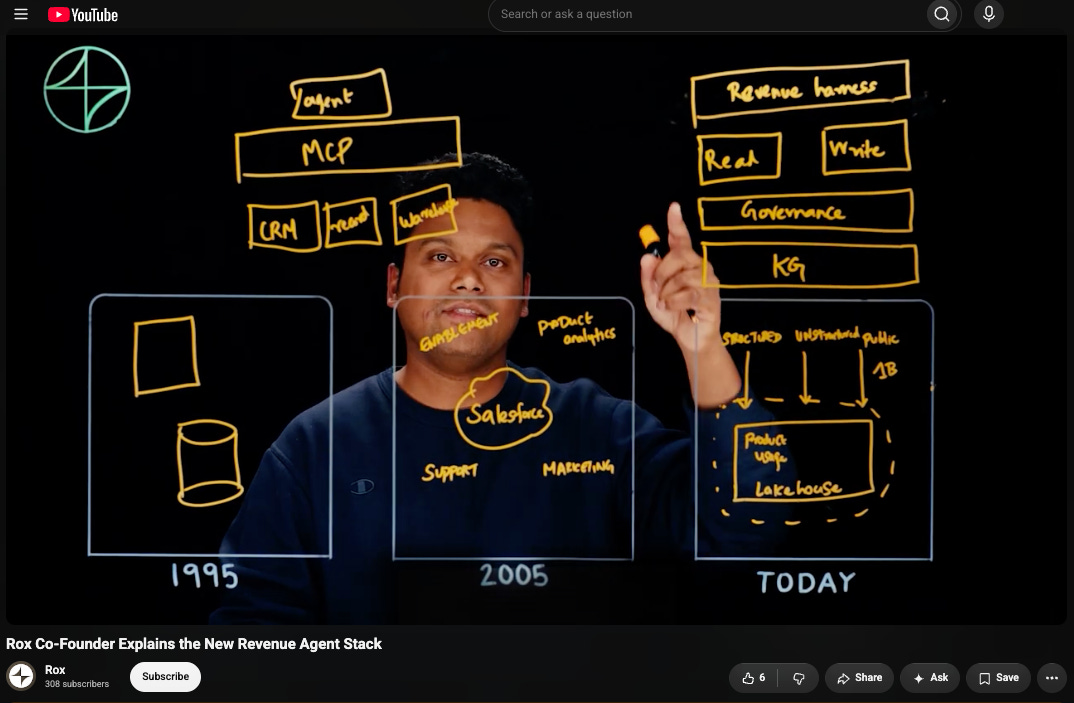
The whole (7 min) video is worth watching, but here’s the tldr:
The GTM data already migrated, out of the CRM and into the lake house.
That makes the lake house the system of record, the only place the full customer picture exists.
The lake house is now operational, which means you can run agents directly on your system of record instead of on a stale copy.
For teams setting up an AI-native revenue system, you have to rethink how your data is structured, or else none of the agentic workflows you layer on top will flop due to missing context or inaccuracies.
Harness
A revenue harness is necessary to make these magical models work for teams. They give you the right context about your business, while leveraging this powerful, alien technology that is LLMs.
Rox enables teams building their own custom revenue harness, by providing what’s missing with out-of-the-box technology. This enables teams to deploy agents reliably, safely, and at scale, by giving them the tools needed to do things like testing, governance, compliance, evals, and other (somewhat boring, but necessary) tasks to run agents in enterprise orgs.
As one example, I recently got a message from a (very impressive) GTM team who built a custom harness. They’re using Rox as a core piece of infrastructure to build on top of. This type of builder is more and more going to run GTM systems at the fastest-growing companies in the world. As Kyle Norton shared with us, you want to “build your intelligence and buy your infrastructure.” Rox is building said infrastructure, which means they’re well-positioned to slot into these types of teams/systems.
Agents
Rox is entirely focused on “revenue agents.” But, what does that actually mean in revenue orgs at mid-market and enterprise companies? Let’s jump into a couple of examples to show exactly how the best AI-native revenue teams are building agents using Rox.
Prospecting is dead as we know it. In Rox’s launch around outbound prospecting a week ago, Ishan said:
This isn’t a faster way to prospect, it’s the end of prospecting as a job that you used to do by hand. Your reps weren’t hired to click through contact lists, they were hired to engage with customers to close and grow them. So let the agents prospect, and live in Rox.
I don’t see this as AI replacing humans. That’s not what the best teams are doing. Instead, they’re using AI for certain tasks (like researching, admin tasks, etc) so that sellers have more time for creative and impactful work that AI cannot do. Agents enable (or superpower or augment) the best sellers on your team.
Another example of agents is having them run revenue end-to-end. “No SaaS, no CRM, no Enrichment. Just an agent.” This is a wild statement, but I think the right future (and apparently thousands of other people agree). Like I said earlier, Ishan and the team at Rox are living in the future, and pulling us into it.

Two years ago, Rox launched agents. And then, earlier this year, they hit an inflection point: their largest enterprise customers switched many of those agents from Copilot to Autopilot. Rox continues to help revenue teams build bleeding edge agents.
And (as of today) it’s all self-serve!
Rox has spent the last 2.5 years spending all of their time doing research and shipping products to solve problems at revenue teams in the world’s largest enterprises (AI-native companies like MongoDB, Ramp, WSP, Puma Energy, XBOW, and Together AI).
They’ve launched a dialer, live call coaching, AI sequences, custom apps for RevOps, automated workflows, org charts, inbound agent, account plans, deal review/forecasting, deck generator, mac app, voice mode, and (much) more. This company SHIPS.
And today, they’re opening up the entire platform to all, 100% self-serve. This is not a watered-down version of Rox. All you need to do is sign up, sync Salesforce, connect your data, and the agents are ready.
Give it a try (and let me know what you think if you do!) → Build your Revenue Agent stack today. Get a demo. Get started now.

One last thing: I’ll be in San Francisco on Tuesday, August 25th, for an event with Rox x Clay x OpenAI. Apply here to come hang with 75 GTM Engineers and RevOps leaders.
That’s it for today! Let me know what you think of today’s post (I read all the replies).
As always, thank you for your attention and trust. I do not take it for granted.
See you next time*,
Brendan 🫡
*For the legends who made it all the way to the end, here’s a sneak peek of our next few posts:
How a CRO manages his $30M revenue org through Claude Code
A look under the hood of the GTM tool built by a Director of GTM Engineering at a $1B company
The swimlanes between RevOps and GTM Engineers