


If you were forwarded this newsletter, join 8,162 weekly readers—some of the smartest GTM operators & founders—by subscribing here:
Thanks for reading this hand-rolled, 100% organic, farm-to-table (human-written) newsletter.

Presented by Clay.
Bring AI agents, enrichment, and intent data together and turn insights into relevant, timely action. Start building for free.
& Supported by:

Attention → AI Agents for RevOps
Clarify → The Autonomous CRM
Nooks → Agent Workspace for Intelligent Outbound
Sumble → Buying signals from tech stacks, people data, & active projects
11x.ai → Accelerate growth with a digital GTM workforce

Hey, y’all! 👋
I’m excited to continue to shine a light on the smartest GTM operators today. I had the pleasure of interviewing two of the best in the game recently. And wrote this piece (with their feedback). It was surprising and refreshing. Anyone building a modern GTM engine should learn from them. I hope you enjoy it.
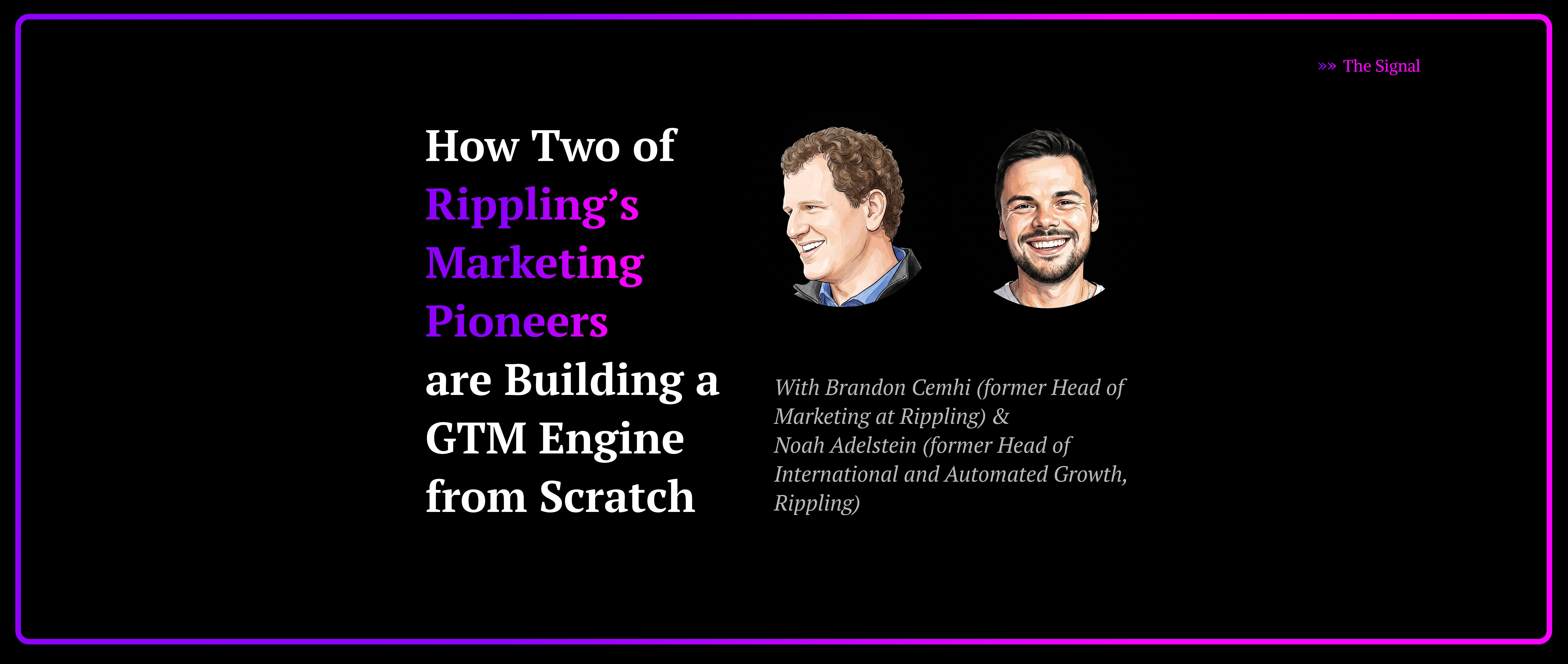
Brandon Camhi joined Rippling in November 2019 at ~150 employees and $10M ARR as the first growth marketing IC. Over the next six years, he then built Rippling’s growth team, and went on to lead all of marketing through nearly $1B in ARR. Noah Adelstein was his Head of International and Automated Growth.
Earlier this year, Brandon joined Netic (a Founders Fund and Greylock-backed AI revenue engine for essential services) as their COO. Noah followed him to lead Growth (and also writes an amazing newsletter, the gtm engineer).
These two helped build the GTM playbook at Rippling to a massive scale. And now they’re building the machine again, from scratch. Fresh slate. With AI at their disposal.
That’s why I saw it as a unique chance to hear first-hand how two people who have “been there, done that” are doing it with all the latest in 2026 (roles, tools, motions). I don’t think there’s a better pair of people to hear from when it comes to building a modern marketing engine.
I went into this conversation expecting to hear about Claude Code workflows and fully agentic outbound systems. “More agents than humans” was the title I imagined I’d be giving this post.
Instead, I left with a thesis I didn’t expect: the marketing principles of the best teams are timeless, and the foundation matters more than the tooling. Collecting learnings is a job for humans, not AI. The perfectly built agent can’t scale something before a human—with taste and intuition—collects the context first.
There is too much focus on the tooling and what is new, when in reality, what really matters is the same set of foundational marketing principles. And, what will really matter as AI advances is not who has the best agent, but who can best use these new capabilities to tell incredible stories and move the minds and hearts of the market.
Their contrarian takes were refreshing. So, I was grateful they were willing to spend time sharing with me to put this piece together.
Alright, enough of my thoughts, let’s get to the golden nuggets of wisdom they dropped.
Alpha is in the timeless marketing principles of the last 100 years
There is no shortage of fomo on our feeds about how we’re all behind when it comes to using AI in go-to-market. I’m as guilty as anyone of this. Yet, Brandon’s main point in our conversation rings in my ears still:
The things that always unlocked alpha for me paired a deep understanding of the latest tactics with the timeless principles on human psychology and storytelling that have informed great marketing for the last 100 years.
And then the question becomes: “how much is the tactical landscape really changing versus the bar for execution on that same tactical playbook is going way, way up?” I would argue that the biggest shift is that the “permission to play” quality bar on the same set of tactics is rising every day. And over time, the returns will accrue to the teams that deeply understand how to tell incredible stories that resonate.
It’s not that you shouldn’t be using AI (obviously, you should). It’s just that AI doesn’t replace the timeless principles of marketing from the last century. AI raises the bar for execution.
Hire spiky mutants, not generalists
Brandon shared how he’s thinking about building a lean team at Netic, instead of scaling a marketing org to 100+ people (which was the playbook for almost every SaaS company until recently). AI changed that equation. He said (I love this line):
I’d rather have a small team of mutants who each are spiky in one or more areas than a larger team. Each person on the team should raise the bar on a different dimension.
Spiky means exceptional at one specific thing, not competent at everything. AI can automate a lot of the work that used to require many heads. Which means you want people who are amazing at a few things, and you can eventually build automation on top of their work. Some portion of the job is gone, and so you have to nail what’s left: taste, analytical skills, creativity, etc. (depending on function).
For Netic, that means five core pillars: Growth, Content, GTM Engineering, Events, and Product Marketing.
Fewer seats. Higher bar (and more scope) per seat. And a much clearer expectation that each person is a bar raiser on a specific dimension.
Where to search for Alpha (and where not to)
Part of being intelligent about GTM Engineering is knowing what dimensions you want to get alpha on and which ones you want to hold steady. Brandon framed it simply: where do you want to build your secret sauce, and where do you want to do no harm?
One example: Netic chose Salesforce as their CRM. People were surprised when Noah told them because he seems like the kind of operator who would go with one of the new AI-native CRMs (or just build it in-house). While an AI CRM might unlock some upside. It could also be brittle and break in ways that cost you more than the alpha is worth. Salesforce has the deepest integration ecosystem. It’s a known quantity. They chose predictable reliability at the infrastructure layer.
An example of a place they chose to find alpha: building out their TAM. Instead of pulling a standard firmographic list and calling it a day, they used creativity and thoughtful market context to go deep. They determined that using a new, innovative “source of truth” may not give them an edge. But creative workflows and applications on top of it would.
They’re still early in figuring out their tech stack, but current (other) tools include: Salesforce and Gong (as examples of getting the foundations right), and then Replit and Claude Code (as ways of building on top), and Clay (for things like lead orchestration, inbound enrichment, and signals).
I think this is one of the most useful mental models for any GTM leader right now. Every week, there’s a new tool or tactic on LinkedIn or X that feels urgent. Brandon pointed out that the best operators have the judgment to know which bets compound and which ones are distractions.
SDRs aren’t dead; dumb SDRs are dead
Netic has two SDRs right now. Both are senior; one was previously a manager of a 15-person team and is now back in the trenches. Both understand the space deeply (deep customer empathy).
What’s different from a traditional SDR setup is how tight the feedback loop is. Every week, Noah runs what they call a “Shark Tank meeting” with the SDRs. He surfaces signals, they align on account selection criteria, and then they review emails being sent, live conversations happening, and responses. That feedback gets baked back into the following week’s account selection, signals, and messaging.
It’s a very deliberate system where the SDRs are generating context, pattern-matching, and building the playbook that the Growth/GTM Engineers (GTMEs) will codify over time.
Here’s a quote from Noah’s recent piece (the entire thing is worth reading) on his terrific newsletter, the gtm engineer:
Even if we thought we could use AI to automate everything Grif and Aidan are doing (and we don’t), the priority is learning whether outbound works
One specific example Noah shared: when an SDR comes across two CEOs—one with no digital presence and the other with one—they know to handle the outreach to those two CEOs completely differently. That intuition is something you can’t templatize on day one. Only humans can quickly gather that context.
Brandon and Noah are hiring across Growth, Content, and GTM Engineering. If you want to be part of a world-class GTM org selling a product with breakout PMF, reach out to Noah.
Earn the right to automate
This was the throughline of the entire conversation.
Brandon told me: “The best alpha comes when you’ve built deep intuition on your market, and already have a sense of what works.”
He argues that one of the biggest mistakes a company like Netic could make right now is rushing to automate every workflow before they’ve actually built an understanding of what works. They’re not anti-automation. They’re just sequencing it correctly. The SDRs are accumulating context. When the GTME comes on board, they’ll have access to all of that accumulated knowledge, so they can automate the right things instead of guessing.
Noah made the case for why this works better with dedicated humans. He said (and this is coming from someone running one of the biggest GTME podcasts/newsletters in the world): “You get the context way faster when you have humans full-time thinking about it, versus a GTME who’s splitting time across eight other projects.”
This is a pattern I keep seeing at the best companies. The ones who automate well are the ones who did it manually first, learned what actually worked, and then built systems around the proven playbook. The ones who automate poorly are the ones who skipped the manual phase entirely. One note: for orgs that are farther along, the manual work may have already been done, and you can drive meaningful alpha by finding it and automating. So, if a company has 1,000 sign-ups per month, CS needs help. At that point, you would “watch the process + automate” (since you’re already doing it manually).
Noah also said: “Go prove the ceiling is sufficiently high before you think about all the automation.” If something doesn’t work manually, automating that thing definitely won’t work.
For example, if you go look at your inbox right now, you’ll see that most outbound emails are still bad. The reason is that people took the C+ or B- version and scaled the hell out of it with AI. They automated mediocrity. Noah’s challenge: Have you sent a single email (even one!) manually that has gotten a positive reply? If the answer is no, why are you trying to send 100,000 emails a month?
You can still cut through the noise. You just have to do it well. The teams that find the A+ version, write the emails manually, prove the message works, and then automate it—those are the ones that win. Everyone else is producing more noise at higher volume.
Brandon took it further: “I would take a totally analog GTM hire/org that produces hyper-relevant things over a fully automated one that isn’t working. AI is a means to an end. You don’t want your GTM org to be known for being AI-pilled. You want it to be known for producing awesome, valuable things.”
They both are using AI. Just as a means to an end.
Every Exec needs to be in these (AI) tools
Brandon went from leading a ~200-person marketing org at Rippling to personally coding things himself at Netic. Building marketing assets. Getting inside the tools. His view is that leaders of the future need to be immersing themselves in this stuff, because the way you execute the same types of tactics is changing, even if the tactics themselves aren’t.
The current environment has created more noise than ever before, more competitors, more emails, more everything. And AI will continue to exacerbate this new reality.
Here’s what Brandon said about the current moment:
The playbook is actually a lot of the same things, like events, signals, driving engagements, etc. But AI slop has made it such that the way you need to execute it: the need for authenticity and caliber is way more important.
Execs (including Brandon) are getting their hands dirty. Building things that, two years ago, would have been delegated three levels down. Now, you can (and should) build these things yourself—all of the best executives and founders are hands-on right now.
The playbook is broadly the same. The channels, the motions, reaching the right company at the right time with the right message. It’s just that the bar for execution is much higher. And leaders who aren’t operating inside the tools are going to fall behind.
There’s a lot of noise on LinkedIn right now about reinventing GTM from scratch. New playbooks. New roles. New everything.
Brandon and Noah are building from scratch at Netic with every advantage you could ask for: Rippling-scale experience, backed by Tier 1 investors, and a market (service enterprises) that’s massively underserved by modern GTM tooling. And their takeaway after six years of scaling one of the fastest-growing B2B companies in the world?
If you’re building a GTM org right now, the question isn’t whether to use AI. Of course, you should. The question is whether you’ve earned the right to automate, whether you know what works before you scale it, and how to use AI to accelerate certain JTBD if/when helpful.
Picking winners
Noah also pointed out that winning in GTM is about picking the right company. You can come up with all these crazy AI go-to-market tactics, but the most important thing is whether people really like the product. And the best sign of PMF is revenue traction without anything built out in GTM yet. Brandon added: “I think GTM magic happens when you pair an incredible product and market and founder with top-notch GTM creativity and execution.” That’s Netic.
So if you are looking for a winner, check out Netic. They’re hiring across Growth, Content, and GTM Engineering. If you want to be part of a world-class GTM org selling a product with breakout PMF—an engine with humans at the center, where you’ll be asked to build “jaw-breaking” outbound experiences—reach out to Noah.
PS
Here is the original interview clip (8 mins) that caught my attention. If you read this far and want to hear more from Noah and Brandon directly, it’s 100% worth watching:


Thank you for your attention and trust. I do not take it for granted.
See you next time,
Brendan 🫡
Topline was kind enough to ask me to write a guest post for their newsletter (125K readers). You can check it out here:
