


If you were forwarded this newsletter, join 7,844 weekly readers—some of the smartest GTM founders and operators—by subscribing here:
Thanks for reading this hand-poured, 100% organic, farm-to-table (human-written) newsletter.

Presented by Clay.
Bring AI agents, enrichment, and intent data together and turn insights into relevant, timely action. Start building for free.
& Supported by:

Attention → AI Agents for RevOps
Clarify → The Autonomous CRM
Nooks → Agent Workspace for Intelligent Outbound
Sumble → Buying signals from tech stacks, people data, & active projects
11x.ai → Accelerate growth with a digital GTM workforce

Hey, y’all! 👋
I recently had a chance to sit down with Alec Paul, the founder of SalesBrand.
He’s the guy behind some of the best B2B CEO brands on LinkedIn (like Adam Robinson, Gal Aga, and others). He doesn’t post for them (he’s not a “ghostwriter”). He teaches them how to post for themselves, what to say, and how to say it. Hence: “The Rick Rubin of LinkedIn” (as Sam Jacobs described him). He makes the artist sound like themselves, but better.
I asked Alec to look over my LinkedIn feed and rip it apart. And, apart, he ripped it.
I recorded the conversation (just for myself). But then, after the fact, I realized some other people would find it valuable. So I asked Alec if I could share a summary of our conversation, and he said yes. So, here we are. :)
So, let’s get to it.
Tip #1: ➜ “Double my impressions” is not a silly goal
At the beginning of the call, Alec asked me what my goal was, and I (reluctantly) told him: I want to double my impressions on LinkedIn. I half-expected him to tell me that was a vanity metric.
Instead, he said, “That’s not silly. That’s a great goal.”
But with one important qualifier: it needs to be the right impressions. Doubling your reach means nothing if you’re reaching the wrong people. If your content starts going wide and attracting a general audience that doesn’t match your niche, you’ve traded depth for breadth. And for a newsletter like The Signal, depth is the whole business model. The readers are coming back because the content is made for them, not for everyone.
So yes, chase eyeballs. But measure the quality of the views, not just how many.
Tip #2: Spread your posts out
I was posting three times in one day, then going dark for three days. Alec’s reaction was immediate: stop doing that.
Spread them out. One thought leadership post. One lighter post (more on that later). Consistency matters more than volume spikes. The algorithm rewards it and your audience starts expecting you.
His rule of thumb when you do post more than once in a day: space them at least 4 hours apart. Back-to-back posts cannibalize each other’s reach.
Tip #3: Every post needs to pass the “What is this about?” test in two lines
This one was the biggest takeaway from my conversation with Alec.
Alec scrolled through my feed and kept saying the same thing: “I have no idea what this post is about.” He’d get to line four or five before figuring out the topic. “By then, most people have already scrolled past.”
If a reader can’t tell what your post is about in the first two lines, you’ve already lost them. The hook can’t be an afterthought. It’s the thing that gets people to stop scrolling on their feed.
Related: Alec’s 10% Strong-Opinion Test. If less than 10% of people strongly disagree with you, your opinion isn’t strong enough. The reaction you’re chasing is “Amen, someone finally said that” from part of the audience while others push back.
Tip #4: Screenshot, don’t “reshare”
Alec saw what I’ve been doing and said he’s seen it work for others too. Where you screenshot a tweet, paste it into a LinkedIn post, add your own commentary on top. It consistently outperforms LinkedIn’s native reshare feature (I wish LinkedIn made an effort to make “reshares” a real part of their feed, like it is on X… maybe one day… cc LinkedIns-Product-Team).
The screenshot is the visual hook. Your commentary is the post.
Tip #5: Never double-link
I had a post with both a Substack link and a Luma link. Alec flagged it instantly. “I don’t think I would do the double link.”
One link per post. Pick the one that matters most. If you’re torn, put the secondary link in the first comment.
Tip #6: Cut the link preview
LinkedIn auto-generates a link preview box when you include a URL. It looks terrible and it tanks reach. Alec pointed to multiple posts of mine where the link preview was the problem (see example below).
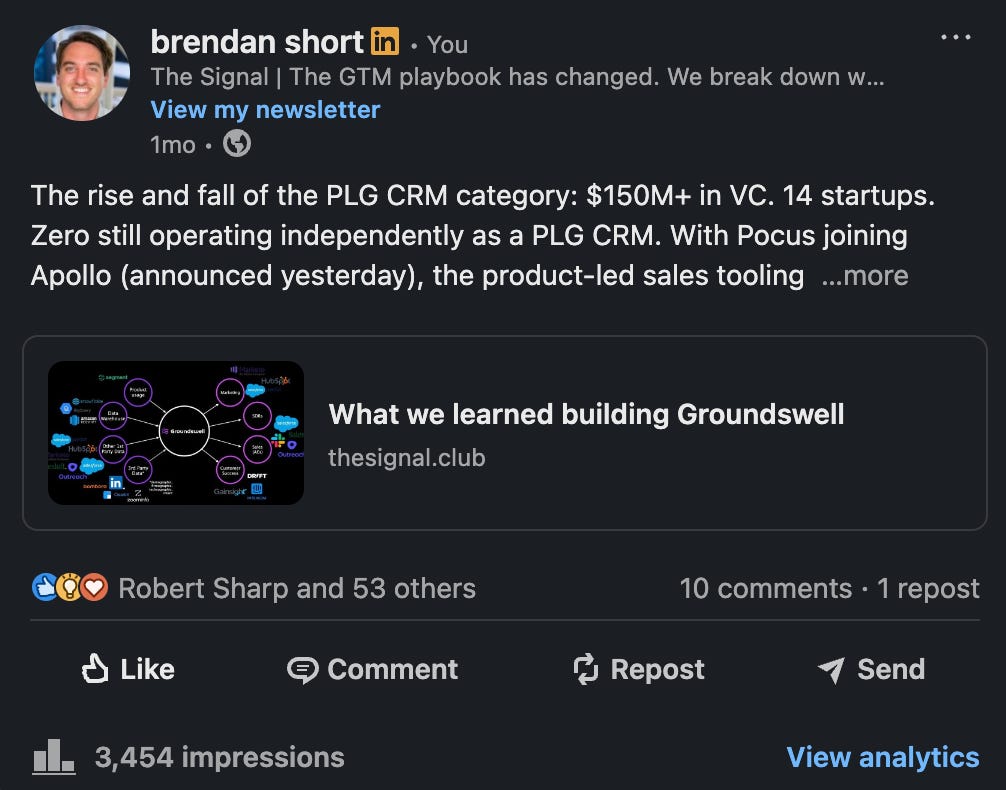
The fix: use an image instead of letting LinkedIn auto-generate the preview. Put the link in the first comment, or write it as plain text (eg: TheSignal.club; no https://).
Note: If you schedule a post and then edit it after publishing, the link preview often comes back. Watch for that.
Tip #7: Tag strategically, or don’t tag at all
I had a post with a bunch of company tags. Alec’s framework: only tag companies and people you believe will actually engage. Clay and Attention will engage. Salesforce and HubSpot probably won’t.
Too many tags, especially from big companies that aren’t going to respond, makes it look like engagement bait. Small, LinkedIn-active companies and individual operators are worth tagging. The big dogs are busy and don’t care. And that hurts reach.
Tip #8: Link to conversion-optimized pages
I don’t know how to solve this yet (since I use Substack).
Alec looked at my Substack page and said it’s not designed to convert. He’s right. Substack is great for writing and distribution, but the landing pages aren’t optimized for cold traffic.
His recommendation: for gated content (reports, data, tools), link to a dedicated page with an email gate. Not Substack. I may test this in the future. The newsletter link in my LinkedIn bio and profile can still point to TheSignal.club, but when I’m driving traffic from a specific post, it should go to a page that’s built to capture emails.
Tip #9: Collect outcome-based social proof, not compliments
People DM me all the time saying they love my content, and sometimes I share those. Alec’s point: “that’s nice, but it’s not useful for growing.”
The social proof that actually converts is outcome-based. “I attended your MCP webinar last quarter, built an automated account scoring system the next week, and got promoted two months later.” That social proof is a great LinkedIn post. “Your content is amazing” is not.
When someone messages you saying they love what you’re doing/building, dig deeper. Ask what they achieved because of what you shared. Ask what changed. Get the outcome. Then turn it that into a post (with their permission).
Tip #10: Break your newsletters into individual LinkedIn posts
I published a piece called “9 Lessons from 11 Growth-Stage Companies Building GTM Agents In-House.” It did well on Substack (above my average number of views for a piece). Alec looked at it and immediately asked: “Did you break all these 9 lessons into individual posts?”
I hadn’t. I should have. (I still should.)
Each lesson is its own LinkedIn post. “Here’s how Vercel built an inbound AI agent. Here’s the stack they used.” That’s a week of content from one newsletter. I sometimes spend 15+ hours on a Substack piece. But don’t spend any time driving traffic to it (outside of existing subscribers). This is something I need to spend more time doing.
Tip #11: Nichemaxxing
Alec shared an article with me, where TBPN’s Isaac Medeiros coined a term: nichemaxxing. The idea is that if The Signal ever hits 100,000 subscribers, I’ve failed.
That sounds counterintuitive. But it means I’ve gone too broad. I’ve diluted the audience. I’ve started writing for “people interested in business” instead of “B2B GTM operators who want to know how the best teams are using AI right now.”
As Isaac put it:
How do brands win in a world where content is democratized, algorithms feed you perfectly tailored interests, and everyone can compete for attention? The answer is nichemaxxing. Real experts. Real points of view. Real people delivering real value. Things AI can’t easily reproduce.
In a world where AI can generate infinite generic content, the moat is specificity. A niche audience, served by someone with real experience in their exact world, is the one thing that gets harder to replicate, not easier.
This works for a SaaS founder building content as they try to win a market.
Tip #12: “Has changed,” not “is changing”
Small language detail, big positioning implication. I was describing The Signal’s thesis as “the go-to-market playbook is changing.” Alec corrected me in real time: “Has changed.”
He’s right. “Is changing” is passive. It implies you’re watching from the sidelines. “Has changed” is definitive. It implies you know what the new playbook is and you’re going to show them.
The meta point here is: every word in your positioning matters. This one word made the whole thing sharper. You have to take a stance to stand out. Controversial takes get attention.
Tip #13: Video matters, but start scrappy
Alec and I talked about video for a while. His take: Zoom-style talking head video is going to be hard on LinkedIn because the feed is saturated with it. Everyone’s on Zoom all day. They don’t want more of it in their content.
If I’m going to do video, it needs to be either high-production (not necessarily expensive, but better than a Zoom call) or interview-based with screen shares showing real workflows and tools. The visual has to be interesting enough to stop the scroll.
But he also said, “Don’t wait for the perfect setup.” TBPN’s first episode was filmed in a terrible-looking office. Start now, improve over time.
Tip #14: Don’t invest in the company page
I asked Alec if I should be posting more on The Signal’s LinkedIn company page. His answer was fast: “Not worth your effort, probably. You can keep it alive so it looks like you have a presence. But the reach from a company page is a fraction of what you’ll get from your personal profile. And the time you spend trying to grow it is time you’re not spending making your personal content better.”
Anecdotally, I almost never read posts from company pages (I feel like they are ads), but I read plenty of posts from founders talking about their products/markets. People buy from people. Same thing applies here.
A few more from Alec’s playbook
These didn’t come up in our conversation, but they’re worth stealing. I found these when I (Claude) was doing research on Alec’s perspectives:
Old Way vs. New Way. Don’t post about your company and how great it is. Contrast how something used to be done with how it should be done now, and cast yourself as the narrator of the shift. Your company becomes a character in your story, not the subject of it. (source)
Content Market Fit. Post 10–15 times, then look at which posts drove profile views and DMs, not likes. Double down on those formats. That’s how you find your version of PMF for content. (source)
Lead your headline with your title, and use “CEO” not “Founder.” At VP and above, leading with your title means other execs accept connection requests without clicking through. “CEO” also signals more authority than “Founder” on LinkedIn. (source)
The first-comment cheat code. Follow 2–3 creators with 100K+ followers, ring their bell, and jump on the post immediately with a substantive comment. An alternative framework, a resource, a real opinion. Not “great post.” Your comment shows up in their audience’s feed, passively. (source)
The “steal their audience” search hack. LinkedIn Search → People → All filters → set location + industry → Followers of → add a competitor or industry authority → Show results. Instant ICP list, no Sales Nav required. (source)
Don’t hire a ghostwriter. This is Alec’s own position, despite being one of the best in the game: “The main thought leaders write their content. Once you start, it gets easier.” He calls his role “publicist and acting coach,” not writer. (source)
AI-written posts have a Welshian accent. His warning on AI tools: “ChatGPT was trained on Justin Welsh, and that’s why 90% of the AI LinkedIn posts you see have a Welshian flair to them.” The tools make everyone sound the same, which undercuts the one thing that actually works: authenticity. Avoid AI-slop! (source)
I believe founders and operators who build authentic audiences on LinkedIn over the next 12 months will have a meaningful distribution advantage over everyone else. The ones who wait will be competing in a much more crowded field.
And this will be even more true, as our feeds fill up with more AI slop with each passing day.

Follow/reach out to Alec Paul to learn more from the guru, directly. He’s legit.
Thank you for your attention and trust. I do not take it for granted.
See you next time,
Brendan 🫡
Related posts:
Alec is an absolute legend and what a value packed post!
loved this! :)