
If you were forwarded this newsletter, join 10,498 weekly readers—some of the smartest GTM operators & founders—by subscribing here:
Thanks for reading this hand-rolled, pesticide-free, farm-to-table (human-written) newsletter.
Presented by:
Clay is the infrastructure GTM engineers build on. Start building for free.
& Supported by:
Attention → AI Agents for RevOps.
Clarify → The Autonomous CRM. Sell more, admin less.
Clearskies → The Context Layer for Revenue AI.
Nooks → Revenue infrastructure for humans and agents.
Rox → Revenue Agents for the Global 2000.
Sumble → Buying signals from tech stacks, people data, & active projects.
Terret → The answer-to-action engine for revenue teams.
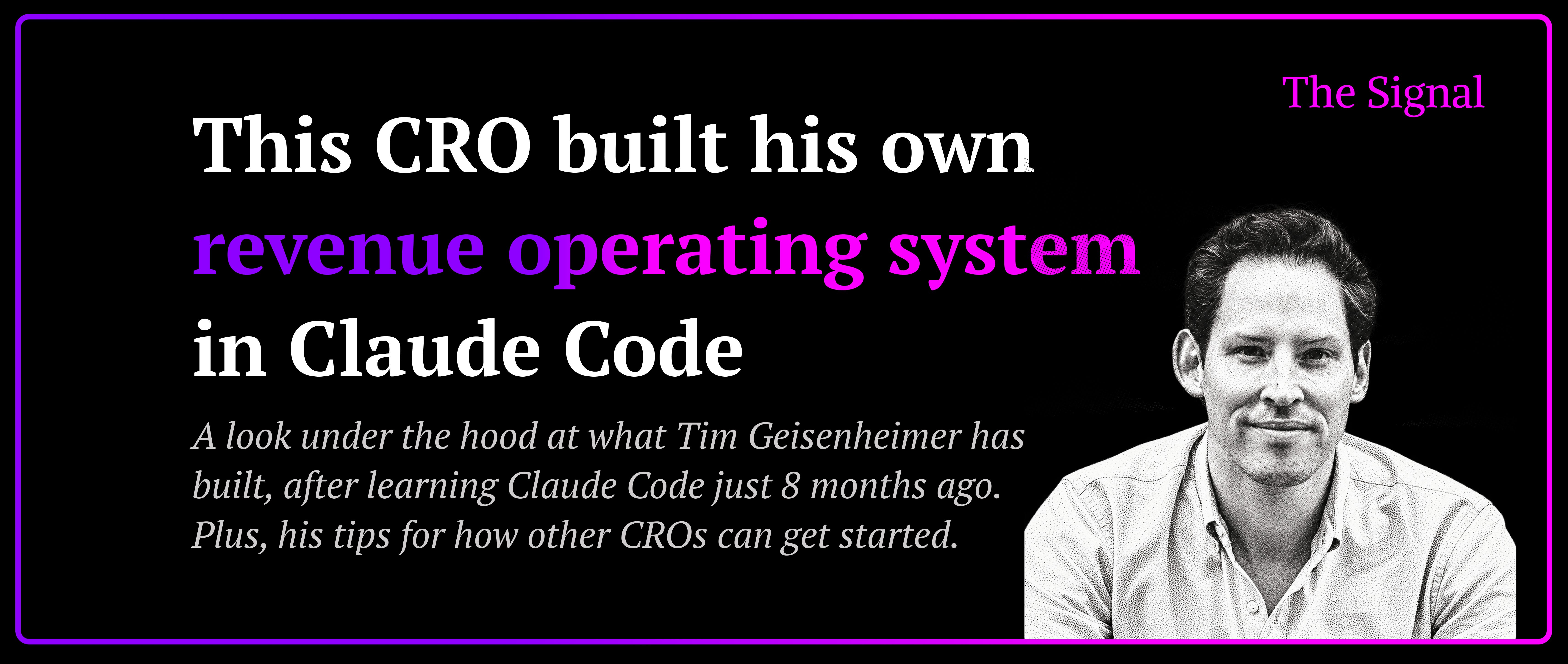
I used to compete directly with Tim Geisenheimer (he was running Correlated, while I was building Groundswell, both in the crowded “product-led sales”/PLG CRM space). And Tim was, by far, the best salesperson of the batch of ~20 competitors. We’ve stayed in touch, and over the last few years, I’ve watched Tim successfully build a killer Revenue team as CRO of Hatch, ultimately leading to an acquisition to Yelp. He recently showed me some of the stuff he’s personally building, and was kind enough to share it with us today (he also shares his tips for any revenue leader who wants to go from AI-dabbler to Claude Code/Codex/Cursor-pilled).
Today, Tim’s 100+ person revenue org runs downstream of Tim’s Claude Code sessions. Across 8 custom internal apps, 20 AI skills, and a whole system of self-reinforcing tools, he’s pushed his org to level up how they source, track, and close deals.
Tim opened a terminal for the first time in his life over winter break, just 8 months ago. Opus 4.5 had just dropped and he was spending a little too much time on X, and he got curious. Kids asleep, movie on, laptop open, while his wife made fun of him (...I’ve been there).
A few months later, Hatch (a top AI lead management platform) was acquired by Yelp for $300M. At the time, Hatch was doing $25M ARR and growing 70%. Things have only accelerated from there: since the close, his revenue org has grown from roughly 17 sellers to about 100. Tim says that Claude is a big part of what made all of this possible.
I’ve been on the hunt for GTM leaders at *scale companies (*dozens or hundreds of reps, complex gtm systems, and several products+personas, etc.) who are hands-on-keyboard with this stuff, and the list is short. Last month, I broke down how Nikko Georgantonis, Hightouch’s RevOps leader, runs their revenue engine on GitHub. I called Kyle Norton the most AI-pilled CRO in SaaS. Tim is coming for the belt.
Tim walked me through the whole machine he built at Hatch. Here’s what we cover in this article:
How Tim got started
How his system is actually structured
The first two things Tim built
What Tim and his team are building next
Where Revenue leaders should start with Claude Code
Takeaways
Alright, let’s get into it.
How Tim got started
The entry point was a Teresa Torres video when Tim was scrolling X on a Saturday night. Teresa tweeted that she manages her whole life with Obsidian and Claude Code, and Tim figured he could build a chief of staff on top of the same setup. He pulled in his calendar, meeting notes, and Slack. From there, he caught the bug…
I just got addicted. I started building things, messing around, learning how far I could go.
The transition from personal hacking to building a real system for his day job happened fast—out of necessity. Right as Tim started tinkering, the Yelp acquisition closed and the revenue org started scaling from ~17 sellers toward 100 people, which created lots of scaling problems that needed to be answered (and fast). How do we ramp reps faster? Who needs coaching, and on what specific things? Why did bookings dip last month in xyz segment? Where will this month actually land?
Tim told me the old way of doing things would have been to procure a bunch of software to solve these problems. But then it hit him… “I bet I can point Claude at a bunch of these.”
For the record, Tim does not know how to code. Keep that in mind for everything that follows.
How his system is actually structured
Tim can start a fresh session and ask any question he wants. So, for example, he could type in (or Superwhisper) “2 weeks ago we were doing a closed-loss analysis, pull it up and turn it into 3 slides,” and it does. Here’s how his system is able to answer any question he throws at it:
On the data side, MCP connectors and APIs feed Claude Code from HubSpot (pipeline and deals), ChartMogul (MRR and churn), Attention.com (thousands of transcripts), BigQuery (product usage), plus Slack, email, and meetings.
A system like this only works if you feed it (and maintain) the right context. Tim added 18 curated context files describing how Hatch goes to market, 43 memory files of gotchas and decisions, and (one of my favorite artifacts in the whole system) a “Sales Bible” distilled from 409 calls of Tim’s #1 rep. He studied what makes Hatch’s best seller good and wrote it into the files every agent reads. That tacit knowledge is gold.
It all lives in GitHub. “GitHub is the memory,” Tim says. “Commits are just different sessions. Anything I work on gets committed back. I don’t open GitHub. It’s just there.”
And Clay sits under the hood of it all. Enrichment runs in Clay and lands as HubSpot custom properties, so Claude reads it through the CRM. Tim has also started poking at Clay’s new CLI and API.
The system turns a bunch of little tasks into automations.
What used to be my Sunday night is now a single automation.
Daily. Upsell signals get scanned overnight and posted to Slack by rep at 7am. Every closed-won deal gets a CS handoff doc written from its own call history, hourly. At 5pm a headless agent sweeps Slack, email, and meetings into Tim’s task list and DMs him the digest.
Weekly. Rep, manager, and SDR scorecards roll up into his Monday leadership brief. A midweek deal-level forecast ships with risk scores and the top-15 must-win pipeline list. The Friday sales all-hands deck refreshes itself from live data.
Monthly. On the 20th, a scheduled agent emails Tim that it’s time to run the end-of-month deal push. At month end, a “path to close today” gets written for every late-stage deal (from the CRM plus the deal’s own calls), and an MRR decomposition explains what grew, what churned, and why, customer by customer.
The first two things Tim built
The CRO Cockpit
Tim built his forecasting war room over a weekend. It was live for managers to use on Monday morning. Four months later, it’s the default screen for sales leadership. Roughly 39,000 lines of code, 188 commits, and Tim as the only author. All built by a CRO who couldn’t code before December.
He told me his starting prompt was basically just “look at state-of-the-art forecasting tools like Clari, review the documentation, then use our context files to build similar functionality tailored to our business.” (This was the Opus 4.8 era, pre-Fable/Astra.) Managers layer their commits and calls on top, so the forecast becomes a blend of AI and human input.
Tim shared with me that they recently created a new lead channel that generated hundreds of inbound leads. Because of the spike, most of them weren’t routed and followed-up with correctly. So, that night, with the help of Claude Code, Tim shipped a live tracker tab, plus a daily alert that showed untouched leads (and the rep’s name who was responsible for each one). He was then able to add several features that the managers wanted within 24 hours. This speed of iteration is a good example of what’s possible when the CRO owns an in-house build personally.
Within 48 hours, the majority of the leads had been touched, response time was down significantly, leading to almost 100 demos booked. (Tim proactively mentioned other contributing factors: manager oversight/accountability and a leaderboard everyone can see.)
Deck Studio
Tim was unimpressed with Gamma and Google Slides for building on-brand decks that also know the business. So he built his own workflow. Reps type a brief (or drop in a transcript) and get a finished, Hatch-branded customer deck in minutes, with real case studies and battle cards baked in. It runs on $20/month of hosting.
Thirteen weeks in, the team has produced 377 decks across 49 creators. Wins that used custom decks are closing at a roughly 30% higher relative rate and coming in 50–70% larger ACVs. One of the most compelling pieces of anecdotal feedback was the fact that even marketing adopted the tool. One colleague on the marketing team Slacked Tim, “Dropped the same prompt I’d put into Gamma earlier today. Ours came out so much better.”
What Tim and his team are building next
Tim feels like they’ve only scratched the surface. Here’s what’s on their roadmap.
Rolling out next → one rep’s churn-winback play that’s being replicated across every AE’s book. Churned accounts get scanned, ranked, and shipped to the CRM as worked lists with the play attached.
In pilot → a rep-facing Slack assistant opens the same brain to the whole team. Any rep asks about any account (billing, usage, upsell signals) and gets the answer in the thread.
And on outbound → Hatch sells to home services companies, where Apollo and ZoomInfo coverage is thin. So data providers now battle head-to-head on the same lead lists, and every test gets logged with a hypothesis, a cost, a KPI, and a verdict. A likelihood-to-win model trained on Hatch’s own closed deals is in build, feeding the forecast and eventually deciding which plays are worth a rep’s morning.
Where Revenue leaders should start with Claude Code
At the end of the conversation, I asked Tim where he’d recommend a CRO or RevOps leader who hasn’t fully gone down the (AI) rabbit hole yet, should start. Here’s what he told me:
Clean up your data first. Tim’s data was also in decent shape going in (his CTO from Correlated, Tim’s last startup, came with him to Hatch and keeps BigQuery clean). If your warehouse is a mess, that’s step zero.
Start with analysis. Connect your systems with read access only. No write permissions back to the CRM or your data warehouse. You should start with analysis; you don’t need to be messing with the core systems.
Don’t run it solo. Almost every CRO should do this alongside RevOps and the data team. Tim built most of v1 himself, but the Hatch RevOps team is taking on more of it, and they’re the right long-term owner.
Don’t give up. Tim estimates he’s spent “hundreds of hours, probably more” (mostly nights after the kids went down). My experience has been similar. I’ve spent 10+ hours a week for the last 18 months re-skilling myself. So if you spent a weekend trying to “learn AI” and didn’t ship anything to production yet, don’t quit.
Takeaways
Here are a few things I learned (and/or re-affirmed) after spending time with Tim:
Automate recurring questions. Start by turning one recurring question that eats into your week into your first skill (that’s how /demo-show-rate was born for Tim, for instance).
You don’t have to live in the terminal. Cowork, ChatGPT-for-work, and newly released Grok Bot (check out our Live Show from last week: Grok Bot for GTM) connect to the same systems over MCP or a virtual machine and skip the command line entirely. Tim defaults to the terminal because that’s the muscle he built. Do what you’re comfortable with to start. Just start!
Humans for the last-mile. It took me too long to reach this conclusion, so I’ll save you the time: over my 18 months of consulting, I saw that the “last-mile” should be done by a human. In other words, nothing sends itself without a human reviewing it. Keep humans on the last mile... At least for now.
Tim is the future CRO prototype. I think that in, let’s say the next 3 years, the CROs at the darling companies will be the ones who spent hundreds of hours in 2026 learning Claude Code (like Tim), not the ones who outsourced it to someone on their team (RevOps, GTME, whoever).
Reach out to Tim
If you’re a revenue leader who is curious about building these types of things (or already have built something), Tim wants to chat with you. You can connect with Tim on LinkedIn.
(Also, Hatch is hiring! So if you want to work with Tim at a truly AI-native revenue org, go check out their open roles.)
Thanks to Tim for the conversation and for sharing alpha with us today. You’re the man.
That’s it for today!
As always, thank you for your attention and trust. I do not take it for granted.
See you next time,
Brendan 🫡
PS: We had 25 GTM nerds get together last week at a Sauna/Cold Plunge spot here in Austin (shout-out to Sumble for co-hosting!). I’m planning a couple of things during Sculpt (Clay’s conference in SF on Oct 8th) so let me know if you’ll be around, would love to say hello!
Related posts:
How a $100M ARR Company Runs RevOps on GitHub; Inside Hightouch’s Agent Repo (Skills for every rep. A four-layer repo for RevOps. And three AI experiments that got pulled. With Nikko Georgantonis, Head of GTM AI & Systems at Hightouch.)
How to Think About Build vs. Buy in the AI Era (“Build Your Intelligence. Buy Your Infrastructure.” With Kyle Norton, CRO of Owner.com.)
Inside “ChatGTM”: Cursor’s Internal Sales AI Used by their 400+ Sales Org (SDRs are booking 3x qualified meetings and AEs are shaving ramp by 50%+. What Cursor’s Head of Enterprise Growth, George Hou, built. And whether you should build your own version.)


