

If you were forwarded this newsletter, join 5,667 weekly readers—some of the smartest GTM founders and operators—by subscribing here:
Hey y’all! 👋
Six months ago, I said that the future of CRM is autonomous, and Clarify was betting their entire company on it. Patrick and Ondrej built Iteratively (sold to Amplitude). And are now taking on one of the biggest categories in software: CRM. There may not be a more qualified team to rebuild the CRM with a new architecture, which is needed in the AI era.
Back in June, I wrote: “What’s truly underrated about AI: it enables us to spend more time with other humans. The promise isn’t constant AI interaction—it’s AI working invisibly in the background on our behalf.”
That was the vision. This week, they’re launching the product to prove it.
If my piece 6 months ago was about the promise of Clarify, today’s deep dive is about delivering on the promise.
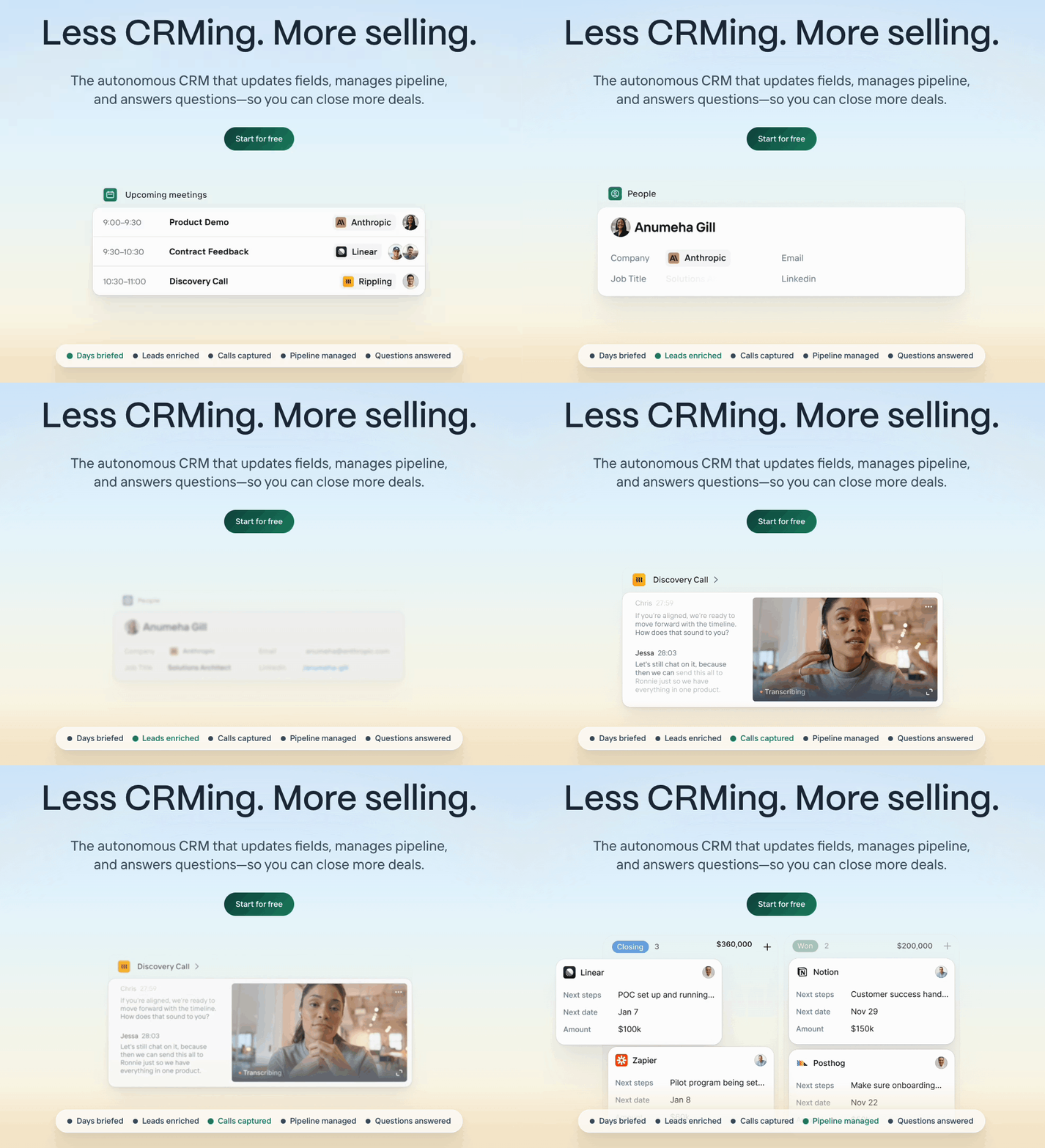
Yesterday, Clarify introduced “Rep”—their AI sales agent. And after spending time with the latest release, I can say this: the “autonomous CRM” isn’t just positioning anymore. It’s becoming real.
Here’s what we cover in today’s post:
Meet: “Rep”
Rep: The Product Details
AI Fields: Where the Real Magic Happens
Why the Big Players Can’t Catch Up
Looking Forward
Let’s get into it.
Meet: “Rep”
Something interesting is happening in software. The best AI-first companies aren’t just shipping features—they’re creating characters.
Intercom has “Fin” for customer support. Descript has “Underlord” for video editing. And now, Clarify is introducing “Rep” for CRM.
This isn’t just branding fluff. When you name your AI, you’re making a bet. You’re saying: this thing is coherent enough, useful enough, and distinct enough to deserve a name. It’s not a chatbot bolted onto your product. It’s a teammate.
I published a piece earlier this year titled, The $100B+ Winner in GTM Tech Will Sell Labor, Not Software. In it, I said: “The next generation of vendors in the space will be companies that can get budget, not from SaaS spend, but from labor spend on the P&L.” Clarify (and Rep) are heading in this exact direction (in my humble opinion).
Rep is Clarify’s first interactive expression of their autonomous CRM thesis. It’s a personal sales agent that helps you close more deals.
Here’s how the team describes it:
“We built Rep to make sellers’ days easier. It does the work you’d do if you had the time: meetings briefed, follow-ups written, pipeline cleaned. It follows every deal—reading meeting transcripts and emails that matter, so when you need context, you can just ask Rep.”
The top reps are incredibly disciplined. But that discipline requires a lot of manual work. That changes with the launch of Rep.
Here are some of the specific things Rep can do:
Instant Meeting Prep → Rep briefs you before every call so you always know what’s coming.
Deals That Stay on Track → It watches every meeting and message to surface the deals that matter now.
Follow-Ups, Done for You → Rep writes your follow-ups and updates your fields automatically.
Ask Anything → Get instant, context-aware answers about any deal, meeting, or message.
The interesting thing here isn’t the feature list. It’s the philosophy underneath.
Most “AI CRMs” are still reactive. You ask it something. It answers. Clarify’s bet is that the AI should be proactive. It should know you have a meeting in 20 minutes and prepare you without being asked. It should notice a deal is stalling and surface it before you remember to check.
They called this “ambient intelligence” in my piece earlier this year. Rep is the manifestation of that concept.

Rep: The Product Details
Let me break down what Rep actually does, because the details matter.
Rep reimagines the CRM homepage around your daily workflow. Three tabs—Meetings, Deals, Tasks—organized by urgency and value, not by database structure. The Meetings tab shows you what’s coming, generates follow-ups automatically after calls, and pre-loads context for every conversation. The Deals tab highlights your highest-value opportunities and the ones closing soon. Tasks pulls in your action items.
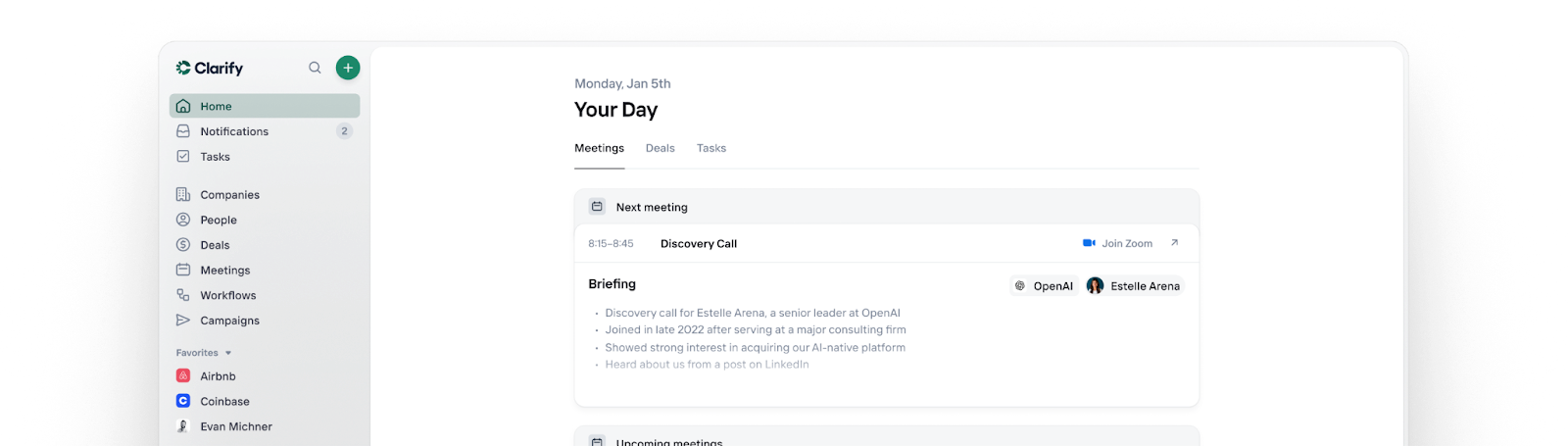
This sounds simple, but think about what it replaces: the ritual of logging into your CRM, clicking through records, manually checking what’s happening with each account, scrambling for context before a call. Rep collapses that into a single view that knows what you need.
The interaction layer is context-aware—pre-loaded with information about whatever record you’re viewing. And it scales: small modal, focused modal, full conversation, depending on how deep you want to go.
The design choice here is significant. They’re not building a separate AI chat interface you have to navigate to. They’re embedding intelligence directly into the workflow. You’re never more than one click from asking Rep anything about the record in front of you.
Meeting records get cleaner layouts, enhanced summaries with adjustable formats, quick copy buttons, and linked deal cards. These are quality-of-life improvements that compound. Every small friction removed means reps spend less time administering the system and more time selling.
The phrase from the team that stuck with me: “Rep handles the busywork so you can close all your deals.”
While writing this piece, Clarify’s founding engineer called out something important: Rep is free. Here’s why that’s interesting, strategically, as they put it to me: “we’re betting that AI isn’t an upsell or a SKU, that it is a part of the core experience. Almost the ‘UI’ layer of the future. You don’t charge for a UI upgrade, and Rep is the UI upgrade of the AI era.” This is pretty wild, and a glimpse into the future.
One other thing worth calling out is the “AI Island” interface as a demonstration of AI-native. It’s a pain to figure out how to put the AI on every screen in a tasteful user-centric way. Many places needed slight adjustments to make a home for Rep as it moves with you through the product, but that’s what AI-native means; AI-native is the work you do to make it so natural and obvious that users wonder how it ever worked any other way.
AI Fields: Where the Real Magic Happens
If Rep is the visible face of Clarify’s AI, then AI Fields are the engine underneath. And honestly, this might be the more important feature.
Traditional CRM fields are dumb containers. You define a field, like ”Industry” or “Deal Stage” or “Competitor Mentioned”, and then a human fills it in. Maybe they forget. Maybe they get it wrong. Maybe the information changes and nobody updates it.
AI Fields flip this. You describe what you want to know, and the AI generates and maintains the value automatically. It can pull from the record itself, from associated records like meetings and emails, and even from internet research.
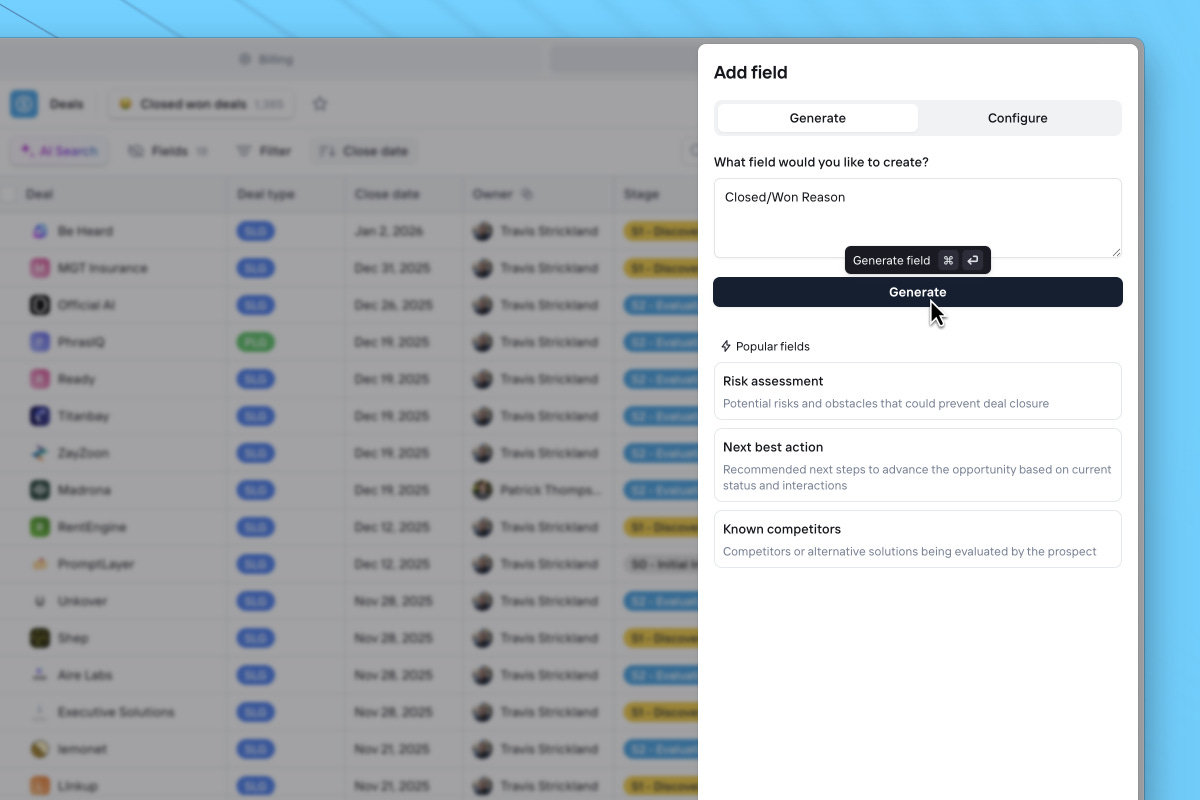
Below are some concrete examples (I pulled these directly from Clarify’s documentation):
On Deals:
“What competitors have been mentioned?”
The AI scans past meetings and emails to identify alternative solutions being discussed. Critical context that usually lives in a rep’s head (or nowhere).
“What’s blocking this deal?”
The AI examines recent communications and surfaces blockers like product requests or missing stakeholders.
“Why did we win/lose this deal?”
Instead of forcing reps to fill out post-mortem fields manually, the AI captures the details from the final emails and calls.
On Companies:
“Is this company my ICP?”
Define your ideal customer criteria, and the AI tells you whether each company matches.
“What’s their assets under management?”
The AI researches publicly available information and populates the field.
“Why did this customer churn?”
When customers tell you why they’re leaving (over email, on a call), the AI captures it.
The workflow is elegant. You describe a field in plain language. Clarify’s AI names it, picks the type, and writes the autofill instructions. Then you can run it against your first 10 rows to test, or autofill everything at once. It’s a glimpse into the magical future that AI is going to enable (not if, but when).
So, what makes this different from other AI enrichment tools? Context. And context compounds.
Clarify’s AI can see your meeting summaries, your email threads, your deal history. It’s not just pulling generic firmographic data from a third-party database. It’s reasoning through your actual customer relationships.
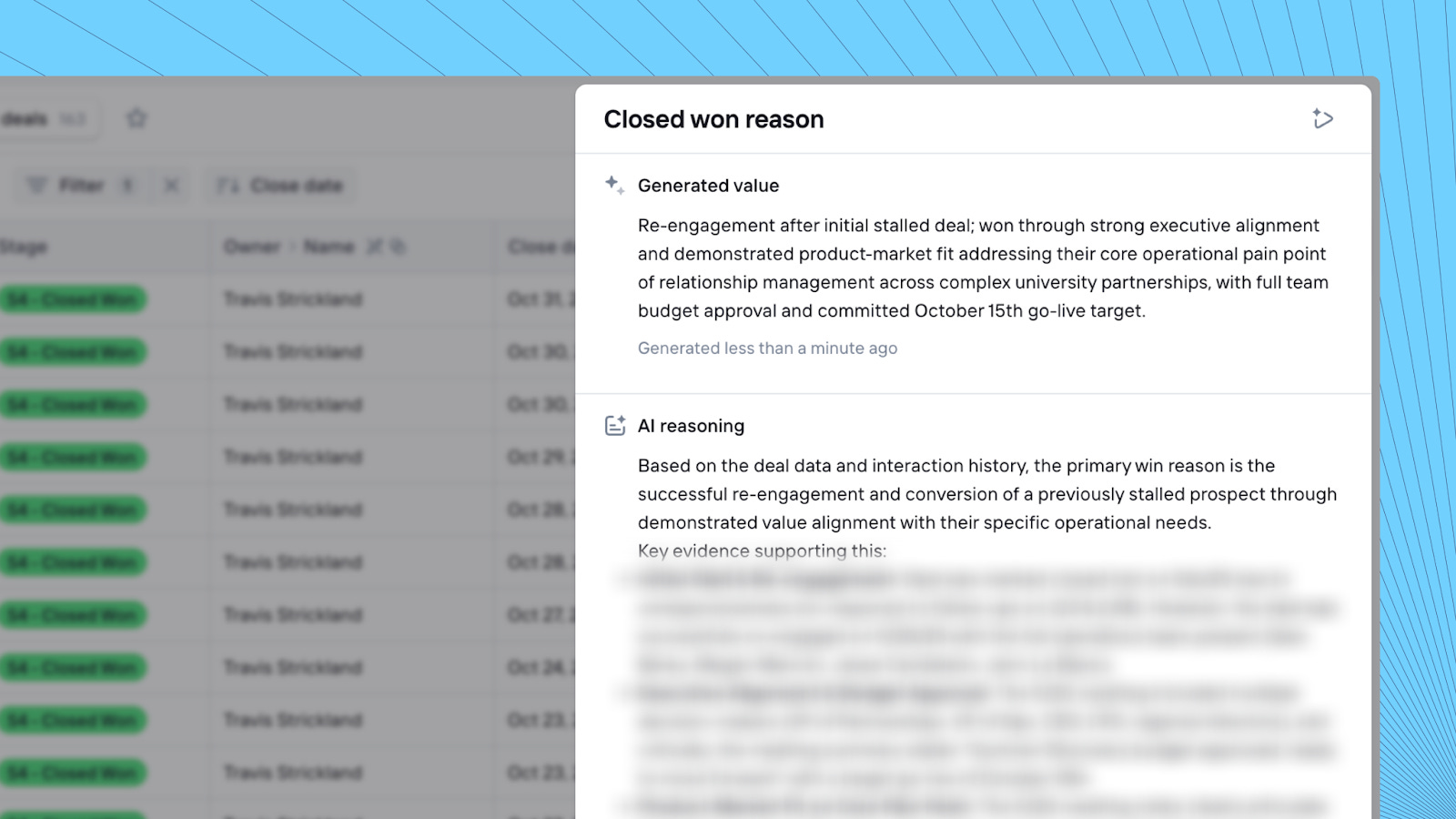
You can hover over any AI-populated field and see the reasoning. The AI shows its work. This matters for trust. You can verify whether the AI got it right, and adjust the instructions if it didn’t. As a former rep, and manager, having this level of transparency is critical.
Why the Big Players Can’t Catch Up
Let’s zoom out. What are the big CRM vendors doing about AI?
HubSpot launched Breeze at INBOUND 2024. It includes Breeze Copilot (a chat assistant), Breeze Agents (for content, social, prospecting, customer service), and Breeze Intelligence (data enrichment). Four agents, 80+ features, everything embedded across their platform.
Salesforce launched Agentforce at Dreamforce 2024. It’s a suite of autonomous AI agents for service, sales, marketing, and commerce. Service Agent handles customer inquiries. Sales Development Rep engages prospects 24/7. Sales Coach provides personalized role-play. They’ve now shipped Agentforce 2.0 and 3.0, adding observability tools and enterprise controls.
These are serious investments (literally billions of dollars and thousands of engineers).
So why do I still think Clarify has a shot to take down the big kids on the block?
Architecture. (I know, it’s not sexy. But, it’s true.)
When I wrote about Clarify in June, I quoted their team on this: “AI-native describes the underlying architecture—it’s built from the ground up with AI at the core. Autonomous is how Clarify wants the CRM to feel—intelligent, proactive, and self-moving.”
HubSpot and Salesforce are adding AI to existing products. They have decades of database schemas, workflow logic, and UX patterns to maintain backward compatibility with. Their AI has to work within the constraints of systems designed before large language models existed. They’re bolted-on features.
Clarify started with AI as the foundation. Their data model, their interface, their entire product philosophy assumes AI is doing the work. They don’t have legacy constraints because they don’t have legacy.
This is the classic innovator’s dilemma playing out in real-time. The incumbents can’t abandon their existing architectures without breaking their customers. The upstart can build for the future because they have nothing to preserve.
I also think there’s a philosophical difference. The big players are betting on AI as a layer—copilots you talk to, agents that do tasks. Clarify is betting on AI as infrastructure—something that works invisibly, constantly, without requiring you to prompt it.
Here’s the distinction between AI as an Assistant versus AI as an Executive:
For an Assistant, you ask them to do a task. Things like: Will you go get me coffee? Will you take notes in this meeting? Will you book my flight?
On the other hand, an Executive is proactively telling you of opportunities (or threats) in your business. Things like: Hey, one of our competitors just had an outage, let’s run a campaign against them today.
Rep is trying to be the Executive. Not waiting for commands. Anticipating needs. That’s a fundamentally different bet than what Salesforce and HubSpot are building.
Looking Forward
Six months ago, Clarify had a vision. Now they have Rep.
Is the autonomous CRM fully here? Not yet. There’s still work to do. The AI needs to get smarter. The integrations need to deepen. The use cases need to expand beyond early adopters.
But the trajectory is clear. The CRM that works for you—instead of you working for it—is no longer a pitch deck concept. It’s live in the wild. And it’s name is Rep.
If you’re a seller tired of spending evenings updating Salesforce, or a GTM leader who’s watched your team drown in administrative overhead, or a founder wondering what AI-native actually means in practice... Rep is worth trying.
The team behind it is world-class. They understand data architecture deeply enough to rebuild it from scratch. They’re targeting small companies first (ironically, the HubSpot playbook), which means you can actually try this today without an enterprise procurement cycle.
The future of sales isn’t about more AI interaction. It’s about AI working invisibly to free us for more human connection and strategic thinking.
Rep is a real step toward that future.
I recommend signing up for Clarify and playing around with it. Connect your email and calendar, and watch the CRM build itself. Let them know The Signal sent you (I will get no commission, but will get some street cred).
Thank you for your continued attention and trust—I do not take it for granted.
See you next time,
Brendan 🫡
PS: If you made it this far, check out Clarify/Patrick’s newsletter: