

If you were forwarded this newsletter, join 7,859 weekly readers—some of the smartest GTM founders and operators—by subscribing here:
Thanks for reading this hand-poured, 100% organic, farm-to-table (human-written) newsletter.

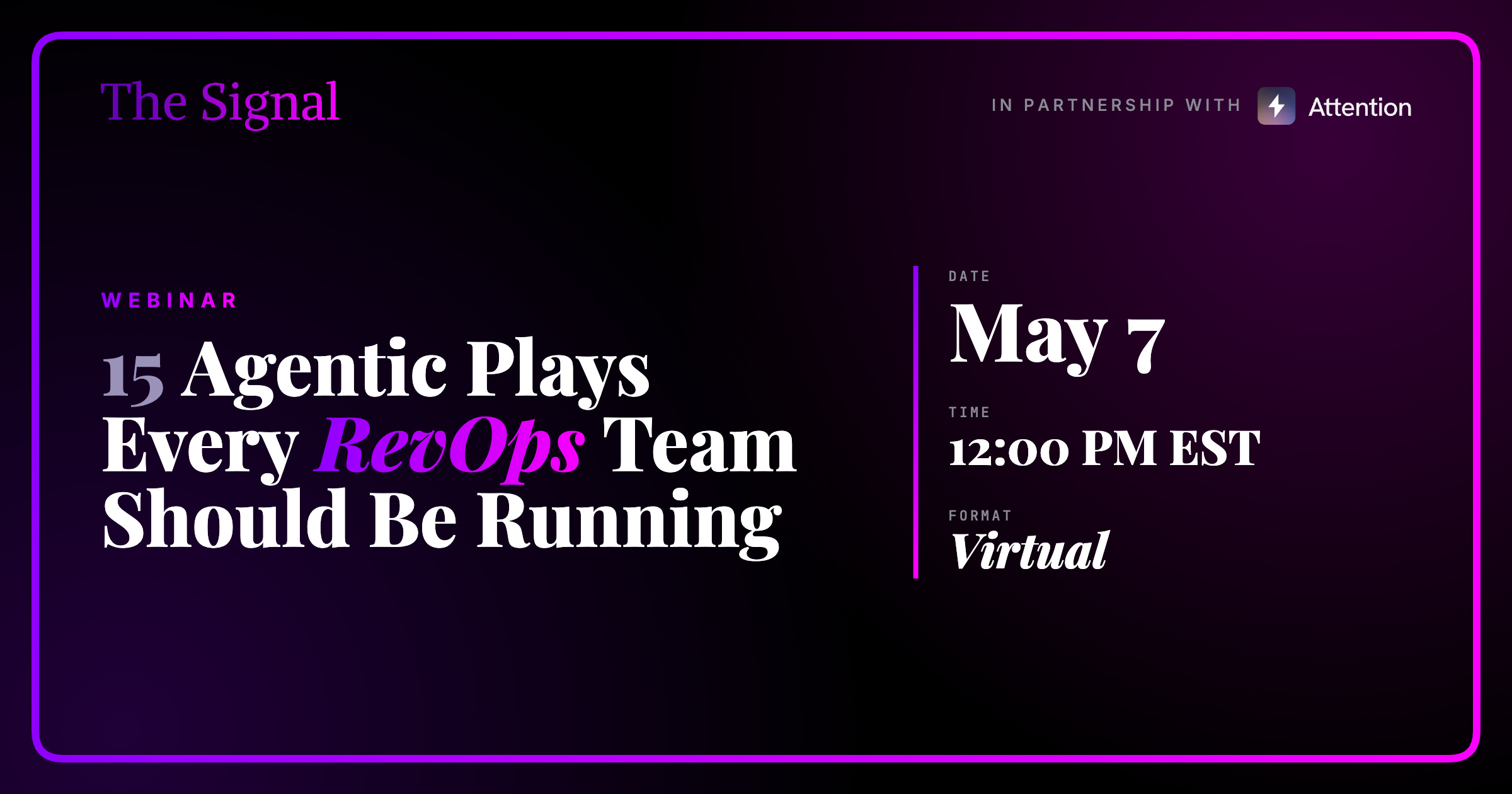
I’m co-hosting a live session (with Attention.com) to walk through 15 specific agentic plays RevOps teams should set up using the client interaction data* you already have (*call recordings/transcripts, emails, and Slack messages).
Join us one week from today (limited capacity) → Thursday, May 7th:

Hey y’all! 👋
Happy last day of the quarter! (to those who celebrate fiscal Q1, anyway.) Get those last gong hits in.
I was talking to a CRO at a fast-growing startup recently, and we were both shocked by how badly people misunderstand what you can actually do with client interaction data (call transcripts, emails, Slack messages, etc.).
Most teams treat their conversation intelligence platform like YouTube. A library of recordings you go back and watch when you need to find information or build a new onboarding program. Maybe you pull up a call before a QBR. Maybe a manager listens to a few calls a week for coaching. But the platform mostly just... sits there.
Your call recordings aren’t a content library. They’re some of your most actionable first-party data. Every call contains buyer language, objections, competitor mentions, champion signals, pricing reactions, feature requests, and expansion cues. The best sales orgs are building hundreds of agents and workflows triggered by stuff that gets mentioned on their calls.
Most people know they should be doing more with AI and their customer interactions. But they aren’t. They’re still just doing summaries, recap email drafting, and some manual coaching.
There’s a real opportunity to use platforms, like Attention.com, to move from passive call recorders to proactive AI agents that turn every conversation into action.
Last April, I wrote a deep dive on Attention.com: The Army of AI Agents That Turn Your Sales Conversations into Action. Here’s how I opened that piece:
Most people building go-to-market tooling are obsessing over third-party data. But, there is a goldmine of information in every company’s systems already: customer conversations, emails, and meeting transcripts.
The problem is - this data sits dormant (becoming less useful over time as it collects dust in the corners of the CRM or CDW or otherwise), and it is distributed across disparate systems and “objects.” Attention is activating this data. Mining for the interesting nuggets and then operationalizing them, in real-time. That’s the vision they’re realizing, by building a system of AI agents that don’t just capture sales conversations, they automate the work traditionally done by the best enablement analysts, RevOps specialists, and top performers.
That was 12 months ago. It’s even more true today.
But AI is only half the unlock. The other half is knowing which plays to run.
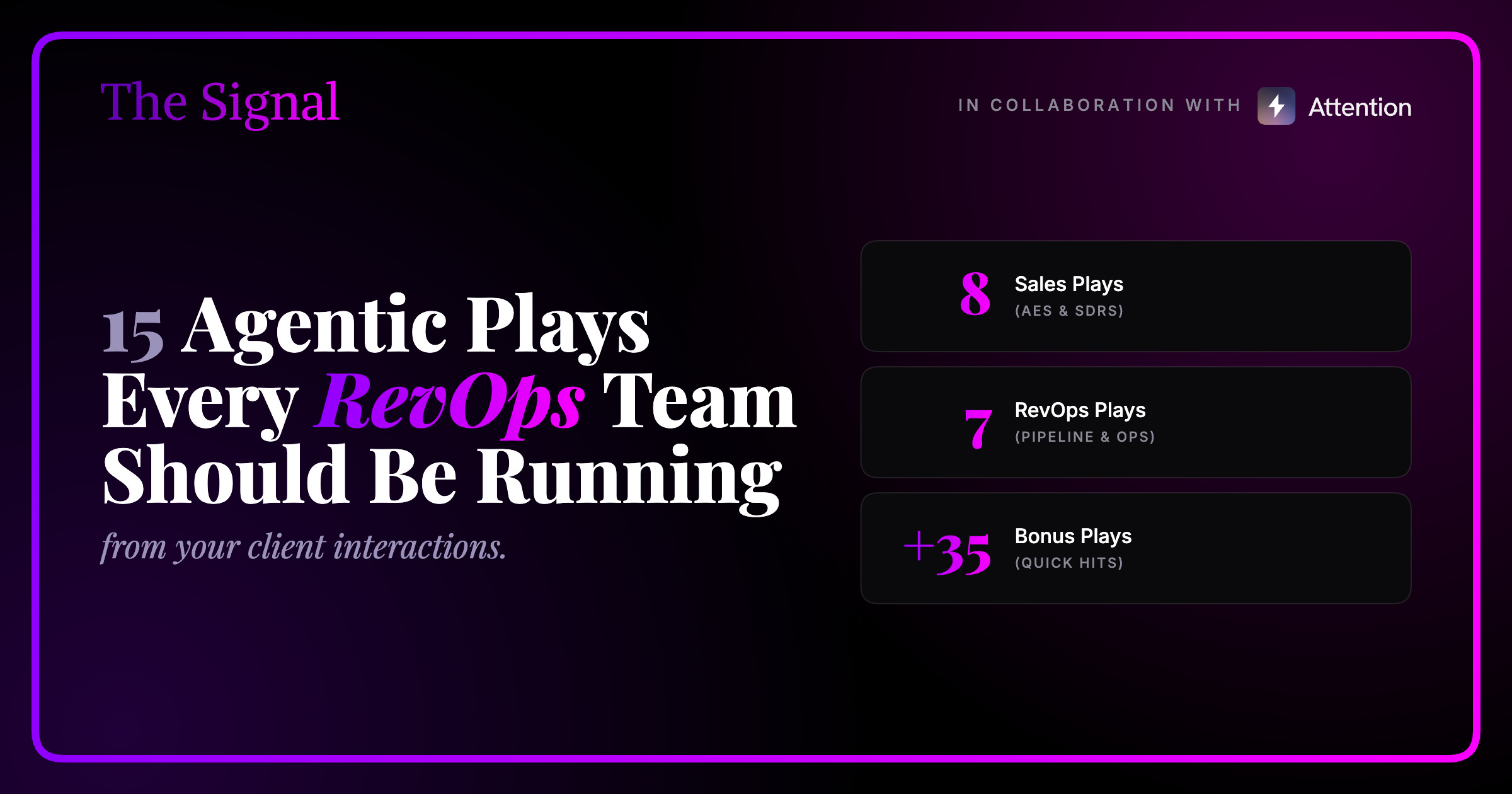
So, for today’s sponsored deep dive post (with Attention.com), we put together 15 core plays that the best GTM teams are running on client interaction data right now. These can be done with Attention.com out of the box. But, even if you aren’t using them, you can set up these plays.
Steal them, and make them your own. All of them are powered by the same raw material: the client interactions you already have captured.
Alright, let’s jump in.
Sales (AEs & SDRs) Plays
1. Auto-populate MEDDIC fields after every call.
The transcript gets parsed and Metrics, Economic Buyer, Decision Criteria, Decision Process, Identified Pain, and Champion get written directly into CRM fields. Not with generic placeholders, with the actual language from the call. “Their CFO needs to see a 3x ROI within 12 months” goes straight into Metrics. “VP of Ops, Sarah Chen, is our internal champion but reports to a skeptical CTO” populates both Champion and Economic Buyer.
This saves reps 20–30 minutes per meeting. But the bigger win is accuracy. Reps filling MEDDIC fields from memory at 5pm on a Friday are guessing. AI parsing the raw transcript with a truth-seeking prompt is not. One team saw their MEDDIC completion rate go from 35% to 92% within three weeks of turning this on.
2. Draft follow-up emails using the prospect’s own words.
Within 60 seconds of a call ending, AI generates a personalized follow-up pulling the buyer’s exact challenges and action items. Not your marketing team’s words, or your words, the prospect’s words.
When a VP of Sales tells you “our biggest problem is that reps spend more time in Salesforce than on the phone,” and your follow-up email opens with that exact phrase, you signal that you actually listened. Teams report 23% higher response rates than manual follow-ups. That tracks. Compare this to the generic “Great connecting today! As discussed, here are some next steps...” emails that most reps send. The prospect said specific words. Use their exact language in your follow-up.
3. Surface battlecards mid-call in real time.
When a prospect mentions a competitor, raises a pricing objection, or asks a technical question, the right talking points hit the rep’s screen while the conversation is still happening. AI-powered battlecards help you answer any prospect question while on the call.
Think about how this changes the dynamic. A prospect says “we’re also looking at [Competitor X],” and within seconds the rep has the top three differentiators against that competitor and the most effective rebuttal from top performers, all on screen. Less “let me get back to you on that question” and more “here’s exactly how we handle that.” This is especially powerful for newer reps who haven’t built up the pattern recognition that a 10-year AE carries in their head.
4. Auto-generate business cases from multi-call synthesis.
After 3–5 conversations, AI compiles every stated goal, ROI expectation, and buying criterion into a business case draft using the metrics discussed on the calls. No more building decks from memory.
The keyword is synthesis. The prospect’s CEO mentioned “reducing time-to-hire by 40%” on call one. The VP of Ops talked about “cutting onboarding from 6 weeks to 2” on call three. The CFO said in an email “we need to justify any new spend against a 14-month payback period.” AI pulls all of those threads together into a single business case doc that mirrors the buyer’s own success criteria, not your generic ROI calculator. This turns a 4-hour deck-building exercise into a 15-minute review.
5. Build stakeholder maps from every transcript mention.
Every person mentioned by name or role across all deal calls gets mapped, including people who never joined a meeting. “I’ll need to run this by our legal team” on one call, and then “my manager, David, is going to want to see a security review” on the next call. Those passing mentions build a full picture of the buying committee.
Closed-won opps have 2x more buyer contacts than closed-lost opps. Most reps only map the people who show up on a Zoom. The stakeholders that get mentioned but never join are often the blockers or the final approvers. If your deal has a ghost stakeholder you’ve never engaged, that’s a risk. This play surfaces them before it’s too late.
6. Detect single-threaded deals and trigger multi-threading.
Buyer-side participant count gets monitored per deal, and an alert is triggered when a deal is single-threaded. The system tracks how many unique buyer-side voices appear across calls, how many distinct email addresses are engaged, and whether new stakeholders are being introduced over time.
When a deal has only one contact after three calls, it gets flagged automatically with a suggested action: “Consider requesting an intro to [role] based on similar closed-won deals.” Multi-threading boosts win rates by 130% in deals over $50K. But most teams don’t catch single-threaded deals until the forecast review (when it’s too late). Running this as an automated trigger means the rep gets the nudge in week two, not week eight.
7. Alert on deal velocity drops from engagement patterns.
Each deal’s email cadence, call frequency, and response times get benchmarked against closed-won norms. When engagement drops below the healthy baseline, the system fires an alert before the deal goes dark.
It’s not just “this deal is slow.” It’s specific. “This deal averaged 3.2 emails/week for the first 4 weeks. Over the last 10 days, it’s dropped to 0.4 emails/week. Similar deals that followed this pattern closed-lost 78% of the time.” That gives the manager something concrete to coach on in the next 1:1. Closed-won deals average 8.2 emails per week vs. 1.9 for closed-lost. The velocity data is already in your system. You just need to benchmark it and set the threshold.
8. Build personalized objection heat maps per rep.
I wish I had this when I was managing reps. Here’s how it works: every objection each rep faces gets categorized and cross-referenced with outcomes. Rep A converts pricing objections at 45% but timing objections at 12%? Now you know where to coach.
Instead of generic team-wide training on “handling objections,” managers can pull up a rep’s individual heat map and say: “You’re great on pricing and competitive pushback. But you’ve faced 14 timing objections in the last quarter and converted only one. Let’s listen to how [top performer] handled a similar timing objection on the [xyz] deal.” You can scale this across a 30-person team, and you’re running personalized enablement without adding headcount.
RevOps Plays
9. Score deal risk from conversation signals, not CRM stages.
Health scores get assigned based on what’s actually happening in calls: Economic Buyer participation, objection resolution, sentiment trends, not just the stage a rep selected. Attention.com’s reporting and forecasting module does this automatically.
Think about how most deal health scores work today. A rep moves a deal to “Proposal Sent” and the CRM says it’s 60% likely to close. But what if the last two calls had declining sentiment? What if the Economic Buyer hasn’t joined a call since discovery? What if the prospect asked “can you send over pricing so I can compare it to [Competitor]” (a comparison signal, not a buying signal)? Conversation-based scoring catches all of this. One team found that deals where the Economic Buyer appeared on fewer than 30% of calls closed at half the rate, regardless of CRM stage.
10. Validate pipeline forecasts against conversation evidence.
What reps claim in the CRM gets cross-referenced with what was said in calls. A rep marks “Commit” but the prospect hasn’t responded in 10 days? Flagged. A rep calls it “Best Case” but the last call had three unresolved objections and no next meeting scheduled? Also flagged.
This is sandbagging and happy-ears detection at scale. Most forecast accuracy issues come from the same problem: the forecast is based on what the rep believes, not what the prospect said. Cross-referencing CRM stage against transcript evidence closes that gap. A lot of sandbagging AEs are about to get exposed (looking at you, Tyler). But so are the optimistic ones who genuinely believe a deal is on track when the transcript says otherwise (ahem… Nick). RevOps leaders report 15–20% improvement in forecast accuracy within the first quarter of running this play (the board is going to love you for implementing this one).
11. Automate win/loss analysis across every closed deal.
Every call and email for closed-won and closed-lost deals gets reviewed. Surfacing which objections, competitors, personas, and messaging patterns drove outcomes. The day the deal closes, not the next quarter.
Traditional win/loss analysis is a quarterly project. Someone interviews 10–15 accounts, writes up themes, and presents findings 6 weeks later. By then, the market has moved. With AI, every closed deal gets analyzed automatically: which competitor was mentioned most, which objection went unresolved, whether the champion went silent before close-lost. Attention.com’s Ask Anything feature lets you query across all calls to understand why you’re winning and losing. “Show me every deal we lost to [Competitor X] where pricing was the stated objection” becomes a 10-second query, not a 10-hour research project. It’s like having a Chief of Staff in your Slack 24/7.
12. Monitor sales methodology compliance at scale.
Every call gets evaluated against MEDDIC/BANT/SPICED criteria to determine whether reps validated each element vs. just mentioned a keyword. AI coaching scorecards can auto-grade every call against your chosen framework. No more moderating debates on whether a deal is an SQL. Create the rubric, then AI applies it semantically at scale.
The distinction between “mentioned” and “validated” is critical here. A rep saying “so who’s the decision maker?” is not the same as confirming that the Economic Buyer has budget authority, a timeline, and will attend the next call. AI can tell the difference. One sales team used this to move MEDDICC-specific language from 2% to 17% of call time, and more importantly, saw their win rates on qualified pipeline jump proportionally. Without AI, managers review maybe 3–5 calls per rep per month. With it, every call gets scored.
13. Build closed-lost re-engagement campaigns from objection mining.
This is one of the highest-ROI plays on this list because the pipeline already exists. You’ve already done the discovery. You’ve already built the relationship. The deal just didn’t close for a specific, documented reason.
The specific objection from every lost deal (pricing, feature gap, timing, competitor) gets extracted and segmented. RevOps builds targeted sequences per cluster: “pricing changed” or “we built that feature” or “competitor renewal approaching.”
When that reason changes (you ship the feature, you adjust pricing, their competitor contract comes up for renewal), you have a warm re-engagement opportunity with full context. Now you can have an evergreen play that uses your own first-party data instead of starting from scratch.
14. Refine ICP from won-deal conversation patterns.
What do your closed-won transcripts have in common? Not the firmographic data (industry, headcount, revenue) that lives in your CRM, but the conversational patterns. Which problems do they mention? What buying triggers come up? What language do they use?
This goes deeper than standard ICP analysis. You might discover that prospects who mention “board pressure to reduce vendor count” close 40% faster than the rest. Or that deals where “security review” comes up in the first call (not the third) have 2x the win rate. These are signals that live in transcripts, not in your enrichment data. Mining them lets you build an ICP based on how your best customers actually talk about their problems, which is far more useful for targeting and messaging than industry + headcount alone.
15. Analyze call patterns to compress sales cycles.
Which call sequences, cadences, and topics correlate with the shortest won deals? The data reveals the pattern, and it’s often not what you’d expect.
Maybe your fastest deals always have a technical deep-dive in call two (not call four). Maybe deals where the AE sends a follow-up within 30 minutes close 15 days faster on average. Maybe three calls in the first 10 days beats five calls spread across six weeks. Top performers manage 2.6x more deals with sales cycles 42% shorter. When you analyze the transcript data, you often find it’s because of a process (a specific sequence of topics covered in a specific order). Once you find the pattern, you can coach every rep to run it.
35 More Quick Hits
Those 15 plays are a great place to start. And here are another 35, that should get your creative juices flowing, grouped by function.
Sales
16. Build SDR-to-AE handoff packages from call clips. SDRs clip the exact moments where the prospect stated their problem, budget range, and requirements, so the AE walks in with full context instead of a one-paragraph CRM note.
17. Route cross-sell opportunities from account conversations. When a customer mentions a challenge solvable by a different product line, the system flags it and auto-notifies the right team with context. (Attention.com has a dedicated Cross-Sell Radar agent for this.)
18. Detect buying signals to optimize pitch timing. Transcript analysis reveals which questions or moments consistently trigger pricing discussions, then coaches reps on when to introduce value vs. when to hold.
19. Generate mutual action plans from call language. Milestones, deadlines, and stakeholder responsibilities get extracted from transcripts and dropped into a shared MAP.
20. Run pricing negotiation prep from historical patterns. Before a negotiation call, AI pulls the most common objections from similar personas, the highest-converting rebuttals from top performers, and discount thresholds from comparable deals.
21. Optimize executive sponsor engagement timing. Transcript data reveals when VP+ contacts actually engage across the deal cycle.
22. Customize proposals from transcript insights. Discovery calls contain what the buyer said matters most. The system pulls those priorities and populates proposal templates that mirror them.
23. A/B test cold call opening lines from transcript data. Tag which opener each SDR used and correlate with outcomes across hundreds of calls. Fun fact: “How have you been?” delivers a 6.6x higher meeting-booking rate vs. “Did I catch you at a bad time?”
24. Bridge discovery to demo with AI-generated prep briefs. The buyer’s top use cases and competitive concerns get extracted from discovery and mapped to specific product features, so the AE leads with what matters.
RevOps
25. Validate stage gates from transcript evidence. The system cross-checks whether conversation evidence supports the stage a rep advanced to. Did the Economic Buyer actually participate? Was budget confirmed? Deals that fail get flagged with a specific gap report.
26. Automate CRM hygiene from transcript cross-referencing. Next steps, objections, competitor mentions, and deal signals get extracted from calls and written to CRM fields, then discrepancies between what the rep entered and what was discussed get flagged.
27. Score cross-team handoff quality. What the SDR discussed gets compared with what the AE covered. Did the prospect have to repeat themselves? Each handoff gets a quality score and RevOps identifies systemic failures.
28. Run pricing and discount pattern analytics. Negotiation transcripts get scanned to identify which reps discount too early, which concession patterns correlate with better margins, and the revenue impact of unnecessary discounting.
29. Mine competitive intelligence from the full call library. Every competitor mention gets aggregated with surrounding context, and positioning shifts get tracked quarter over quarter. Attention.com’s Competitive Intelligence Tracker delivers weekly reports out of the box.
30. Build and maintain curated call libraries for onboarding. RevOps sets filters (closed-won, above-average ACV, top performers) and the system auto-updates every 30 days, so the library never goes stale.
31. Rebalance territories using conversation effort data. Instead of account count alone, RevOps layers in call duration, sentiment, multi-threading depth, and deal complexity. Better territory design can increase revenue 2–7% without changing strategy.
32. Identify process bottlenecks from call topic clustering. If 60% of deals stalling at “Technical Validation” involve calls where prospects ask about security compliance but no SE is present, that’s a process bottleneck you can fix.
Customer Success
33. Build a churn early warning system from call sentiment. Every CS call gets an automated sentiment score, and calls below a threshold auto-post to a “Churn Risk” Slack channel.
34. Detect expansion signals from customer conversations. Growth plans, new team hires, feature requests aligned with premium tiers, and positive adoption language all get flagged and surfaced while momentum is high.
35. Eliminate context loss on sales-to-CS handoffs. Every promise sales made, every success criteria discussed, and every stakeholder’s priorities get compiled across all deal calls so the CS team starts onboarding with full context.
36. Auto-generate QBR prep from quarterly call synthesis. All recorded interactions for a specific account over the past quarter get compiled into a structured executive summary. Teams report cutting QBR prep from 8–12 hours to under 60 minutes.
37. Score customer health from conversation signals beyond usage. Calls, emails, and support interactions get evaluated for sentiment direction, escalation language, and renewal timing mentions, catching accounts with high usage but declining call sentiment.
Marketing & Product
38. Mine voice-of-customer for messaging and ad copy. Hundreds of call transcripts reveal how prospects actually describe their problems. One company feeds extracted keywords directly into Google Ads, so their campaigns use the words customers actually use.
39. Aggregate competitive intelligence from live deal conversations. Marketing builds living battlecards with real buyer language and tracks competitive positioning shifts over time.
40. Generate content at scale from anonymized transcripts. PII gets redacted, then anonymized call conversations get rewritten into SEO-optimized blog posts.
41. Track campaign attribution through conversation mentions. When prospects mention your podcast, benchmark report, or billboard in a sales call, it gets captured, closing the loop between brand investment and deal creation in ways UTMs never could.
42. Build an objection-driven content strategy. (This is a personal fave.) Objections get ranked by frequency and correlated with deal outcomes. Marketing builds content that proactively addresses the most common deal-killers before they arise in the sales cycle.
43. Aggregate feature requests routed directly to the product board. “I wish” phrases and feature names get tracked across all calls, ranked by frequency, tagged with customer segment and ARR, and product managers get linked to the exact call moments.
44. Run competitive feature gap analysis from lost-deal transcripts. Which competitor features were cited as differentiators in lost deals? The transcripts turn anecdotal “we lost on feature Y” into quantified gap data for roadmap decisions.
45. Detect bugs and product issues from support call patterns. When mention frequency crosses a threshold, the product team gets auto-notified with aggregated context on how many customers mentioned it, with clips of their frustration.
Enablement/Management
46. Structure new hire onboarding around real deal arcs. New reps follow a full deal from the first discovery call through close, hearing how top performers navigated each stage. Teams using this method had 50% faster ramp time and 64% more revenue in the first quarter.
47. Generate AI coaching scorecards with automated rep feedback. After every call, discovery quality, objection handling, methodology adherence, and talk-to-listen ratio get scored with timestamped examples. Attention.com’s coaching scorecards auto-select the right rubric per call type.
48. Build a discovery question repository from top-performer calls. Enablement extracts every question top-converting reps ask, organized by deal stage and persona, then validates whether other reps are asking the right qualification questions.
49. Detect behavior drift with real-time leadership alerts. Reps offering discounts too early? Skipping discovery? When calls match these patterns, alerts send to managers via Slack.
50. Generate AI roleplay scenarios from real customer conversations. Enablement feeds real call scenarios into AI training tools that create interactive roleplays with scoring. One team built 14 training courses with 75+ scenarios in three hours.
You’re sitting on a treasure trove of data in your customer interactions. All you have to do is activate it with a bit of creativity. I hope these plays spark some ideas and give you some quick wins.
The teams running a bunch of these plays simultaneously will be operating at a fundamentally different level than everyone else. The data is already sitting there. These plays just put it to work.
Platforms like Attention.com are accelerating this by moving past passive analysis toward AI agents that act on your data. So if you’re looking to get AI agents deployed across RevOps (and more), reach out to the team at Attention.com and let them know The Signal sent you.
Thank you for your continued attention and trust. I do not take it for granted.
See you next time,
Brendan 🫡
PS: Don’t forget to secure your spot for our live session on this topic on Thursday, May 7th.